


.webp)
In this article
Direct-to-consumer mail order drugs are changing how people fill prescriptions, shop for prices, and think about insurance. Three big names leading this shift are Mark Cuban’s Cost Plus Drugs, Amazon Pharmacy, and, as of early February 2026, the new federal Trump Rx initiative.
Instead of waiting in line at a local pharmacy, more people are ordering medications from home, just like they order clothes, groceries, or electronics. These newer pharmacy models promise three main things: lower prices, greater transparency, and more convenience.
Several trends are driving the growth of direct-to-consumer (DTC) pharmacies:
- Rising out-of-pocket costs, especially for people with high-deductible health insurance plans or no insurance, are prompting consumers to seek cheaper options outside traditional pharmacy benefit manager (PBM) networks.
- Online shopping has made people comfortable managing important purchases—like healthcare—from their phones and laptops.
- New drug pricing models are exposing how confusing and opaque typical prescription pricing can be, and consumers are demanding simpler, upfront numbers.
Within this landscape, Cost Plus Drugs, Amazon Pharmacy, and Trump Rx take very different approaches—but they all aim to make it easier for you to see what you’ll pay and to get medications delivered to your door.
The Mark Cuban Cost Plus Drug Company (often called Cost Plus Drugs) is a public benefit corporation founded to cut out middlemen and sell primarily generic drugs at near-wholesale cost with a small, fixed markup and price transparency.
How Cost Plus Drugs works
Cost Plus Drugs uses a simple, transparent pricing formula:
- The acquisition cost of the drug (what the company pays the manufacturer)
- Plus a 15% markup
- Plus a flat pharmacy service fee (around 5 dollars)
- Plus a small shipping fee (a bit over 5 dollars for home delivery)
There are no coupons, no percentage-off gimmicks, and no hidden negotiations with PBMs; you see the ingredient cost and each fee itemized at checkout. As of 2026, Cost Plus Drugs lists more than 2,000 medications—mostly generics—covering many chronic conditions, such as high blood pressure, diabetes, and mental health issues, as well as some specialty generics.
You typically:
- Search for your medication on the Cost Plus website
- See the price without logging in
- Ask your prescriber to send the prescription to Cost Plus or download a sample prescription
- Pay with a credit card and get it shipped directly to your home
Health insurance usually is not used at Cost Plus; instead, you pay cash, which may or may not be cheaper than your copay, depending on your plan.
Pros of Cost Plus Drugs for consumers
For the right medications and situations, Cost Plus can offer dramatic savings:
- Very low prices on many generics, sometimes far below typical retail or even insurance copays, because the company avoids PBM spread pricing and opaque rebates.
- Clear, itemized pricing makes it easier to compare against your local pharmacy or insurance-covered price.
- Home delivery and a growing network of retail partner pharmacies increase access, especially for people in areas with fewer affordable options.
Cost Plus Drugs: Limitations to keep in mind
Cost Plus Drugs is not a full replacement for every consumer:
- The focus is on generics; many brand-name drugs and newer therapies are not available. For example, the popular weight loss drugs Wegovy and Zepbound are not available through Cost Plus Drugs.
- Because it is cash-pay mainly, the amount you spend generally does not count toward your health insurance deductible unless you submit receipts and your plan allows it.
- If you qualify for robust insurance coverage, manufacturer copay cards, or Medicare subsidies, those options may sometimes beat Cost Plus on certain drugs.
Cost Plus Drugs shines for people with high-deductible plans, no insurance, or expensive generic copays, but it’s less helpful if your plan already covers your medicines at low cost.
Amazon Pharmacy is a full-service online pharmacy integrated into the Amazon platform, offering home delivery of most prescription medications and several ways to save, especially for Amazon Prime members.
How Amazon Pharmacy and RxPass work
Amazon Pharmacy began offering mail-order prescriptions in 2020 and has since layered on multiple savings programs: RxPass, Prime Rx, automatic coupons, and support for PillPack for medication sorting.eurekalert+1
Key features include:
- RxPass: a subscription where eligible Prime members can get a list of about 60 common generic medications for a flat fee of 5 dollars per month, with no insurance and free delivery.
- Prime Rx: a prescription savings benefit that offers up to 80% off generic drugs and 40% off brand-name drugs at participating pharmacies and through Amazon Pharmacy.
- Free two-day shipping (and in some areas, same-day delivery) for Prime members on many prescriptions.
- Automatic application of manufacturer coupons at checkout, when available, can significantly lower costs for some brand-name medications.
- 24/7 access to pharmacists for questions via phone or chat and optional dose-sorted packets through PillPack for people on multiple medications.
Amazon Pharmacy accepts most major insurance plans, but also aggressively markets its services to people paying cash or using discount programs.
Pros of Amazon Pharmacy for consumers
For many households already using Amazon, the appeal is straightforward:
- All-in-one convenience: you can manage prescriptions in the same account you use for other shopping, track refills, and arrange at-home delivery with a few clicks.
- Multiple savings levers—RxPass, Prime Rx, coupons, and insurance—can be combined strategically to lower costs.
- Upfront pricing lets you compare your copay, cash price, and RxPass eligibility before you place an order.
A recent analysis of RxPass found that the 5-dollar monthly subscription can substantially improve medication adherence for chronic conditions like high blood pressure, high cholesterol, and depression, because price is less of a barrier for eligible drugs.
Amazon Pharmacy: Limitations and trade-offs
Amazon Pharmacy is powerful, but not perfect:
- RxPass covers only a fixed list of generic drugs; if your medications fall outside that list, you may not benefit from the subscription.
- Not all insurers or employer plans may integrate seamlessly with Amazon, especially for complex prior authorizations or specialty drugs.
- Some consumers are uneasy about a single large tech company handling so much health data, even though pharmacies must comply with privacy regulations.
For people who value convenience and already pay for Prime, Amazon Pharmacy and RxPass can noticeably simplify and lower the cost of routine medications, especially common generics.
Trump Rx is a new federal initiative launched under the Trump administration, designed as a direct-to-consumer portal that provides pharmacy coupons or steers patients to drug manufacturers' websites to buy certain brand-name drugs at government-negotiated discounts.

What Trump Rx is and how it works
Trump Rx, launched February 5, 2026, has two main pillars:
- A government-run portal that directs patients to pharmaceutical manufacturers’ own direct-to-consumer sites, where they can purchase selected brand-name drugs out-of-pocket at discounted prices.
- An aggressive pricing strategy using “Most Favored Nation” (MFN) concepts and trade pressure to push manufacturers to offer U.S. consumers prices closer to—or in line with—the lowest prices they charge in other wealthy countries.
Early announcements highlighted a deal with Pfizer and indicated that companies like AstraZeneca and Merck would participate for certain brand medications. Some brand-name drugs on Trump Rx.gov are, on average, around 50% cheaper than current U.S. list prices.
Trump Rx is being positioned as complementary to existing pharmacies, not a replacement. Unlike Cost Plus Drugs and Amazon Pharmacy, you can’t purchase drugs directly from Trump Rx.
Pros of Trump Rx for consumers
If you take expensive brand-name medications, Trump Rx could offer meaningful advantages:
- Potentially large discounts on select brand-name drugs that are often unaffordable under traditional pricing.
- A single federal portal makes it easier to find out whether your medication is eligible for special pricing, rather than hunting down coupons across multiple websites.
- By pushing toward MFN-style pricing, Trump Rx aims to reduce the international pricing gap that often leaves U.S. patients paying far more in health care costs than patients in other developed countries.
Trump Rx: Limitations, uncertainties, and fine print
Because Trump Rx is new, there are still open questions:
- The program initially covers only a limited set of brand-name drugs, not the entire market.
- Discounts are structured as cash prices; depending on how your insurance works, purchases through manufacturer sites may not count toward deductibles or out-of-pocket maximums.
- The actual level of discount can vary and may not always beat what you might get through a strong employer plan, state programs, or patient assistance plans.
For now, Trump Rx is most promising for patients who rely on a small number of very expensive brand-name drugs and either lack robust insurance or still face high out-of-pocket costs even with coverage.
Here’s a big-picture look at how these three options differ.
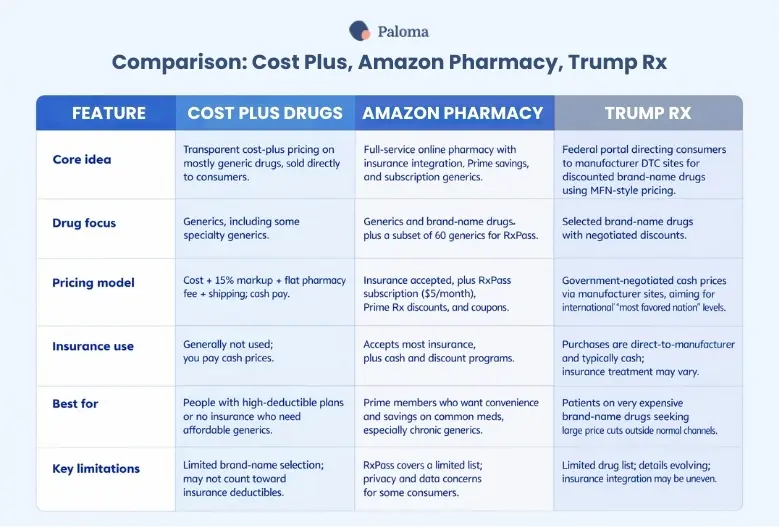
The following is a price comparison of generic and brand-name levothyroxine (Levoxyl), liothyronine (Cytomel), Wegovy, and Zepbound, as of February 2026. Note: Cost Plus Drugs, Amazon, and Trump Rx do not offer prescription natural desiccated thyroid (NDT) medications.
Levothyroxine (88 mcg) – Price Comparison
Liothyronine (5 mcg) – Price Comparison
Wegovy (Semaglutide)
Zepbound (Tirzepatide)

Choosing between Cost Plus Drugs, Amazon Pharmacy, Trump Rx, and your local pharmacy is not an all-or-nothing decision. Many people will mix and match, using different channels for different prescriptions.
Here’s a practical way to think it through:
1. List your medications and current costs
Write down each drug, the dose, how often you take it, your current copay or cash price, and whether it’s generic or brand-name.
2. Check Cost Plus Drugs for generics
Look up your generic medications on CostPlusDrugs.com to see their all-in cash price (drug cost plus markup, fee, and shipping). Compare that to your current pharmacy price and insurance copay.
3. Explore Amazon Pharmacy and RxPass
If you’re a Prime member, see whether your drugs are included in RxPass’s 5-dollar-per-month list.
Use Amazon Pharmacy’s price tools to compare your copay, Prime Rx cash price, and any coupons on brand-name drugs.
4. Check Trump Rx for specific brands
If you take costly brand-name medications (for example, certain cancer, autoimmune, or GLP-1 drugs), check Trump Rx.gov to see if your drug appears on the discounted list.
5. Factor in non-price issues
For each option, consider: shipping times, refill coordination, pharmacist access, privacy preferences, and whether you prefer a relationship with a local pharmacist.
An example scenario: Someone with hypothyroidism who takes generic levothyroxine might save the most by getting it through Amazon RxPass. In contrast, a separate thyroid medication, such as generic liothyronine, could be significantly cheaper through Cost Plus Drugs. If they also rely on a high-cost brand-name thyroid medication, such as Cytomel or Levoxyl, it may be worth checking Trump Rx to see whether a lower cash price is available for that specific drug.
Ordering medications directly doesn’t mean you should manage your conditions alone.
- Tell your prescriber if you switch pharmacies or start buying drugs through Cost Plus or Amazon, so they know where refills are going and can monitor for interactions or dosing issues.
- Keep your own up-to-date medication list, including where you fill each prescription and what you pay for it.
- For complex conditions or drugs with narrow safety margins, discuss any major changes in how you access or pay for medications before you switch.
Online pharmacies and manufacturer portals must comply with privacy and security regulations, but data sharing practices can still vary.
- Review privacy policies to determine whether your prescription data might be used for marketing or data analytics, or shared with third parties.
- If you are uncomfortable with a particular platform’s data practices, consider using more traditional channels or services with stricter limits on secondary data use.
Direct-to-consumer drug programs can make medications more affordable and accessible, and they’re rapidly reshaping how we buy prescription drugs in the U.S. Whether deeply discounted generics at Cost Plus Drugs, subscription generics and integrated savings at Amazon Pharmacy, or brand-focused federal discounts through Trump Rx, there are more options than ever to help save on medication costs. None of these services is a silver bullet, but each can be a powerful tool when matched thoughtfully to your medications, insurance situation, and comfort with online care. They aren’t, however, one-size-fits-all, especially for people managing chronic and hormonally sensitive conditions.
For individuals with thyroid disease, consistency matters. Small changes in thyroid medication dose, formulation, or brand can meaningfully affect symptoms and lab results. Similarly, newer GLP-1 and GIP medications used for weight management and metabolic health require careful dosing, monitoring, and follow-up to ensure both effectiveness and safety over time.
While cash-price pharmacies, subscription programs, and direct-to-consumer options may offer significant savings, cost should be considered alongside clinical oversight, medication continuity, and long-term health goals.
At Paloma, we encourage you to:
- Talk with your clinician before switching thyroid medications or starting GLP-1 or GIP therapies
- Monitor your symptoms and lab values after any medication or dose change. (Paloma’s complete home thyroid test kit makes it affordable and convenient.)
- Choose treatment options that balance affordability with medical guidance and ongoing support.
By comparing transparent prices, leveraging subscriptions and discounts, and staying coordinated with your healthcare team, you can work with your Paloma provider to use these new models to cut costs, boost convenience, and still keep safety at the center of your healthcare and medication decisions.
In the end, lower prices are important—but so is using the right medication, at the right dose, with the right level of care to support sustainable health.
What are direct-to-consumer pharmacies?
They are services that let you order prescription medications online and have them shipped directly to your home, often with transparent pricing and fewer middlemen.
How is Cost Plus Drugs different from a regular pharmacy?
Cost Plus Drugs sells mostly generic medications using a clear cost-plus formula, showing exactly what you’re paying for the drug, markup, fees, and shipping.
Does Cost Plus Drugs accept insurance?
Generally, no—you pay cash, which can be cheaper than insurance copays for many generic drugs but may not count toward your deductible.
What is Amazon RxPass?
RxPass is a subscription for Amazon Prime members that offers about 60 common generic medications for a flat monthly fee with free delivery.
Can I use my insurance with Amazon Pharmacy?
Yes, Amazon Pharmacy accepts most major insurance plans and also lets you compare insurance prices with cash prices and discounts.
What exactly is Trump Rx?
Trump Rx is a federal portal that points patients to manufacturer websites where certain brand-name drugs are sold at discounted, government-negotiated cash prices.
Can I buy drugs directly from the Trump Rx website?
No—Trump Rx itself doesn’t sell medications; it directs you to participating manufacturers’ sites.
Are brand-name drugs available through Cost Plus Drugs?
Very few. Cost Plus Drugs mainly focuses on generics, so many newer or brand-name medications aren’t offered.
Will these services work for people with chronic conditions, such as thyroid disease?
They can help lower costs, but consistency matters, so any switch in pharmacy or medication should be discussed with a healthcare provider.
Do I have to choose just one pharmacy option?
Not at all—many people save the most by using different services for different medications based on price, convenience, and insurance coverage.
Is it safe to switch pharmacies for thyroid medications like levothyroxine or liothyronine?
It can be, but consistency is critical with thyroid drugs. Even small changes in manufacturer, formulation, or dosing can affect symptoms and lab results, so switches should be discussed with your clinician and followed by monitoring.
Can I get GLP-1 or GIP weight loss drugs like Wegovy or Zepbound through these services?
Availability varies. Cost Plus Drugs does not offer these medications. Amazon Pharmacy sells them at standard cash prices, and Trump Rx may offer discounted pricing on select GLP-1 drugs through manufacturer sites.
Do GLP-1 or GIP medications require extra medical monitoring when using cash-pay or online options?
Yes. These medications require careful dose escalation, side effect monitoring, and follow-up to ensure safety and effectiveness, especially for people with thyroid or metabolic conditions.


%20(1).webp)


