


.webp)

In this article
- What is stress, really?
- The biology of stress: Your nervous system under fire
- T4–T3 conversion and Reverse T3
- How stress worsens your symptoms
- Stress and your immune system: The Hashimoto’s connection
- Thyroid autoantibodies: The inflammation marker you need to know
- The gut–thyroid axis: A critical and often overlooked link
- Getting the right diagnosis: Beyond TSH
- How to reduce and protect against stress
- The three M’s of stress-busting
- Try these resources
- Healing from the inside out: nutrition & lifestyle
- A note from Paloma
- Frequently asked questions
We are so used to hearing “it’s just stress” from healthcare practitioners. Doesn’t that feel like a brushoff—like the doctor is saying your very real, physical symptoms are somehow all in your head? When you’re hypothyroid and struggling with debilitating, confusing symptoms, being told they’re “stress” can be maddening.
The truth is: stress has everything to do with your hypothyroidism—including those unresolved symptoms—and many other health challenges besides. The modern human experience is defined by a persistent paradox: while we face far fewer physical predators than our ancestors, our biology remains hard-wired for survival. When you navigate high-pressure deadlines, traffic, or chronic emotional strain, your body cannot distinguish between a charging lion and a mounting pile of professional and familial challenges. It immediately initiates an ancient survival protocol that prioritizes short-term preservation over long-term metabolic vitality.
Central to this survival response is your thyroid gland—a master metabolic regulator that is routinely in the crosshairs of our relentless modern stress response. When the HPA–HPT axis (the crucial communication link between your stress response and your metabolic system) is chronically activated, the resulting hormonal cascade can trigger thyroid disorders that conventional testing easily misses. Understanding this interplay is the first step toward reclaiming your health.
That stress—mental, emotional, or physical—can worsen symptoms you may assume are due only to your hypothyroidism. It is frequently the missing piece of the puzzle.
What is stress, really?
Many people think stress is simply feeling “frazzled,” but from a medical standpoint, stress is far broader and more complex. Stressors can be mental, emotional, or physical—and many are hiding in plain sight. Are any of these affecting you right now?
- Short or interrupted sleep (less than 7 hours a night)
- An imbalanced diet heavy on sugar and processed foods
- Frequent caffeine or nicotine consumption (one venti Starbucks equals about three servings of regular coffee—be honest with yourself!)
- Unresolved hormonal imbalances
- Chronic infections such as gingivitis, Epstein-Barr virus, candida (yeast), long COVID, and others
- Recent surgery or injury
- Life-related stress: family, relationships, job, finances, commute, news, politics
If even one of these sounds familiar, you’re experiencing stress—and it may be quietly working against your thyroid and your overall hormonal health.

The biology of stress: Your nervous system under fire
The “Fight-or-Flight” response
At the core of the stress–thyroid connection lies the autonomic nervous system, which toggles between two states: sympathetic (fight-or-flight) and parasympathetic (rest-and-digest). This ancient survival mechanism focuses the body on immediate safety over long-term health. Chronic stress keeps the sympathetic branch in a state of hyper-arousal—a “sympathovagal imbalance”—that signals the body to divert blood flow away from non-essential metabolic processes to prioritize muscle tension and rapid sensory perception.
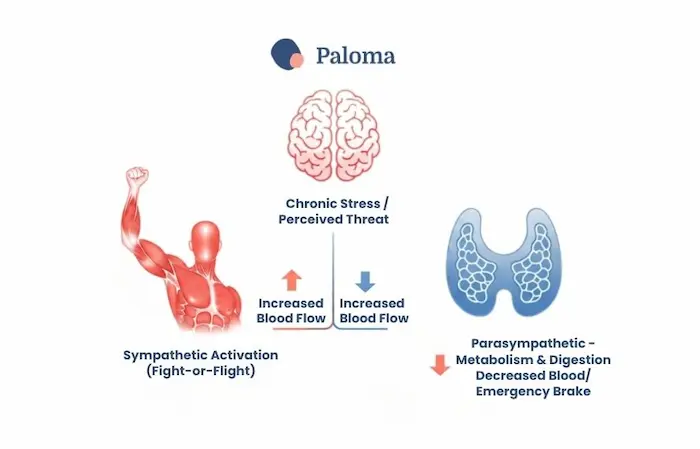
The HPA–HPT axis: When your stress system silences your thyroid
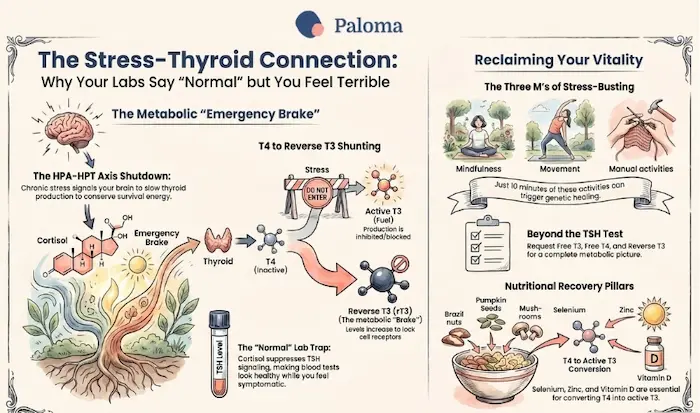
The hypothalamic-pituitary-adrenal (HPA) axis and the hypothalamic-pituitary-thyroid (HPT) axis are in constant communication. When stressors activate the HPA axis, the resulting hormonal cascade actively inhibits the HPT axis. This crosstalk ensures that as long as your body remains in a high-cortisol state, the thyroid gland receives the message to slow hormone production—effectively prioritizing survival over metabolic speed. It is not a malfunction. It is an intelligent, if frustrating, “emergency brake” designed to conserve fuel during perceived crises.
Why your labs look “normal” but you feel terrible
Cortisol exerts a potent influence on the brain’s perception of thyroid status. Under elevated cortisol conditions, the pituitary gland often slows thyroid-stimulating hormone (TSH) production. While a lower TSH might appear “normal” on standard blood tests, it actually represents a suppression of the signaling mechanism meant to stimulate the thyroid—not a reflection of healthy thyroid function.
This is the critical limitation of TSH-only screening. TSH is a lagging indicator. In stress-induced thyroid dysfunction, it often remains within the “normal” range while the patient is clearly suffering from suboptimal hormone production. Relying solely on TSH ignores the HPA–HPT connection entirely.
T4–T3 conversion and Reverse T3
The thyroid primarily secretes T4, an inactive pro-hormone that must be converted into T3—the active, energy-driving hormone—in peripheral tissues. Stress is a major inhibitor of this conversion by blocking the enzyme. Many patients suffer the classic symptoms of hypothyroidism—fatigue, weight gain, cold intolerance—even when their T4 levels look “normal.” They possess the fuel, but the machinery required to light the metabolic fire is compromised.
When the body decides to shunt energy away from active metabolism, it converts T4 into reverse T3 (rT3) instead of active T3. Think of rT3 as the body’s metabolic emergency brake: it occupies the same cellular receptors as active T3 but provides none of the metabolic benefits—essentially locking the doors to your cells. This survival adaptation conserves energy in the short term, but when it persists, it produces the systemic sluggishness characteristic of autoimmune thyroid disorders.
Many patients suffer classic hypothyroid symptoms even when T4 values look ‘normal.’ They possess the fuel. The machinery to light the metabolic fire is simply compromised.
How stress worsens your symptoms
Any chronic stress—mental, emotional, or physical—can worsen symptoms you might otherwise chalk up solely to your hypothyroidism. Stress can trigger or worsen what many thyroid patients consider the “big three” symptoms:
- Fatigue (research confirms the link)
- Weight gain (demonstrated in multiple studies)
- Anxiety and depression (stress as a neurological trigger)
Beyond the big three, stress also contributes to:
- Hair loss
- Sleep problems—difficulty falling and staying asleep
- Muscular, joint, and body pain
- Brain fog, anxiety, and mood volatility (often misdiagnosed as primary psychiatric disorders, when the root cause is metabolic)
The cardiovascular connection
The link between stress, thyroid, and heart health is measurable. Heart rate variability (HRV)—a powerful proxy for nervous system resilience—correlates strongly with T3 levels. Research shows that higher variability aligns with lower T3 values, demonstrating how stress erodes the thyroid’s ability to support cardiovascular function. This can manifest as palpitations and reduced exercise endurance.
The metabolic spiral: Insulin resistance and weight gain
Thyroid hormones dictate the rate at which your cells use energy. When that rate is suppressed, the body becomes prone to insulin resistance and stubborn weight gain. Because metabolism is forced into “conservation mode,” even modest caloric intake can lead to weight retention. This creates a secondary stressor—the frustration of not losing weight—which further elevates cortisol and worsens thyroid suppression in a self-reinforcing cycle that conventional care rarely addresses holistically.
Stress also increases the risk—already elevated in hypothyroidism—of developing Type 2 diabetes and heart disease. With all these potential consequences in play, we simply cannot afford to ignore the role stress plays in our hormonal and immune health.
Stress and your immune system: The Hashimoto’s connection
Stress can wreak havoc on your immune system in ways that go far beyond catching more colds. The stakes are especially high for thyroid patients:
- Stress can impair immune function and slow recovery from illness
- It may worsen inflammation in autoimmune disease, including Hashimoto’s, the most common cause of hypothyroidism
- It may trigger autoimmune diseases and their symptoms outright
Chronic stress eventually leads to glucocorticoid resistance, resulting in the immune system losing its precision. While cortisol is naturally anti-inflammatory, prolonged exposure can make the immune system less responsive to these regulatory signals. The result: a dysregulated immune response where the body begins to view its own tissues as a threat—potentially triggering an autoimmune condition.
Thyroid autoantibodies: The inflammation marker you need to know
As the immune system becomes hyper-vigilant, it increases production of pro-inflammatory cytokines. In susceptible individuals, prolonged inflammation can trigger the formation of thyroid autoantibodies—specifically TPO (thyroid peroxidase) and TgAb (thyroglobulin antibodies). These markers signal the onset of Hashimoto’s thyroiditis, in which the immune system mounts a targeted attack on thyroid follicles, triggering chronic inflammation that further impairs healthy endocrine function.
The gut–thyroid axis: A critical and often overlooked link
The “leaky gut” phenomenon is a critical link in the autoimmune cascade. Stress alters the gut microbiome and increases intestinal permeability, allowing undigested food proteins and toxins to cross into the bloodstream. This prompts an immune reaction—and because some of these proteins structurally resemble thyroid tissue, the immune system can begin to attack the thyroid itself. This process, called molecular mimicry, is why managing gut health is essential for anyone seeking to address the root causes of autoimmune thyroid disease.
Getting the right diagnosis: Beyond TSH
The comprehensive thyroid panel
To accurately assess the metabolic impact of stress, a comprehensive panel is essential. This must include Free T3, Free T4, and Reverse T3. Comparing the ratio of Free T3 to Reverse T3 provides an objective window into whether your body is favoring metabolic activity or the emergency brake state—vital information for understanding why symptoms persist and why medication may not be working as intended.
TPO
Anyone with thyroid symptoms should have TPO and TgAb antibodies tested regularly. Identifying these markers shifts the treatment paradigm from simple hormone replacement to addressing the underlying autoimmune inflammation—a fundamentally different approach that targets the cause rather than the symptoms.
How to reduce and protect against stress
Herbert Benson, M.D., distinguished mind-body professor at Harvard University and founder of the Benson-Henry Institute for Mind-Body Medicine, has earned the title “Father of Mind-Body Medicine.” His landmark book, The Relaxation Response, demonstrated that physiologic stress-reducing activities, such as meditation, could prevent and reduce the proven health effects of stress. His most recent research found that just ten minutes of practicing stress management daily can trigger positive genomic and genetic changes.
"Ten minutes of daily stress management can cause positive genomic and genetic changes—reducing depression, improving immune health, balancing hormones, and reducing fatigue.” —Herbert Benson, M.D., Harvard University
Specifically, daily physiologic stress reduction can:
- Reduce depression and anxiety
- Curb food cravings
- Improve immune health
- Reduce blood pressure
- Improve sleep
- Improve hormonal balance
- Reduce mental and physical fatigue
Before you grab that bowl of popcorn and settle onto the couch for a Netflix or Tiktok binge, let’s clear something up: physiologic stress management isn’t always what you think of as “relaxation.” As enjoyable as streaming or surfing may be, it doesn’t qualify as a physiologic stress-reducing practice.
The three M’s of stress-busting
Think of these three categories as your toolkit:
1. Mindfulness
Mind-based activities involving minimal movement:
- Affirmations and prayer
- Meditation and guided meditation
- Breathwork / Pranayama
2. Movement
Gentle, movement-based activities—with the emphasis on gentle. If it involves intense breathing, pain, or an elevated heart rate, it doesn’t count:
- Gentle yoga
- Tai Chi or Qi Gong
- Contemplative walking
3. Manual
Hands-on activities that ease you into a calm, focused state of mind:
- Playing a musical instrument
- Painting, drawing, or coloring
- Crafting, carpentry, knitting, crocheting, embroidery
- Weeding, gardening, baking bread
There’s no need to sit in a lotus position for hours. Commit to ten minutes of your chosen activity to shut down the mental chatter, calm your body, and enter a state of mindful flow. Those few minutes deliver all the benefits.

Try these resources
- The Thyroid Meditation—a guided meditation audio program designed specifically for thyroid patients
- Guided sleep meditations to bring calmness and awareness to your body and lower your stress response
- A free 15-minute guided walking meditation on YouTube
- The Calm app—featuring free guided meditations and breathwork sessions, with more options for paid subscribers
- Color a mandala online for free (studies show coloring complex geometric shapes can significantly reduce anxiety)
Healing from the inside out: nutrition & lifestyle
The nutritional foundations of thyroid health
Specific nutrients are non-negotiable for thyroid recovery. Selenium is critical for the conversion of T4 to T3 and for reducing thyroid antibodies. Zinc supports immune balance, while Vitamin D acts as a potent immunomodulator. Iodine is needed for hormone production, but too much can worsen autoimmune thyroiditis in susceptible individuals—monitoring is essential.
Adaptogens: Ashwagandha and beyond
Adaptogens help the body modulate its stress response. Ashwagandha has been shown in some studies to support thyroid function and help balance cortisol levels, while Cordyceps can improve cellular energy production. These botanicals function as a buffer, helping prevent the full-scale HPA–HPT breakdown during stressful periods.
Anti-Inflammatory diet and gut health
A nutrient-dense, anti-inflammatory diet is the cornerstone of healing. Many patients benefit from identifying food sensitivities—particularly to gluten and dairy—which often trigger gut–thyroid autoimmune flares. Focusing on whole foods that stabilize blood sugar prevents the repeated cortisol spikes that suppress thyroid function.
Managing internal stressors
It’s not just external events that drive stress. Caffeine can overstimulate the adrenal glands, increasing cortisol and harming thyroid function. Stabilizing blood sugar through protein-rich meals is a simple but profound way to lower your physiological stress load.
Vagus nerve stimulation: The biology of calm
The vagus nerve is the primary conduit of the parasympathetic nervous system. Techniques like deep diaphragmatic breathing, brief cold exposure, or even humming stimulate the vagus nerve, signaling the body to shift from a state of alarm to a state of repair. Understanding this biological pathway is key to counteracting metabolic slowdown.
Sleep: Your most powerful tool
Recovery begins with the nervous system. Establishing a consistent sleep–wake cycle and protecting your circadian rhythm are the most effective ways to signal to your body that it is safe to exit survival mode. Morning light exposure and reducing blue light in the evening are essential habits for resetting the HPA axis—and through it, supporting thyroid function.
A note from Paloma
Understanding the relationship between stress and thyroid health means recognizing that your body is a masterpiece of survival. When the thyroid slows down, it is rarely a sign that something is “broken.” Instead, it is a strategic retreat—a protective adaptation to a world that feels chronically unsafe.
The path forward requires a shift in how we approach thyroid health. You can take control of your metabolism by prioritizing sleep quality, adopting stress management techniques, and working with a practitioner who does comprehensive thyroid testing beyond the standard TSH test. Whether you are dealing with Hashimoto’s thyroiditis, hypothyroidism, or both, recovery is a process of reclaiming your body’s internal safety. Your first step is to work with a thyroid-savvy medical practice like Paloma Health to get optimal treatment—and then systematically address the stressors that are working against you.
Let’s start right now. Take a deep, slow breath—all the way down to your belly. Hold for a few seconds. Slowly exhale. Don’t you feel even a little better already? That’s the power of stress reduction. Now imagine what ten minutes a day will do for you—and your thyroid!
A note from Paloma
Understanding the relationship between stress and thyroid health means recognizing that your body is a masterpiece of survival. When the thyroid slows down, it is rarely a sign that something is “broken.” Instead, it is a strategic retreat—a protective adaptation to a world that feels chronically unsafe.
Frequently asked questions
Can stress actually cause hypothyroidism?
Stress alone does not directly cause hypothyroidism in most people, but it can suppress thyroid function and worsen existing thyroid conditions. Chronic stress can interfere with hormone production, hormone conversion, and immune regulation, making thyroid symptoms more severe.
Why do I have thyroid symptoms when my TSH is normal?
TSH is only one piece of the thyroid puzzle and may not fully reflect thyroid function during periods of chronic stress. Stress can alter hormone signaling and conversion while keeping TSH levels within the normal range.
How does cortisol affect the thyroid?
Cortisol is the body’s primary stress hormone and can suppress communication between the brain and thyroid gland. High cortisol levels may reduce thyroid hormone production and impair the conversion of T4 into active T3.
What is reverse T3, and why does it matter?
Reverse T3 is an inactive form of thyroid hormone that the body produces during times of stress or illness. Elevated reverse T3 can block the effects of active thyroid hormone, contributing to symptoms like fatigue, weight gain, and brain fog.
Can stress worsen Hashimoto’s disease?
Yes. Chronic stress can increase inflammation, disrupt immune function, and contribute to the production of thyroid antibodies that attack the thyroid gland in Hashimoto’s thyroiditis.
What symptoms can stress and thyroid problems have in common?
Stress and thyroid dysfunction share many symptoms, including fatigue, anxiety, depression, sleep disturbances, weight changes, brain fog, and reduced exercise tolerance. This overlap can make it difficult to identify the true cause of symptoms without a comprehensive evaluation.
What thyroid tests should I ask for besides TSH?
Many thyroid experts recommend a more comprehensive assessment that includes Free T4, Free T3, thyroid antibodies such as TPO, and, sometimes, Reverse T3. These tests can provide a fuller picture of thyroid function and autoimmune activity.
Can improving gut health help my thyroid?
Gut health plays an important role in immune regulation and thyroid health, especially for people with Hashimoto’s disease. Managing stress, supporting a healthy microbiome, and addressing food sensitivities may help reduce inflammation and autoimmune activity.
What are the best stress-management techniques for thyroid patients?
Effective approaches include meditation, mindfulness practices, breathwork, gentle yoga, Tai Chi, walking, prayer, gardening, crafting, and other activities that promote a calm, focused state. Consistency is more important than duration; even 10 minutes a day can be beneficial.
How important is sleep for thyroid health?
Sleep is one of the most powerful tools for regulating stress hormones and supporting thyroid function. Consistent, high-quality sleep helps calm the nervous system, improve hormonal balance, and reduce the physiological stress that can worsen thyroid symptoms.


%20(1).webp)
.webp)


