


.webp)

In this article:
Your nails may be revealing more about your health than you realize. While most people watch for changes in their weight, energy, skin, or hair, few pay attention to what’s happening at their fingertips. Yet your nails can serve as an early warning system, offering clues about nutritional deficiencies, hormone imbalances, and even thyroid dysfunction long before other symptoms become impossible to ignore.
That’s why seemingly minor changes—such as ridges, brittleness, splitting, discoloration, or slower growth—deserve a closer look. These changes are often dismissed as a normal part of aging or everyday wear and tear, but they can sometimes signal that something deeper is happening inside the body.
If you've noticed ridges running across or down your nails, your thyroid could be part of the story. Understanding what your nails are trying to tell you may help uncover hidden health issues and provide valuable insight into your thyroid function and overall well-being.

Dealing with Hypothyroidism? Video chat with a thyroid doctor
Get answers and treatments in minutes without leaving home - anytime. Consult with a U.S. board certified doctor who only treats hypothyroidism via high-quality video. Insurance accepted.
Schedule

Nail ridges are lines or grooves that appear on the surface of yourfingernails or toenails. These ridges can run vertically (from the base of thenail to the tip) or horizontally (across the nail from side to side). In manycases, you can both see and feel them when you run a finger across the nail.Some ridges appear raised, while others create noticeable indentations.
Your nails are made primarily of keratin, the same structural proteinfound in your hair and the outer layer of your skin. Because nails are livingtissues that grow continuously, their appearance can reflect changes happeningelsewhere in the body. Factors such as aging, nutrition, hydration,medications, and underlying health conditions can all affect nail growth andtexture.
Just as hair may become thinner or more brittle and skin may become drierover time, nails can also change with age and overall health. While some nailridges are completely normal and harmless, others may provide clues aboutnutritional deficiencies, chronic illnesses, or hormone imbalances, includingthyroid disorders.
Vertical ridges in nails
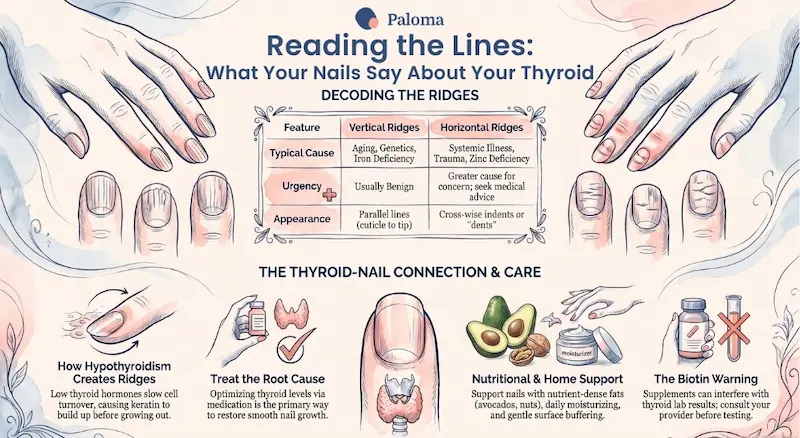
Vertical ridges on the nails are pretty common and are usually benign, meaning that they do not signal that anything is wrong. Running from your cuticle to the tip of your nail, these ridges in fingernails are generally a sign of aging, and as such, can become more pronounced the older you get.
Some people are also more likely to have ridges in their nails based on their genes and environmental factors like their diet and how they use their hands.
If you have vertical ridges, you may also notice that the nails undergo other changes, such as:
- Thickening or thinning
- Becoming rougher
- Splitting easily
- Forming fissures, and
- Breaking frequently
In some cases, vertical ridges may be a sign of rheumatoid arthritis or peripheral vascular disease.
Horizontal ridges in nails
You will need to be more concerned about a horizontal line if it occurs on multiple fingers or multiple ridges appear on one nail without an apparent cause. The appearance of horizontal ridges on numerous fingers may be a sign of chronic disease or systemic illness.
Illnesses that can cause horizontal or Beau's lines include:
- Acute kidney failure
- Syphilis
- Mumps
- Thyroid disease like hypothyroidism
- Subungual melanoma (melanoma of the nails)
- Diabetes
- Endocarditis
- Pneumonia
- Zinc deficiency
- Malnutrition
The thyroid gland produces thyroid hormones that affect every cell in your body. Thus, every organ system can suffer when thyroid hormone levels are out of balance, including the integumentary system, including your skin, hair, and nails.
People with too little thyroid hormone (hypothyroidism) often struggle with symptoms of dry skin, brittle nails, and hair thinning.
Your nail health is very sensitive to thyroid fluctuations because itdepends on rapid cellular turnover. Thyroid hormones serve as the primarypace-setters for this process, regulating the rate at which nail cells divideand mature.
When thyroid production is insufficient, hypothyroidism slows cellular turnover in the nail. This is not merely a lack of growth; it is a failure ofthe natural replacement process. Keratin cells build up unevenly before they have the opportunity to grow out smoothly, creating the physical sensation of elevated ridges. Simultaneously, the thyroid's command over oil production diminishes, compromising the nail barrier and leading to dry, brittle nails.
Start by treating your thyroid condition
If there is a reason for the ridges in your fingernails, you need to treat the cause. If you have a thyroid problem like hypothyroidism, you need to optimize your thyroid hormone levels with thyroid hormone replacement medication.
Thyroid medication is usually the first step in treating hypothyroidism, but there are also other ways you will want to support your nails if they have ridges.
5-Day Thyroid Meal Plan
In this free download, you'll get a five-day meal plan that includes a grocery list and recipes for breakfast, lunch, dinner, two snack options, plus dessert.
.jpeg)
Eat a healthy diet
Malnutrition may be a likely cause of nail ridges in many people, and certain medical conditions can make it hard to absorb the proper nutrients to support your whole body down to your nails.
It is essential to eat a nutrient-dense diet full of wholesome foods with minimal (or no) processing. Refined sugars, alcohol, caffeine can also interfere with healthy nail growth, so try to limit these items as much as possible. Your nails benefit from natural food sources rich in lipids, peptides, and natural oils that occur in avocados, eggs, and nuts.
Furthermore, antioxidants can give your integumentary system the boost it needs to promote health renewal and regeneration. Additionally, because many diseases like hypothyroidism or Hashimoto's disease (an autoimmune disease that is the leading cause of hypothyroidism) may cause a level of chronic inflammation in the body, it is helpful to incorporate anti-inflammatory foods into your diet.
Try a support supplement
It can sometimes be challenging to get all of the nutrients you need, even if you eat a diverse diet. Sometimes, the food we eat interacts with our ability to absorb specific minerals and vitamins, or the gut has difficulty breaking down particular molecules causing nutritional deficiencies.
Taking a supplement that aims to help support your skin, hair, and nails can be a great way to get plenty of certain nutrients you may generally have difficulty obtaining.
Keep in mind that if you take a supplement that contains biotin, it can interfere with some thyroid lab results, so check with your lab to ask if you should avoid taking biotin before testing your thyroid.
Note: Paloma Health's lab uses a specialized assay, so there is no need to delay your medications or supplements, including biotin. You may also take the Paloma Health at-home thyroid test with or without regard to food, so no need to fast.
A note from Paloma Health
If you are worried about ridges in your fingernails, it pays to test your thyroid, as nail ridges are common in people struggling with thyroid hormone imbalance. You can check your thyroid with an at-home thyroid test kit.

Frequently asked questions
Can hypothyroidism cause ridges in fingernails?
Yes. Low thyroid hormone levels can slow nail growth and cellular turnover, which may contribute to ridges forming on the nails, especially when combined with brittleness and dryness.
Are vertical ridges in nails always a sign of thyroid disease?
No. Vertical ridges are very common and often develop naturally with aging. However, when they appear alongside other symptoms, they may be worth discussing with a healthcare provider.
What are Beau’s lines?
Beau’s lines are horizontal grooves or indentations that run across the nail. They can develop when nail growth is temporarily interrupted by illness, injury, severe stress, nutritional deficiencies, or certain medical conditions.
Why does hypothyroidism affect nail health?
Thyroid hormones help regulate growth and repair throughout the body. When hormone levels are low, nail growth slows down and nails may become weaker, drier, and more prone to ridges or breakage.
Can thyroid medication improve nail ridges?
In some cases, yes. When hypothyroidism is properly treated and thyroid hormone levels are optimized, nail growth and appearance often improve over time, although results may take several months.
Are brittle nails and nail ridges connected?
Often they are. Many people who develop nail ridges also notice that their nails become dry, thin, split easily, or break more frequently.
Could vitamin deficiencies cause nail ridges?
Yes. Low levels of nutrients such as iron, zinc, biotin, and certain B vitamins may contribute to nail changes, including ridges, brittleness, and slow growth.
When should I see a doctor about nail ridges?
You should consider medical evaluation if nail ridges appear suddenly, affect multiple nails, worsen over time, or occur alongside symptoms such as fatigue, hair loss, weight changes, dry skin, or other signs of thyroid dysfunction.
.webp)


.webp)


