



.webp)
In this article
Linda Goggin, MD is a Board Certified Family Physician with extensive training in Functional Medicine and Complex Medical Illness, with a focus on addressing root causes of hormonal imbalance.
Harsha Moole, MD, is an internal medicine physician, medical outcomes researcher, and founder of FindMyDirectDoctor.
Before diving into hormone therapy and brain health, it helps to get clear on what dementia actually is. Dementia isn't a single disease — it's an umbrella term for a decline in memory, thinking, reasoning, and behavior severe enough to interfere with daily life, according to the National Institute on Aging. Alzheimer's disease is the most common form, but vascular dementia, Lewy body dementia, and frontotemporal dementia also fall under the dementia umbrella, and it's common to have a mix of more than one type.
It's also worth saying clearly: dementia is not a normal part of aging. Many people live into their 90s and beyond without ever developing it. That said, risk does rise with age, and researchers are working hard to understand which factors — hormonal, genetic, cardiovascular, and lifestyle — tip the scales. If you've been navigating brain fog, mood changes, or memory lapses during perimenopause, you may already be familiar with how closely hormones and cognition are linked; Paloma's article on neurowellness and your hormones digs into that connection in more depth.
Common signs and symptoms of dementia
Dementia symptoms vary by type and by which brain regions are affected, but according to the National Institute on Aging, common warning signs include:
- Memory loss that disrupts your daily life — repeating questions, misplacing items, forgetting recent conversations
- Difficulty finding the right words, following a conversation, or completing familiar tasks
- Getting confused about time or place, including in familiar neighborhoods
- Poor judgment or decision-making, such as falling for scams or mismanaging money
- Withdrawal from work, hobbies, or social activities
- Changes in mood or personality, including increased anxiety, suspicion, or irritability
A single memory slip isn't cause for alarm — occasional forgetfulness is a normal part of a busy life. What matters is a pattern of change that's noticeable to you or the people around you. If that's happening, the National Institute of Neurological Disorders and Stroke recommends bringing it up with a doctor rather than waiting it out.

Why dementia looks different for women
Dementia doesn't affect men and women equally. Menopausal women make up roughly two-thirds of Alzheimer's cases, a gap researchers attribute to a combination of longer average lifespan and biology specific to women. The key factors for women appear to be the effects of menopause on brain metabolism, and the fact that the most well-established genetic risk factor for Alzheimer's disease, the APOE4 gene variant, appears to raise risk more in women than in men, according to the University of Exeter's summary of new UK Biobank research. That combination is exactly why researchers have spent decades trying to understand whether hormone replacement therapy (HRT) — which replaces the estrogen a woman's body stops producing at menopause — might also change dementia risk.
Estrogen isn't just a reproductive hormone. It plays a meaningful role in supporting your neuron function, brain glucose metabolism, and blood flow to the brain. When estrogen production drops sharply at menopause, many women notice the menopausal symptoms almost immediately — the forgetfulness, word-finding trouble, and mental haze often nicknamed "brain fog" or sometimes called "peri-brain." These are in addition to well-known symptoms such as night sweats and hot flushes. For most women, these symptoms ease once hormone levels stabilize after the menopause transition. But researchers have long suspected that the same estrogen decline driving day-to-day brain fog might also be relevant to longer-term dementia risk.
The estrogen-brain connection
The timing is notable: for many women, the drop in estrogen at menopause coincides with what scientists believe is the earliest, "preclinical" window of Alzheimer's disease — the period, sometimes a decade or more before symptoms appear, when changes are already beginning in the brain. That overlap is part of why menopause has been described in research as a distinct neurological transition state, not simply a reproductive milestone. It doesn't mean menopause causes dementia — most women never develop dementia — but it does help explain why hormone changes are a genuine, biologically plausible piece of the puzzle. It's also part of why so many women in perimenopause describe mood and memory symptoms. Paloma's article on depression during perimenopause covers how tightly those symptoms are intertwined with hormonal shifts.
Surgical menopause and higher risk
Not all menopause transitions happen gradually. Surgical menopause — brought on by removal of both ovaries (bilateral oophorectomy), sometimes along with a hysterectomy — causes an abrupt estrogen drop, compared to the years-long tapering of natural menopause. Prior research has linked surgical menopause, especially at a younger age, to a higher risk of dementia later in life. That makes women who've had this surgery a particularly important group to understand when it comes to menopausal hormone therapy's effects on brain health, which is exactly the group the newest research zeroed in on.
In August 2026, researchers from the two UK universities published the largest study of its kind to date in the journal Alzheimer's & Dementia. The team analyzed health data from 183,450 postmenopausal women in the UK Biobank, following them for an average of 13.3 years. During that time, almost 4,000 women developed dementia. Rather than asking a single yes-or-no question — does HRT raise or lower dementia risk — the UK Biobank researchers set out to identify which women were most likely to benefit, and when.
What the researchers found
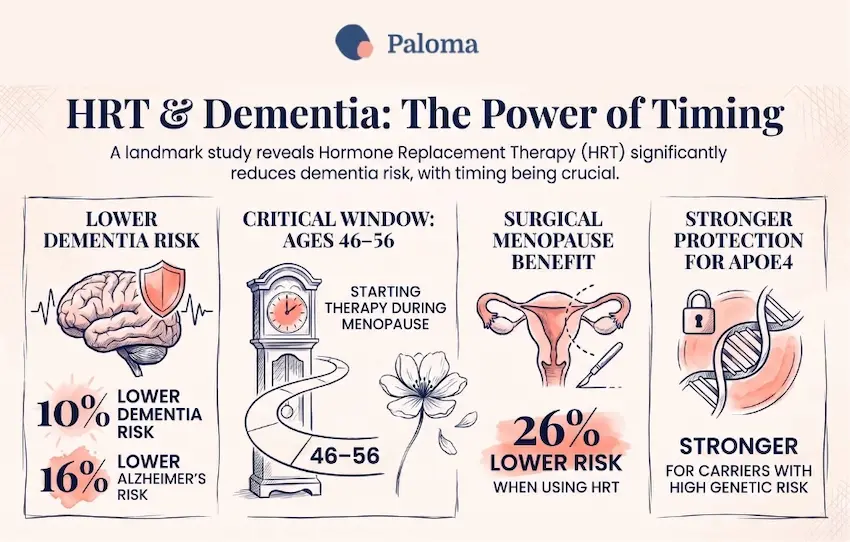
Women who had used HRT were about 10% less likely to develop dementia — and 16% less likely to develop Alzheimer's disease — than women who never used it.
That headline finding, reported by the study lead, Professor Anne-Marie Minihane and colleagues, was an association observed across the full study population — not proof that HRT directly prevents dementia in every woman who takes it. Still, in a field where research has often pointed in conflicting directions, a reduction of this size, in a study this large, is significant.
Who benefited the most?
The protective association wasn't uniform. It was substantially stronger in a few specific groups:
- Surgical menopause: Women who'd had their ovaries removed and used hormone therapy were about 26% less likely to develop dementia than those who didn't use it — the largest benefit seen in the study.
- Lower lifetime estrogen exposure: Women who started their periods later or reached menopause early — both markers of less cumulative lifetime estrogen exposure — saw about a 16% lower risk of any dementia type with HRT use.
- APOE4 carriers: The protective association between HRT and dementia was stronger in women who carry the APOE4 gene variant, a group typically considered higher-risk with few established prevention options.
Why does timing seem to matter?
The age when hormone therapy begins also mattered. Women who started HRT between ages 46 and 56 saw the greatest reduction in dementia risk. This pattern is consistent with the "critical window" hypothesis, the idea that hormone therapy may be more protective when started close to the menopause transition rather than years afterward. The study did not find the same benefit for women who started HRT outside that window.
According to Harsha Moole, MD, an internal medicine physician:
"The idea of a critical window has been discussed for years, and this study adds weight to it. In practice, it means that the timing of the conversation matters, and women who started around menopause saw the signal strongest. It is not a hard cutoff where starting later is worthless – it is a nuance worth discussing, not a rule.”
As one of the study authors, Professor David Llewellyn of the University of Exeter Medical School, said: "Rather than asking simply whether HRT affects dementia risk, we've been able to identify which women are most likely to benefit, and when. That's the foundation on which genuinely personalized approaches to women's brain health can be built."

If you've followed HRT headlines over the years, you may be wondering why this news sounds so different from what you've heard before. The honest answer: research on hormone therapy and dementia has genuinely been inconsistent for two decades, and this new study is best understood as one important piece of a larger, evolving puzzle — not the final word.
The WHIMS study and why it worried doctors
Much of the caution around HRT and brain health stems from the Women's Health Initiative Memory Study (WHIMS), a large randomized trial published in the early 2000s. WHIMS enrolled women 65 and older — well past the usual age of menopause onset — and found that a specific regimen (oral conjugated equine estrogen, with or without a progestin) actually increased the risk of dementia and cognitive decline, according to a widely cited review in Lancet Neurology. A 2022 nationwide cohort study from Taiwan, published in Neurology, similarly found HRT use associated with a higher risk of dementia in a broad population of women. Findings like these are a major reason many doctors have historically been cautious about recommending HRT for brain health, and why a 2025 systematic review and meta-analysis in The Lancet Healthy Longevity concluded that, taken as a whole, the existing evidence doesn't clearly show HRT either raises or lowers dementia risk on average.
What's different about this new study?
Several design differences help explain why the new UK Biobank findings look more favorable.
- First, scale and duration: with over 183,000 women followed for more than 13 years, this is a far larger and longer observational dataset than most prior studies.
- Second, and more importantly, it didn't stop at asking whether HRT helps or hurts on average — it explicitly modeled who benefits, accounting for menopause type, genetic risk, lifetime estrogen exposure, and age at HRT initiation as modifiers.
WHIMS, by contrast, studied older women starting HRT long after menopause, which the critical window hypothesis suggests is precisely when hormone therapy is least likely to help the brain and most likely to carry cardiovascular risk. The authors of the new study themselves note that future research should dig further into how HRT composition, dose, and route of administration affect these findings — this is an active, evolving area of science, not a settled one.
This research is genuinely encouraging, but it's most useful when translated into your specific situation. A few scenarios worth understanding:
If you're in perimenopause or early menopause
If you're in the general window this study highlighted — roughly age 46 to 56 — and already considering HRT for menopausal symptoms such as hot flashes, sleep, mood, or brain fog, this research adds another data point worth discussing with your provider, particularly if dementia runs in your family. It's not, on its own, a reason to start HRT if you don't otherwise have symptoms or risk factors that warrant it. Paloma's overview of HRT for perimenopause is a good starting point if you're weighing the decision.
If you've had a hysterectomy or oophorectomy
Surgical menopause showed the strongest protective association with HRT in this study — about a 26% lower dementia risk among users. If you've had or are planning to have your ovaries removed, this is a conversation worth having proactively with your surgeon and your primary care or menopause provider, ideally before or soon after surgery, since the critical-window effect suggests earlier initiation matters.
Dr. Moole counsels that hysterectomy with ovary removal warrants a very different conversation. According to Dr. Moole:
"The estrogen drop is sudden and complete, symptoms can be more severe, and the risk-benefit math changes without a uterus (no endometrial concern with estrogen). That patient often deserves a more proactive discussion, not a more cautious one."
Paloma's Linda Goggin, MD, has a specific HRT protocol for younger women. According to Dr. Goggin:
"If a person goes through surgical menopause, it is likely earlier than she was meant to stop cycling. In that instance I might suggest rhythmic or physiologic replacement therapy. In this type of replacement we use topical estrogen and progesterone to mimic a younger woman's cycle. This allows you to maintain the peaks of estrogen and progesterone that happen during the month, which have unique benefits such as improved bone health as well as signaling repair to the body. When estrogen peaks we release factors that facilitate the healing of the vasculature and blood vessels. So maintaining that natural Rhythm can be very helpful for many reasons."
If you carry the APOE4 gene or have a family history
The study found a stronger association between HRT and dementia among APOE4 carriers — a group that has historically had few proven options to lower their elevated risk. If you have a strong family history of Alzheimer's disease, or you've had genetic testing that identified an APOE4 variant, it's worth raising this specific study with your doctor. Genetic risk is complex, and testing isn't right for everyone, but knowing your status can help personalize the conversation.
Whatever your situation, here's how to translate this research into a productive conversation with your doctor.
Bring the study to your appointment.
Mention the 2026 UK Biobank study (Squires et al., Alzheimer's & Dementia) by name because not every provider will have seen it.
Share your full history.
Menopause type (natural vs. surgical), age at menopause, age at first period, and family history of dementia all appeared to change the results — your doctor needs these details to interpret the research for you personally.
Ask about timing.
If you and your doctor decide HRT is appropriate, this research suggests earlier initiation, closer to the start of menopause, may matter for brain health specifically.
Don't treat HRT as a stand-alone dementia prevention plan.
The strongest, most consistent dementia risk factors remain factors like cardiovascular health, physical activity, sleep, social connection, and blood sugar control. HRT is one input among many, not a replacement for them.
Dr. Goggin is a firm believer in taking a holistic approach.
"There are many things you can do to improve brain health preventatively. It's all about optimizing hormonal systems, detoxifying as much as possible, and putting healthy lifestyle habits into place. Sleep, good nutrition, Stress Management, vigorous exercise—all of these can support brain health throughout a lifetime. There's good evidence that you can actually improve cognition, and possibly reverse some cognitive decline when you implement all of these at once."
Dr. Moole emphasizes this advice.
“What I wish more people understood: dementia risk is not just about HRT. Sleep, blood pressure, diabetes control, hearing, and staying active all matter, and the women asking about HRT are often the same ones I can help most with those other levers. HRT is one piece of a brain-health plan, not the whole plan.”

Consider the form of HRT
Most experts now recommend topical forms of estrogen. According to Paloma physician Linda Goggin, MD:
"We now understand that topical estradiol does not carry an increased risk of clotting or stroke (which was the big concern for women in their later menopausal years). Previously, we thought that adding estrogen might not be safe, but it turns out that the problem was using oral estrogens rather than a topical estrogen. Topical estrogen is safe and in fact, as shown in this recent study, HRT with estradiol may reduce the risk of Alzheimer's. Great news!"
Loop in your thyroid.
If you have hypothyroidism or Hashimoto's, thyroid hormone and estrogen interact, and both affect cognition — a coordinated treatment plan matters more than treating either in isolation.
Revisit the decision over time.
Guidance in this area is evolving quickly; what's right for you at 47 may look different from what's right at 57, so periodic check-ins with your provider are worth it.
Conversations like this one — where new research meets a personal decision about hormones — are exactly what Paloma Health was built for. Our physicians specialize in the overlap between thyroid health, perimenopause, and menopause symptoms and treatment, so you're not left trying to piece together how your thyroid medication, your hormone levels, and your brain health all fit together on your own.
Through convenient at-home thyroid testing, video visits with hormone-focused doctors, and nutritionist support, as a Paloma member, you can talk through questions like whether HRT is a safe fit for your health history, how to take HRT and thyroid medication together, or what to expect from different hormone delivery methods.
If findings like the ones in this article resonate with you — especially if you've had surgical menopause, a family history of dementia, or persistent brain fog and cognitive impairment — that's worth bringing directly to a Paloma provider, who can look at your full picture rather than any single symptom in isolation.
Does HRT prevent dementia?
No single treatment can guarantee dementia prevention, and HRT is no exception. The new research shows an association with lower risk in certain groups, but it's not a proven prevention strategy on its own.
Is HRT safe for brain health?
For many women undergoing hormonal changes, especially those starting menopausal hormone therapy around the time of menopause, current evidence — including this new study — is reassuring for brain health. Safety always depends on your personal and family health history, so it's a decision to make with your doctor, not a blanket answer.
What age should I start HRT to protect my brain?
This study found the strongest neuroprotective effects and benefits among women who started HRT between ages 46 and 56, supporting the idea that earlier initiation, closer to menopause, may matter more to prevent adverse brain changes. That's a general pattern from the data, not an individual guarantee, so timing should still be personalized with your provider.
Does the type of HRT matter for dementia risk?
Likely yes, but the UK Biobank study used general HRT-use data and couldn't fully separate estrogen-only versus combined estrogen-progesterone therapy, dose, or delivery method. The study authors themselves flagged this as an important next step for future research.
I already have dementia in my family. Should I take HRT?
Family history is exactly the kind of detail that should shape this conversation with your doctor, since APOE4 carriers showed a stronger protective association with HRT in this study. It's not a decision to make from a blog post — bring your family history to a provider who can weigh it against your full picture.
Can HRT help if I'm already having memory problems?
This study looked at preventing new dementia diagnoses in women without existing cognitive impairment, not at treating memory problems that have already started. If you're noticing memory changes now, that's a reason to see a doctor for evaluation, not to start HRT as a treatment for symptoms already underway.
Does HRT increase my risk of Alzheimer's if I'm over 65?
Older research, including the WHIMS trial, found that starting a specific type of HRT after age 65 increased dementia risk, which is part of why timing is emphasized so heavily in current guidance. This new study focused on women who typically started HRT earlier, so its reassuring findings don't necessarily apply to starting HRT for the first time well after menopause.
What is APOE4, and should I get tested?
The APOE4 genotype is a gene variant that's the best-established genetic risk factor for Alzheimer's disease, and it appears to raise risk more in women than in men. Genetic testing for this Alzheimer's biomarker is a personal decision with real emotional and practical implications, so it's worth discussing with your doctor or a genetic counselor rather than deciding on your own.
Does surgical menopause always mean higher dementia risk?
Surgical menopause (from ovary removal) has been linked to higher dementia risk in past research, likely because it causes an abrupt rather than gradual estrogen decline. This new study found that HRT use was linked to the largest risk reduction in exactly this group, which is worth discussing with your surgeon or doctor if you've had or are considering this surgery.
How does thyroid health fit into all this?
Thyroid hormone and estrogen both influence brain metabolism and cognition, and hypothyroidism on its own can cause brain-fog-like symptoms that overlap with menopause symptoms. That overlap is why a coordinated approach — evaluating thyroid and hormone health together, rather than one at a time — tends to give a clearer picture.

The strongest, most consistent dementia risk factors remain factors like cardiovascular health, physical activity, sleep, social connection, and blood sugar control. HRT is one input among many, not a replacement for them.
Paloma's Linda Goggin, MD believes a holistic approach is most effective. Says Dr. Goggin:
"There are many things one can do to improve brain health preventatively. It's all about optimizing hormonal systems, detoxifying as much as possible, and putting healthy lifestyle habits into place. Sleep, good nutrition, Stress Management, vigorous exercise—all of these can support brain health throughout a lifetime. There's good evidence that you can actually improve cognition, and possibly reverse some cognitive decline when you implement all of these at once."
Dr. Moole emphasizes this advice.
“What I wish more people understood: dementia risk is not just about HRT. Sleep, blood pressure, diabetes control, hearing, and staying active all matter, and the women asking about HRT are often the same ones I can help most with those other levers. HRT is one piece of a brain-health plan, not the whole plan.”
Consider the form of HRT
Most experts now recommend topical forms of estrogen. According to Paloma physician Linda Goggin, MD:
"We now understand that topical estradiol does not carry an increased risk of clotting or stroke (which was the big concern for women in their later menopausal years). Previously, we thought that adding estrogen might not be safe, but it turns out that the problem was using oral estrogens rather than a topical estrogen. Topical estrogen is safe and in fact, as shown in this recent study, HRT with estradiol may reduce the risk of Alzheimer's. Great news!"
Loop in your thyroid.
If you have hypothyroidism or Hashimoto's, thyroid hormone and estrogen interact, and both affect cognition — a coordinated treatment plan matters more than treating either in isolation.
Revisit the decision over time.
Guidance in this area is evolving quickly; what's right for you at 47 may look different from what's right at 57, so periodic check-ins with your provider are worth it.
Conversations like this one — where new research meets a personal decision about hormones — are exactly what Paloma Health was built for. Our physicians specialize in the overlap between thyroid health, perimenopause, and menopause symptoms and treatment, so you're not left trying to piece together how your thyroid medication, your hormone levels, and your brain health all fit together on your own.
Through convenient at-home thyroid testing, video visits with hormone-focused doctors, and nutritionist support, as a Paloma member, you can talk through questions like whether HRT is a safe fit for your health history, how to take HRT and thyroid medication together, or what to expect from different hormone delivery methods.
If findings like the ones in this article resonate with you — especially if you've had surgical menopause, a family history of dementia, or persistent brain fog and cognitive impairment — that's worth bringing directly to a Paloma provider, who can look at your full picture rather than any single symptom in isolation.
Does HRT prevent dementia?
No single treatment can guarantee dementia prevention, and HRT is no exception. The new research shows an association with lower risk in certain groups, but it's not a proven prevention strategy on its own.
Is HRT safe for brain health?
For many women undergoing hormonal changes, especially those starting menopausal hormone therapy around the time of menopause, current evidence — including this new study — is reassuring for brain health. Safety always depends on your personal and family health history, so it's a decision to make with your doctor, not a blanket answer.
What age should I start HRT to protect my brain?
This study found the strongest neuroprotective effects and benefits among women who started HRT between ages 46 and 56, supporting the idea that earlier initiation, closer to menopause, may matter more to prevent adverse brain changes. That's a general pattern from the data, not an individual guarantee, so timing should still be personalized with your provider.
Does the type of HRT matter for dementia risk?
Likely yes, but the UK Biobank study used general HRT-use data and couldn't fully separate estrogen-only versus combined estrogen-progesterone therapy, dose, or delivery method. The study authors themselves flagged this as an important next step for future research.
I already have dementia in my family. Should I take HRT?
Family history is exactly the kind of detail that should shape this conversation with your doctor, since APOE4 carriers showed a stronger protective association with HRT in this study. It's not a decision to make from a blog post — bring your family history to a provider who can weigh it against your full picture.
Can HRT help if I'm already having memory problems?
This study looked at preventing new dementia diagnoses in women without existing cognitive impairment, not at treating memory problems that have already started. If you're noticing memory changes now, that's a reason to see a doctor for evaluation, not to start HRT as a treatment for symptoms already underway.
Does HRT increase my risk of Alzheimer's if I'm over 65?
Older research, including the WHIMS trial, found that starting a specific type of HRT after age 65 increased dementia risk, which is part of why timing is emphasized so heavily in current guidance. This new study focused on women who typically started HRT earlier, so its reassuring findings don't necessarily apply to starting HRT for the first time well after menopause.
What is APOE4, and should I get tested?
The APOE4 genotype is a gene variant that's the best-established genetic risk factor for Alzheimer's disease, and it appears to raise risk more in women than in men. Genetic testing for this Alzheimer's biomarker is a personal decision with real emotional and practical implications, so it's worth discussing with your doctor or a genetic counselor rather than deciding on your own.
Does surgical menopause always mean higher dementia risk?
Surgical menopause (from ovary removal) has been linked to higher dementia risk in past research, likely because it causes an abrupt rather than gradual estrogen decline. This new study found that HRT use was linked to the largest risk reduction in exactly this group, which is worth discussing with your surgeon or doctor if you've had or are considering this surgery.
How does thyroid health fit into all this?
Thyroid hormone and estrogen both influence brain metabolism and cognition, and hypothyroidism on its own can cause brain-fog-like symptoms that overlap with menopause symptoms. That overlap is why a coordinated approach — evaluating thyroid and hormone health together, rather than one at a time — tends to give a clearer picture.
%20(1).webp)
.webp)


