


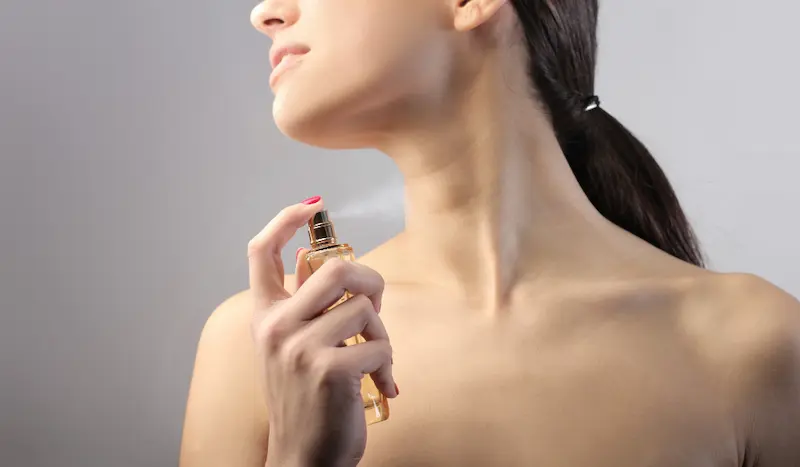
.webp)
In this article
If you have Hashimoto’s thyroiditis or hypothyroidism, you may have seen claims online that spraying perfume on your neck can damage your thyroid or affect your levels of thyroid hormone.
In fact, there’s a popular video on Instagram that claims that “Every time you spray perfume on your neck, you’re spraying it directly onto your thyroid gland.”
This claim has caused a stir, but as with many viral videos, there are a few nuggets of truth and a big helping of misleading hype.
Let’s take a look at what the science actually shows, what is exaggerated, and what people with thyroid conditions should know before they worry about their perfume.
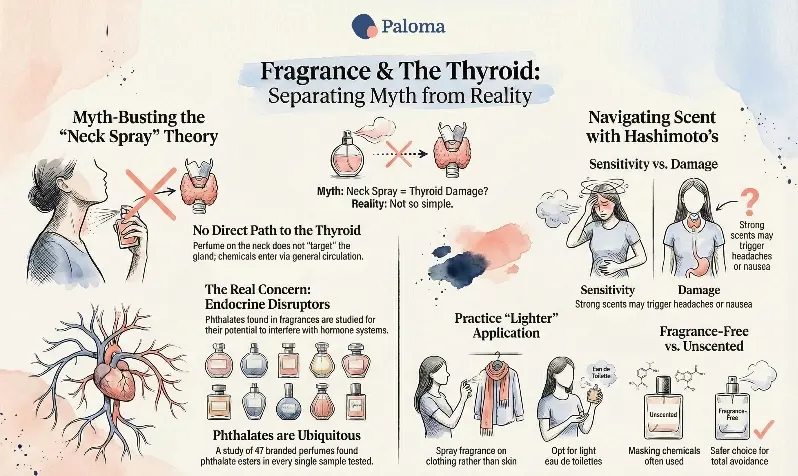
The short answer is: not directly, at least not in the way viral posts suggest. Your thyroid gland sits in the front of the neck, but perfume sprayed on the neck does not “go straight to the thyroid.” Skin absorption is real, but chemicals absorbed through the skin enter the body via normal circulation rather than traveling directly to your thyroid gland.
So, remember: There is no evidence that perfumes sprayed on the neck directly cause thyroid disease or affect thyroid hormones!
But that doesn’t mean that you shouldn’t take a look at the effect of some ingredients in fragrances. Perfume is not chemically simple. Many fragrances contain mixtures of solvents, aroma compounds, and preservatives, and some products may include ingredients -- especially phthalates -- that researchers study for possible endocrine and hormone-related effects. The concern is about the effects of chemical exposure over time, not about the location where the spray lands.
The word “fragrance” can hide a lot. In personal care products, fragrance mixtures may include many compounds that are not individually listed on the label, which makes it harder for consumers to know exactly what they are exposed to. Reviews of endocrine-disrupting chemicals note that fragrance-related ingredients such as phthalates can appear in cosmetics and other consumer products.
A study screening 47 branded perfumes found phthalate esters in all samples tested, with diethyl phthalate showing the highest overall levels. That does not mean every perfume is harmful, but it does explain why researchers and consumer advocates continue to pay attention to fragrance ingredients.
People with an autoimmune disease like Hashimoto’s thyroiditis, or hypothyroidism (an underactive thyroid) often live with symptoms like fatigue, brain fog, constipation, dry skin, hair changes, and feeling cold. When you already feel unwell, it is natural to wonder whether everyday exposures — including perfume — might be making things worse.
Some people also notice that strong scents make them feel headachy, nauseated, or irritated, even when those scents do not change thyroid hormone levels. In that case, perfume may be a symptom trigger rather than a thyroid disease trigger.
A lot of concern comes from the idea that the neck is somehow a special danger zone for perfume. That is overstated. Spraying fragrance on the neck does not directly target your thyroid gland, and there is no evidence that this habit alone damages thyroid tissue or causes Hashimoto’s thyroiditis.
Still, the neck is skin, and skin can absorb small amounts of chemicals. If you are sensitive to fragranced products, the site of application may matter because the neck is close to the face, nose, and airways, where scent can feel especially intense.
The scientific conversation centers on endocrine disruptors — chemicals that may interfere with hormone systems. Reviews on thyroid-disrupting chemicals describe how certain compounds can affect thyroid hormone production, transport, or signaling, and fragrance-related ingredients are part of that broader discussion.
Research also suggests associations between phthalate exposure and thyroid-related outcomes. For example, a PMC study examining phthalate exposure and thyroid function reported relationships between exposure measures and thyroid outcomes. However, the association does not show that perfume causes hypothyroidism or autoimmune disease, including thyroid conditions.
If you have hypothyroidism, your primary focus should still be on proven treatment: getting the right diagnosis, taking prescribed thyroid hormone replacement medication correctly if needed, and following up with your clinician. Perfume is not a substitute for medical evaluation of thyroid symptoms, and avoiding fragrance will not replace medical management when treatment is needed.
If you have Hashimoto’s thyroiditis or other autoimmune disorders, a more realistic concern is chemical sensitivities. Some people with autoimmune disease feel better when they reduce exposure to strong scents and other irritating personal care products, even if those products are not causing measurable thyroid gland damage. In other words, fragrance may affect your comfort more than your lab values.
You may want to reduce or avoid perfume if you notice:
- Headaches, dizziness, or nausea after using it.
- Throat irritation, coughing, or asthma symptoms around fragrance.
- Skin burning, redness, or rash where you spray it.
- A clear pattern of feeling better in fragrance-free environments.pmc.ncbi.nlm.nih+1
For some people, fragrance-free beauty products are simply a better fit. You do not need to prove a thyroid mechanism to justify avoiding a product that makes you feel bad.
If you enjoy perfume but want to be cautious, there are a few practical strategies:
- Choose gentler fragrance: Such as light eau de toilettes or colognes, oil-based scents that are clearly labeled phthalate-free and allergen-conscious, essential oils, and simple-ingredient perfumes from brands that disclose what is in the formula.
- Change your application: You can spray lightly instead of heavily, or spray on clothing rather than your skin.
- Choose phthalate-free perfumes: Some brands market themselves this way, and retailers such as Ulta and Bluemercury carry phthalate-free fragrance and essential oil collections.
- Choose brands that disclose ingredients clearly: You’ll want brands that prioritize transparency and disclose fragrance ingredients when possible.
- Select products that are certified or positioned as safer-clean formulations: Look for certified products and more transparent ingredient standards.
- Avoid very strong, long-lasting sprays: If you are sensitive to odor, headaches, or skin irritation, or have chemical sensitivities, avoid stronger sprays.
Ulta has a collection of phthalate-free perfumes and fragrances.

Depending on the effect perfumes and fragrances have on you, you can also follow this advice:
- Choose fragrance-free products: These are the safest choice if your goal is to avoid both phthalates and scent-triggered irritation as much as possible, or if you have chemical sensitivities.
- Be careful about products labeled only “fragrance” or “parfum:” The FDA says the specific fragrance ingredients are not required to be listed individually.
- Be aware of products marketed as “unscented:” If you are trying to avoid fragrance entirely, unscented products may still contain masking fragrance agents.
The claim that perfume sprayed on the neck directly harms thyroid function is not supported by evidence. What the research does support is a more careful, evidence-based conversation about fragrance ingredients, especially phthalates, and their possible role as endocrine disruptors.
For most people with Hashimoto’s thyroiditis or hypothyroidism, perfume is not a medical emergency. It’s more likely to be a sensitivity issue than a thyroid threat. If you tolerate fragrance, you probably do not need to panic. If you do not tolerate it, fragrance-free alternatives are a reasonable and easy choice.
Still, you can choose to do better yourself with lighter scents, essential oils, fewer sprays, or fragrance-free products. You can also use smarter ways to wear fragrance. That means enjoying what you like while being attentive to comfort, sensitivity, and context. It means applying scent with a lighter hand, choosing smarter surfaces, and respecting the signals your skin and body send back to you. It also means permitting yourself to use less if that feels better. No rule says perfume must be all-or-nothing.
Navigating lifestyle questions—like whether you should avoid perfume, switch to non-toxic personal care products and fragrances, or adjust your diet—can feel overwhelming when you’re already dealing with Hashimoto’s hypothyroidism. That’s where Paloma Health comes in. Beyond diagnosing and treating your thyroid condition and finding the right thyroid hormone replacement for you, Paloma’s team helps you connect the dots between your symptoms, environment, and daily habits. With expert guidance, personalized and easy home lab testing, and ongoing support, you can make informed decisions about lifestyle choices that actually impact how you feel—not just guess. It’s a more complete, whole-person approach to thyroid care that goes beyond prescriptions.
Can perfume make Hashimoto’s thyroiditis symptoms worse?
For some people, yes. Synthetic fragrances can trigger headaches, fatigue, or sensitivities, especially if you’re already prone to chemical intolerance.
Are people with hypothyroidism more sensitive to chemicals?
They can be. Hormonal imbalances and autoimmune disease may make some individuals more reactive to environmental triggers like fragrances.
Is perfume an endocrine disruptor?
Certain ingredients in synthetic fragrances have been linked to endocrine disruption, chemical sensitivities, and thyroid function, but not all perfumes have the same effects. Cleaner formulations may be a better option.
Should I stop wearing perfume completely?
Not necessarily. It depends on your symptoms—if you notice reactions, reducing or switching to natural alternatives may help.
What are safer alternatives to traditional perfumes?
Look for fragrance-free products or those made with essential oils, and choose products with transparent ingredient lists to minimize potential irritants.
Can lifestyle changes really impact thyroid symptoms?
Yes. Diet, stress, sleep, and environmental exposures can all influence how you feel alongside your thyroid condition.
How do I know what’s triggering my symptoms?
Tracking your symptoms alongside exposures—such as foods, products, or stress—can help you identify patterns over time.
Can I manage Hashimoto’s thyroiditis without changing my lifestyle?
Medical treatment is essential, but lifestyle adjustments often play a key role in improving symptoms and overall quality of life.

.webp)


%20(1).webp)


