



.webp)
In this article
If you've started semaglutide, tirzepatide, or another GLP-1 or GIP medication while also managing hypothyroidism along with weight gain, it's worth paying closer attention to your thyroid labs than you have in the past. A growing body of research — including new findings presented at the 2026 European Thyroid Association meeting — shows that these popular weight-loss and type 2 diabetes drugs can quietly shift how much thyroid medication your body needs. For some patients, that shift shows up fast: heart palpitations or jitteriness within weeks of starting a GLP-1. For others, it's subtler — a TSH result that suddenly looks almost too good, or fatigue that a higher dose doesn't fix. None of this means you should avoid GLP-1 therapy if it's right for you. It does mean you and your care team should know what to watch for while your thyroid dose gets recalibrated.
GLP-1 receptor agonists — semaglutide (Ozempic, Wegovy), liraglutide (Victoza, Saxenda), and dulaglutide (Trulicity) — along with dual GIP/GLP-1 agonists like tirzepatide (Mounjaro, Zepbound), were built to help the body manage blood sugar and appetite. They do this partly by slowing gastric emptying — literally keeping food in the stomach longer so you feel full sooner — and partly by driving significant, sustained weight loss. Both of those effects intersect directly with how thyroid hormone replacement medications for hypothyroidism are dosed and absorbed.
Two drug classes, one shared pathway
Whether a medication activates only the GLP-1 receptor or both the GLP-1 and GIP receptors, the downstream effect on the gut looks similar: digestion slows down. Thyroid medication depends on a fairly predictable, well-functioning gut to be absorbed properly, since it's taken up almost entirely in the duodenum and upper small intestine. When gastric emptying slows, both the timing and the total amount of thyroid medication that reaches your bloodstream can shift.
Why this matters for hypothyroidism specifically
Thyroid hormone replacement medication has one of the narrowest therapeutic windows of any commonly prescribed medication: too little, and hypothyroid symptoms creep back; too much, and you can develop drug-induced hyperthyroidism. Because your thyroid medication dose is also calculated largely from body weight, any medication that changes both your weight and your gut motility at the same time — which is exactly what GLP-1 and GIP drugs do — has two separate ways to push your dose out of range.

Your body often signals a mismatched thyroid dose before your next scheduled lab draw does, which is exactly why symptom awareness matters so much once you start a glucagon-like peptide-1 receptor drug or GIP medication. Reviewing the full range of hypothyroidism signs and symptoms can help you notice a change sooner rather than later.
Symptoms of too much thyroid hormone (overtreatment)
● New heart palpitations or a racing pulse
● Anxiety, tremor, or a wired, jittery feeling
● Unusual sweating or heat intolerance
● Trouble falling or staying asleep
● Weight loss that feels faster or more dramatic than you'd expect from the GLP-1 alone
These are the exact symptoms described in published case reports of patients who developed clinical and biochemical hyperthyroidism within weeks to months of starting semaglutide or tirzepatide on top of a previously stable dose of thyroid medication.
Symptoms that could mean you need more, not less
● Fatigue that doesn't lift even as the scale moves
● Brain fog, low mood, or constipation and other symptoms creeping back
● Cold intolerance, dry skin, or hair thinning returning
This pattern can appear when appetite suppression leads to skipped meals, inconsistent medication timing, or interrupted absorption — not because you truly need less hormone.
This is the question a team of endocrinologists in Ankara, Türkiye set out to answer directly, presenting their findings as a poster at the European Thyroid Association's 2026 annual meeting.
What the researchers studied
The retrospective study followed obese adults who were already on a stable levothyroxine dose and euthyroid — meaning their TSH was in the normal range — at the point they started an incretin-based therapy, either a GLP-1 receptor agonist like semaglutide or a dual GIP/GLP-1 agonist like tirzepatide. The team tracked weekly thyroid medication dose, TSH, free T4, free T3, weight, waist circumference, fasting blood sugar, and insulin at baseline and again after three months.
What they found
Over just three months, the researchers documented measurable shifts in weight-adjusted thyroid dosage requirements, along with significant improvements in waist circumference, fasting glucose, and insulin levels—even though overall BMI change hadn't yet reached statistical significance in that short window. The authors pointed to two mechanisms working together: incretin therapies slow gastric emptying, which can alter how much thyroid medication is actually absorbed; and the weight changes associated with these medications independently shift how much hormone a person needs, since thyroid medication dosing is calculated largely from body weight.
A companion study presented at the same meeting looked at GLP-1 therapy in patients not yet on thyroid treatment, and found TSH dropped significantly after three months in people without underlying autoimmune thyroid disease, but not in those with autoimmune thyroiditis such as Hashimoto's — a hint that the reason behind your thyroid status may shape how much a GLP-1 moves your numbers.

Two separate mechanisms are at work, and they can pull your dose in different directions depending on timing.
Slower digestion, slower absorption
Thyroid medication is absorbed almost entirely in the duodenum and proximal small intestine, and its bioavailability is sensitive to gastrointestinal motility. Because GLP-1 and GIP drugs are specifically designed to delay gastric emptying, the amount of thyroid medication your body actually takes up from a given tablet can become less predictable — not necessarily lower overall, but less consistent from dose to dose, which is part of why closer monitoring matters in the first few months.
Weight loss itself changes your dose math
The standard thyroid medication dose is calculated based on body weight for most adults — you can see how dose titration works in more detail. Lose a meaningful amount of weight, and that math changes. Research on major weight loss from other causes, such as bariatric surgery, shows a nuanced pattern: total weekly dose often goes down after significant weight loss. In contrast, the weight-adjusted dose (micrograms per kilogram) can actually go up, because lean body mass and metabolic demands don't always track total body weight in a straight line. Something similar may be happening with GLP-1-driven weight loss, which is why your prescriber needs real lab data—not a formula alone—to get your dose right.
The Ankara study isn't an isolated finding. It joins a growing stack of case reports and larger datasets pointing in the same direction.
Case reports of thyrotoxicosis after starting a GLP-1
Multiple published case reports describe the same basic pattern. In one case, a 56-year-old woman with type 2 diabetes and hypothyroidism on 100 micrograms of levothyroxine had her dose increased to 125 micrograms for rising TSH levels; five months after starting subcutaneous semaglutide, she'd lost 39 pounds and developed clinical hyperthyroidism with a suppressed TSH level, requiring her levothyroxine to be reduced back down.
Another widely cited report described a man on a stable levothyroxine dose who developed rapid weight loss-related thyrotoxicosis after starting tirzepatide. A separate case report described suppressed TSH emerging after a GLP-1 was started in a patient managed with levothyroxine following a total thyroidectomy, and a similar pattern was documented in a patient whose semaglutide therapy triggered iatrogenic thyrotoxicosis that resolved once the levothyroxine dose was adjusted downward.
Large-scale data from real-world patients
Case reports capture the dramatic examples, but larger datasets confirm the underlying trend. An analysis of more than 21,000 patients with hypothyroidism who started a GLP-1 medication found that those who lost more than five pounds saw a meaningful average drop in TSH level. In contrast, patients who gained weight on the same medications saw no significant TSH change at all — direct evidence that it's the weight change, not the drug class itself, driving much of the effect. At the same time, a trial-emulation study using Medicare claims data found that many patients don't get their TSH rechecked as promptly as they should after starting a GLP-1, which means dose mismatches can go unnoticed for months.
The thyroid cancer warning, explained
If you've seen the boxed warning on GLP-1 packaging about thyroid tumors, it's worth understanding what it does and doesn't mean. The warning stems from rodent studies in which GLP-1 receptor stimulation caused thyroid C-cell tumors — a completely different cell type and mechanism from the dosing issue discussed here. Human thyroid C-cells express far fewer GLP-1 receptors than rodent cells do, and the warning specifically concerns medullary thyroid carcinoma, a rare cancer type; it applies mainly to people with a personal or family history of medullary thyroid carcinoma or multiple endocrine neoplasia type 2. It isn't related to the dose-adjustment issue that's the focus of this article, but it's a common source of patient anxiety worth naming directly.
None of this research suggests GLP-1 or GIP medications are unsafe for people with hypothyroidism — many patients use both successfully, and treating obesity or insulin resistance can meaningfully improve overall thyroid function, glycemic control, and metabolic health. What it does suggest is that hypothyroidism shouldn't be treated as a “set it and forget it” condition once you start one of these medications. The patients most likely to be caught off guard are the ones who feel completely fine at the start: euthyroid, on a dose that's worked for years, with no obvious reason to expect a change. That's precisely the population the new research focused on, and it's exactly why proactive monitoring — not waiting for symptoms — is the safest approach.
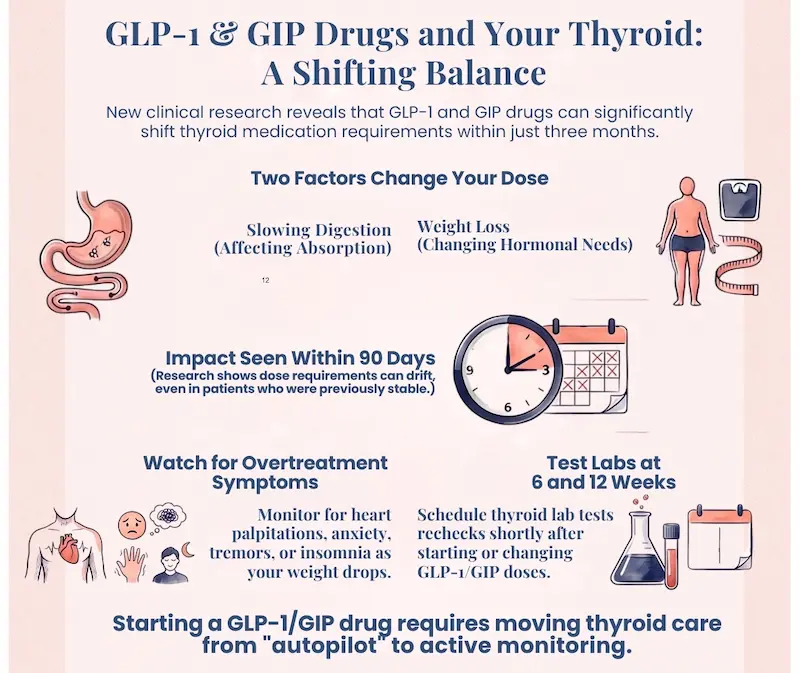
If you're on or starting thyroid medication and are starting or already taking a GLP-1 or GIP medication, here's how to protect your thyroid treatment along the way.
- Tell all your prescribers about both medications. Your thyroid provider and your weight-management or diabetes provider each need the full picture, especially if they're in different practices.
- Get a baseline thyroid panel done close to when you start the GLP-1 or GIP medication, if you haven't had labs recently.
- Plan a recheck at four to six weeks, and again around three months, since that's the window the current research covers — learn how dose adjustments typically work.
- Track symptoms in both directions. Note new palpitations, anxiety, or sweating as carefully as you'd note fatigue or brain fog returning.
- Don't adjust your medication dose on your own, even if you're confident about what's happening. Overtreatment and undertreatment both carry real risks.
- Keep your thyroid medication timing consistent. Take it the same way, at the same time, relative to food and other medications, so your labs reflect a stable pattern—review how to take thyroid medication correctly.
- Ask about nutrient status if your appetite drops sharply. Reduced intake on a GLP-1 can affect more than your thyroid dose—B-12 and other nutrient levels are worth checking too.
- If you're considering starting a GLP-1 and your hypothyroidism isn't yet well controlled, talk with your provider about sequencing — read more on how to think through the timing.
Navigating two interacting medications shouldn't fall entirely on you. Paloma Health's clinicians can prescribe and manage both thyroid hormone replacement and GLP-1 or GIP therapy as part of one coordinated weight-management plan, rather than leaving you to sync up two separate providers on your own. Because thyroid medication dosing depends on accurate, current labs, Paloma's at-home thyroid testing makes it simple to recheck TSH, free T4, and free T3 as often as your treatment plan calls for, without a separate lab visit every time your GLP-1 dose changes.
If you're already on thyroid medication and thinking about starting a GLP-1 — or you've recently started one, and something feels off — a Paloma clinician can review your labs, adjust your dose, and keep both parts of your treatment working together instead of against each other.

Will a GLP-1 medication definitely change my thyroid dose?
Not necessarily—some people see no meaningful change at all. But research shows it's common enough that your provider should plan to recheck your labs rather than assume nothing has shifted.
How soon after starting a GLP-1 should I get my thyroid levels checked?
Many clinicians recommend a check around four to six weeks after starting or changing the dose of a GLP-1 or GIP medication, with a follow-up around three months. That timeline matches the window used in the most recent research on this topic.
Can GLP-1 drugs cause thyroid cancer?
The boxed warning on GLP-1 medications is based on rodent studies of a rare cancer called medullary thyroid carcinoma, and it mainly applies to people with a personal or family history of that condition. It isn't related to common hypothyroidism or to the dose-adjustment issue discussed in this article.
Is it safe to take a GLP-1 if I have Hashimoto's?
Many people with Hashimoto's use GLP-1 or GIP medications safely under medical supervision. Research suggests the thyroid response may look somewhat different in autoimmune thyroid disease than in non-autoimmune cases, which is another reason to monitor labs closely rather than assume your experience will match someone else's situation.
Why did my TSH drop even though I haven't changed my thyroid medication dose?
Weight loss and slowed digestion from a GLP-1 or GIP medication can both change how much thyroid hormone your body needs and how much of your current dose gets absorbed. A dropping TSH on an unchanged dose is one of the most common early signs that your thyroid medication dose may need to come down.
Should I take my thyroid medication and GLP-1 at different times of day?
There's no universal rule, but consistency matters more than the exact timing you choose. Talk with your provider about a schedule you can stick to every day, since irregular timing makes it harder to interpret your lab results.
Will losing weight quickly on a GLP-1 mean I need less thyroid medication?
It's possible, since thyroid medication dosing is partly weight-based, but it isn't automatic. Your provider will look at your actual thyroid test results rather than adjusting your dose by weight alone.
Does tirzepatide affect the thyroid differently than semaglutide?
Both drug classes slow digestion and drive weight loss, which researchers believe drives the thyroid medication-dosing shifts. Case reports and studies to date describe similar patterns with both semaglutide and tirzepatide, though tirzepatide's added GIP activity is still being studied.
What symptoms mean I should call my doctor right away?
New heart palpitations, a noticeably racing pulse, tremor, or significant unexplained sweating after starting a GLP-1 or GIP medication are worth a prompt call, since these can signal overtreatment with thyroid hormone. Don't wait for your next scheduled appointment if symptoms feel sudden or severe.
Can Paloma prescribe both my thyroid medication and a GLP-1?
Yes — Paloma clinicians can manage thyroid medication and GLP-1 or GIP therapy together as part of one coordinated plan. That includes at-home lab testing, so your thyroid dose can be adjusted promptly as your weight and treatment change.


