



.webp)
In this article
Turning 40 comes with a quiet shift. Maybe your energy isn't what it used to be. Maybe the number on the scale keeps creeping up despite doing everything “right.” Maybe your annual physical starts to feel more like a formality than a real check-in on your health.
Here's the thing: your body is changing in ways a basic checkup often doesn't identify. Between perimenopause, shifting metabolism, and the way thyroid symptoms mimic “just getting older,” a lot goes undetected in your 40s and 50s unless you know which tests to ask for.
Below are seven blood tests worth discussing with your doctor — including a few your provider might not order unless you specifically ask.
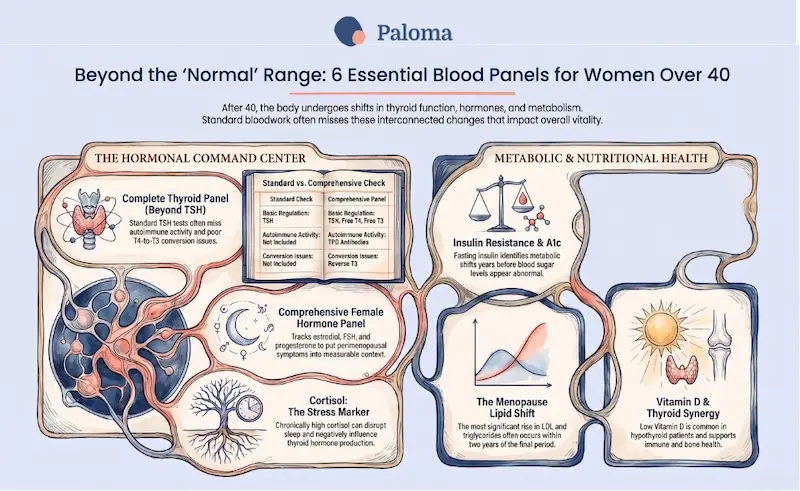
If you take away just one thing from this article, let it be this: a TSH test alone is not the whole story. Many doctors rely solely on thyroid-stimulating hormone (TSH) to screen for thyroid problems, but screening for both subclinical hypothyroidism and hyperthyroidism is typically accomplished through TSH testing, with follow-up testing of free T4 if TSH is high, and free T3 as well as free T4 if TSH is low. That means a full picture requires more than one number.
Thyroid peroxidase (TPO) antibodies deserve special attention too. A high TSH combined with a low free T4, positive TPO antibodies, and a doubling of TSH on follow-up testing are all risk factors for progression to overt hypothyroidism — which is exactly why identifying autoimmune thyroid activity early matters, sometimes years before TSH itself becomes abnormal.
Reverse T3 also helps identify poor T4-to-T3 conversion, and other challenges in thyroid function.
Why this matters more after 40: thyroid dysfunction becomes significantly more common in midlife, and its symptoms — fatigue, weight gain, brain fog, hair thinning, mood changes — overlap heavily with normal aging and perimenopause. That overlap is precisely why so many women go undiagnosed for years. If you want to understand each marker in more depth, this guide on what's included in a full thyroid panel breaks down what TSH, Free T3, Free T4, and TPO antibodies each measure and why. You can also read more about the recommended tests for a hypothyroidism diagnosis if you suspect something's off.
A note on “normal” ranges: Lab reports show you a reference range, but reference ranges are population averages — not a reflection of the optimal range where you feel best. It's entirely possible to fall within the “normal” range and still be completely out of balance.
Get tested
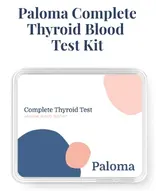
Paloma Health offers the Complete Thyroid Blood Test Kit, a convenient CLIA-certified home kit. tests:
- TSH
- Free T4
- Free T3
- Thyroid Peroxidase Antibodies (TPO)
- Reverse T3 (available as an add-on test)
https://www.palomahealth.com/home-thyroid-blood-test-kit

You can also order a JustLabs Complete Thyroid Panel at affordable direct-to-consumer prices, and have your blood drawn at a local Quest Labs location. This panel includes:
- TSH
- Free T4
- Free T3
- Thyroid Antibodies
- Reverse T3
https://justlabs.health/tests/panel/panel-thyroid-complete

Perimenopause doesn't arrive with an announcement. It creeps in through subtle shifts — a period that's suddenly heavier or lighter, sleep that doesn't come as easily, moods that swing without warning. A hormone panel measuring estradiol, follicle-stimulating hormone (FSH), and progesterone can help put those changes in context, even though perimenopause is ultimately a clinical diagnosis based on symptoms and menstrual history rather than a single lab value.
As estrogen production declines in the years leading up to menopause, the drop in estradiol triggers metabolic changes that raise the risk of dyslipidemia, obesity, insulin resistance, and other downstream effects like diabetes and hypertension. In other words, the hormone shifts you're feeling aren't “just in your head” — they have measurable ripple effects throughout the body.
This transition is also where thyroid health and reproductive hormones start to overlap in complicated ways. If you're hypothyroid, low thyroid hormone levels can significantly impact the experience of perimenopause, since thyroid hormones play a direct role in regulating reproductive function. For a deeper look at how the two intersect, Preparing for Perimenopause When You're Hypothyroid is a helpful place to start, and if you're unsure whether what you're feeling is early perimenopause, thyroid dysfunction, or both, Paloma's guide to hypothyroidism and menopause care walks through how the two conditions can be distinguished and managed together.
Get tested
You can order a JustLabs Female Hormonal Panel, including tests for Estradiol, Progesterone, FSH, LH, Testosterone (Free & Total), DHEA-S.
https://justlabs.health/tests/panel/panel-hormone-female
Cholesterol numbers that held steady for years can start climbing in your 40s — and it's not always about diet. Estrogen plays a protective role against heart disease, and as it declines, that heart health protection fades. Research following women through the menopause transition has found that:
“The shift toward lower estrogen is associated with increases in total cholesterol, LDL cholesterol, and triglycerides, alongside unfavorable changes in HDL cholesterol.”
~ Lipid metabolism in women, 2025
Notably, this isn't a gradual process that unfolds over a decade. Longitudinal research shows that the most significant changes in LDL, ApoB, and triglycerides tend to occur within about two years surrounding a woman's final menstrual period, meaning cholesterol can shift relatively quickly during the menopause transition.
Thyroid function adds another layer here. Paloma has covered this connection in depth: there's a well-established link between thyroid disease and high cholesterol, and even TSH levels on the higher end of “normal” can nudge cholesterol upward. Getting a lipid panel alongside thyroid labs gives you and your doctor a much clearer read on your heart disease risk going into your 50s.
Get tested
You can order a JustLabs Heart Health panel, including:
- A Full Lipid Panel
- ApoB
- Lp(a
- Homocysteine
- hs-CRP
https://justlabs.health/tests/panel/panel-heart-health
Blood sugar regulation tends to become less efficient with age, and the hormonal shifts of perimenopause don't help. An A1c test reflects your average blood sugar over roughly three months, making it useful for spotting trends that a single fasting glucose reading might miss on any given day. It can also spot early signs of insulin resistance or metabolic syndrome, conditions that increase your risk for type 2 diabetes.
This panel goes beyond a routine glucose check — it's designed to identify the slow, silent shift toward insulin resistance that often drives stubborn, diet-resistant weight gain in your 40s and 50s.
Fasting insulin looks at something A1c can miss entirely. You can have a completely normal fasting glucose and A1c for years while insulin resistance quietly builds in the background — your pancreas compensates by producing more insulin to keep glucose in range. That compensation doesn't show up on a standard glucose or A1c test. This matters enormously in midlife: in a study of over 3,000 postmenopausal women, insulin resistance and insulin concentrations were independent predictors of weight gain, even in women who hadn't changed their diet or activity levels.
"Measuring fasting insulin alongside glucose, lipids, and waist circumference can help identify women at higher risk for glucose intolerance, metabolic syndrome, and diabetes" before those conditions fully develop.”
~ Menopause Journal
The pattern shows up even in women who aren't classified as overweight. That same study found that among postmenopausal women reporting a moderate weight gain of roughly 9 kg, nearly 18% had elevated insulin levels compared to women with stable insulin levels.
Together, A1c and fasting insulin give a fuller picture than either test alone: one shows where your blood sugar has been trending over months, the other flags the compensatory insulin response before it shows up in glucose numbers at all.
For women managing hypothyroidism, this panel is doubly relevant, since an underactive thyroid and insulin resistance can compound each other — both slowing metabolism and making weight loss feel like an uphill climb. If weight has felt stuck despite your best efforts, this Paloma article on hormone replacement therapy, tirzepatide, and weight loss after menopause explores how thyroid health, menopausal hormones, and metabolic function interact — and why addressing them together tends to work better than tackling any one in isolation.
Get tested
You can order a JustLabs Insulin Resistance Panel, including:
- Fasting Glucose
- Fasting Insulin
- HbA1c
- C-Peptide
- Comprehensive Metabolic Panel
https://justlabs.health/tests/panel/panel-insulin-resistance
Vitamin D deficiency is remarkably common, and women in midlife are especially likely to be affected. It plays a role in far more than bone health: it's tied to immune function, mood, and — notably for Paloma readers — thyroid health. Vitamin D deficiency during the menopausal transition may aggravate health risks like osteoporosis, sarcopenia, and cardiovascular disease, all of which become more relevant as estrogen declines.
There's also a specific thyroid connection worth knowing about. Studies have found that hypothyroid patients often have low serum vitamin D levels, which may contribute to musculoskeletal complaints, and some research suggests vitamin D3 supplementation may help lower elevated TSH levels in people with thyroid dysfunction. Vitamin D also appears to interact with the body's stress response — vitamin D receptors are found throughout stress-responsive regions of the brain, and evidence suggests vitamin D signaling helps regulate cortisol through the hypothalamic-pituitary-adrenal (HPA) axis, tying it indirectly to test #7 on this list.
If you're already ordering thyroid labs, Vitamin D is worth adding to the same draw. Paloma's at-home thyroid test kit allows you to add on a Vitamin D test without an extra blood draw.
Get tested
Paloma Health offers a Vitamin D test as an add-on to the Complete Thyroid Blood Test Kit.
https://www.palomahealth.com/home-thyroid-blood-test-kit
You can order a JustLabs Vitamin D Blood Test (25-Hydroxy).
https://justlabs.health/tests/vitamin-d
Cortisol, often called the “stress hormone,” is produced by your adrenal glands in response to physical and emotional stress. Chronically elevated cortisol has been linked to changes in how the body stores fat, disrupted sleep, and shifts in appetite — all of which can compound the hormonal changes already happening in your 40s.
There's a thyroid connection here too. A 2016 study found that people with Hashimoto's had higher cortisol levels, though the exact relationship between cortisol and autoimmune thyroid disease is still being debated by researchers. Cortisol can be measured through blood, saliva, or urine testing, and your doctor can help determine which method makes sense for your symptoms.
If refined sugar and processed foods are a regular part of your diet, it's worth knowing that excess refined sugar can trigger insulin spikes that prompt the adrenal glands to release cortisol, which in turn can affect thyroid hormone production — one more example of how these seven tests aren't really separate stories, but interconnected chapters of the same one.
Get tested
You can order a JustLabs Cortisol test.
https://justlabs.health/tests/cortisol-total
The above tests dig into hormones and metabolic health, but they're only part of the picture. A handful of other health screenings become especially important once you hit your 40s — not because something is necessarily wrong, but because spotting changes via early preventive screening gives you far more options.
- PAP test — Screens for abnormal cervical cell changes before they become cervical cancer. Guidelines on frequency shift as you age (and may change further if you've had a hysterectomy), so this is a good one to review with your doctor rather than assume you've "aged out" of needing it.
- Blood pressure check — Estrogen has a protective effect on blood vessels, so as levels decline during perimenopause and menopause, blood pressure often creeps up — sometimes without any symptoms at all. Regular checks catch this shift early, since high blood pressure is a major driver of heart disease and stroke risk.
- Colorectal cancer screening — Risk rises with age, and colorectal cancer often develops silently for years before symptoms appear. Screening (colonoscopy or an at-home stool-based test, depending on your risk profile) can catch precancerous polyps before they ever become cancer.
- Bone density scan (DEXA) — Estrogen helps maintain bone density, so bone loss can accelerate quickly in the years around menopause. A DEXA scan establishes a baseline and flags osteopenia or osteoporosis early, while there's still time to intervene through diet, exercise, or medication.
- Mammogram — Breast cancer risk increases with age, and mammograms remain the most effective screening test for catching it early, often before a lump is felt in a clinical breast exam or self-check. This is especially worth prioritizing if you have a family history or other risk factors.
- Hearing and vision check — Both tend to decline gradually enough that it's easy to adjust without noticing — until the change is significant. Regular checks can find hearing and vision problems, and they matter more than people realize: untreated hearing loss in particular has been linked to cognitive decline and social isolation later in life.

If any of this feels overwhelming, you're not alone — and you don't have to sort through it by yourself. Paloma Health was built specifically for the reality that thyroid health, perimenopause, menopause, and hormonal weight gain rarely show up one at a time. They tend to arrive together, tangled up in overlapping symptoms that are easy for a rushed 15-minute appointment to miss.
Paloma's at-home thyroid test kit measures TSH, Free T3, Free T4, and TPO antibodies — the full picture, not just the single marker many standard panels rely on — with the option to add on Vitamin D or Reverse T3 from the same sample. From there, Paloma's knowledgeable physicians and health care providers review your results and work with you to build a treatment plan tailored to your symptoms and history, not just where your numbers fall on a chart.
Paloma's care model also recognizes that thyroid conditions, perimenopause, and menopause are deeply intertwined — which is why the practice offers dedicated support for menopause and hypothyroid care together, including guidance on how hormone replacement therapy and thyroid medication doses may need to shift in relation to each other. And for women whose weight has felt stuck despite real effort, Paloma's providers can help untangle whether thyroid function, insulin resistance, menopausal hormone changes, or some combination of the three is driving the plateau — because guessing shouldn't be the only option.
Whether you're newly noticing symptoms or have been managing a diagnosis for years, the right tests are the starting point for getting real answers instead of being told your labs are “normal.”

Which blood test should I ask for first if I only get one?
A full thyroid panel — TSH, Free T4, Free T3, and TPO antibodies — is a strong starting point, since thyroid symptoms overlap so heavily with normal aging and perimenopause. It's one of the most commonly missed pieces of the puzzle in women over 40.
Can perimenopause be confirmed with a blood test alone?
Not fully. Hormone levels like estradiol and FSH fluctuate day to day during perimenopause, so diagnosis relies mainly on your symptoms and menstrual history, with bloodwork used to add context rather than to confirm the diagnosis outright.
Why would my doctor test fasting insulin instead of just fasting glucose?
Fasting glucose can stay in a normal range for years even as insulin resistance quietly develops in the background. Fasting insulin, especially combined with glucose to calculate HOMA-IR, can spot that shift earlier.
Is it normal for cholesterol to rise during menopause even if my diet hasn't changed?
Yes, this is a well-documented pattern. Declining estrogen affects how your body processes and clears cholesterol, so LDL and triglycerides can rise even without any change in eating habits.
How often should women over 40 get these blood tests?
Many providers recommend annual testing for thyroid, lipids, and blood sugar markers. However, your doctor may suggest more frequent monitoring if you have symptoms, an existing diagnosis, or a family history of thyroid or metabolic conditions.
Can hypothyroidism actually cause weight gain, or is that a myth?
It's not a myth — an underactive thyroid slows metabolism, which can make weight gain more likely and weight loss more difficult, even without major changes to diet or activity.
Why does my doctor only test TSH instead of a full thyroid panel?
Many standard panels default to TSH because it's typically a sensitive early marker. Still, TSH alone can miss thyroid antibody activity or shifts in Free T3 and T4, which is why a fuller panel gives a more complete picture.
Does vitamin D deficiency actually affect thyroid function?
Research has found that people with thyroid dysfunction often have lower vitamin D levels, and some studies suggest correcting a deficiency may help support healthier TSH levels. However, it isn't a standalone treatment.
I feel exhausted all the time, but my doctor says my labs are normal — what should I do?
Ask specifically which thyroid markers were tested, since “normal” TSH alone doesn't rule out thyroid dysfunction, and consider asking about a fuller panel along with vitamin D, iron, and blood sugar markers.
Can stress really affect my hormone test results?
Yes. Chronic stress raises cortisol, which can influence blood sugar, thyroid function, and even how hormone levels present on a test, so it's worth mentioning ongoing stress to your doctor when reviewing results.

%20(1).webp)
%20(1).webp)
%20copy.webp)
%20(1).webp)


