





This article was written in partnership with Bummed, the first digital health platform focused exclusively on anorectal health, providing telehealth access to prescription treatment for hemorrhoids, anal fissures, and constipation. Medical reviewer Dr. Carmen Fong, MD, FACS, FASCRS, is a board-certified colorectal surgeon, Chief Medical Officer at Bummed, and author of Constipation Nation: What to Know When You Can't Go.
In this article
If going to the bathroom suddenly feels like passing broken glass, you're not alone, and you're not imagining it.
That sharp, tearing pain is often an anal fissure. The backstory is almost always the same: stools got hard, pushing got harder, and something gave. If you have hypothyroidism, that story may sound familiar. A slow thyroid can mean a slow gut, and a slow gut is one of the most common setups for a fissure.
Here's how the two are connected, what a fissure feels like, and what actually helps it heal.
An anal fissure is a small tear in the thin, sensitive skin that lines the anal canal. It's often just a few millimeters long, but that skin is packed with nerve endings, so even a tiny tear can hurt a lot. Most fissures sit at the back, toward the tailbone, where blood flow is naturally lower.
Fissures come in two types:
- Acute fissures are new, usually a few weeks old. Many heal on their own once stools soften.
- Chronic fissures last longer than about 8 weeks or keep coming back. They may form a small skin tag, called a sentinel pile, at the edge of the anus.
Fissures are often mistaken for hemorrhoids, since both can hurt and bleed. Here's a quick guide to the difference between hemorrhoids and anal fissures.
How common are anal fissures?
Very. A large US population study estimated about 342,000 new fissures are diagnosed in the US every year. That's a lifetime risk of roughly 1 in 13. Rates peak in young women and middle-aged men, and the true number is likely higher, since many people treat a fissure at home or write it off as a hemorrhoid.
The signs of an anal fissure are usually hard to miss:
- Sharp, cutting pain during a bowel movement. Many people compare it to passing glass or a razor blade.
- Burning or throbbing afterward that can last minutes to hours.
- Bright red blood on the toilet paper or the surface of the stool, usually just a little.
- A tight, spasming feeling in and around the anus.
- Itching, irritation, or a small skin tag near the tear.
Because it hurts so much to go, many people start holding it in. That makes the next stool harder and the spasm tighter, which is exactly how a small tear turns into a stubborn one.
Always mention rectal bleeding to a provider. Learn more about whether constipation can cause rectal bleeding.
Hypothyroidism means your thyroid isn't making enough hormone. Since thyroid hormone sets the pace for nearly every cell, low levels slow down your energy, metabolism, and digestion. In the US, the most common cause is Hashimoto's, an autoimmune condition that gradually damages the thyroid.
Hypothyroidism symptoms can creep in slowly and are easy to blame on stress or age. Common signs include:
- Fatigue that sleep doesn't fix
- Constipation and bloating
- Feeling cold when everyone else is comfortable
- Dry skin, brittle nails, and thinning hair
- Weight gain or trouble losing weight
- Brain fog, low mood, or depression
- Achy muscles and joints, and heavier or irregular periods
A blood test confirms it. High TSH with low free T4 (and sometimes low Free T3) means overt hypothyroidism, while a mildly high TSH with normal free T4 and free T3 is called subclinical hypothyroidism. A full panel also checks free TPO antibodies, the marker for Hashimoto's. You can test all four at home with Paloma's thyroid test kit.
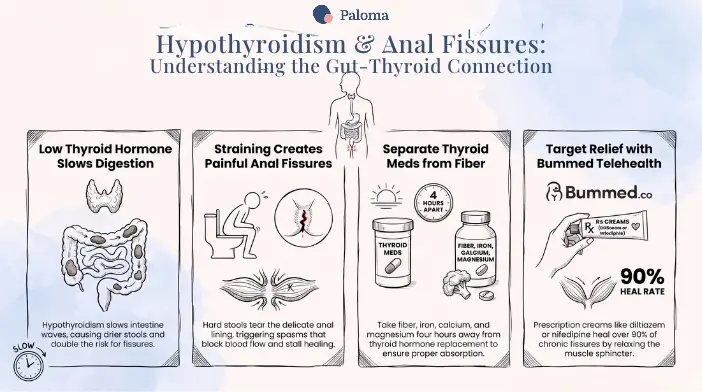
When thyroid levels run low, your gut can slow down too. That's why constipation is a common symptom of hypothyroidism, and one of the surprising ways thyroid disease can show up. Here's how a slow thyroid can lead, step by step, to a tear.
1. The gut slows down
Your intestines move stool along in steady muscular waves. Low thyroid hormone can weaken those waves. A 2024 review in Frontiers in Physiology notes that constipation is a frequent sign of hypothyroidism, and that gut problems are sometimes the only clue a thyroid issue exists. In rare, severe cases, an earlier review found the bowel can slow almost to a standstill.
2. Stools get hard and dry
The longer stool sits in the colon, the more water your body pulls out of it. The result is harder, drier, bulkier stool.
3. Straining stretches the lining
Hard stool takes more pushing, and that force, plus the stretch of a large stool, can split the delicate anal lining.
4. The pain-spasm cycle keeps it open
Once there's a tear, the internal anal sphincter (the ring of muscle you don't control) clamps down in response to the pain. That squeezes off blood flow, so the tissue heals slowly, and the next hard stool reopens the wound.
Breaking that cycle is the whole goal of treatment: softer stools on one side, a more relaxed sphincter on the other. This step-by-step healing guide explains why each step matters.
Hypothyroidism can affect your gut in other ways, too, including changes to your gut microbiome and bloating. Paloma's guide to the gastrointestinal effects of Hashimoto's covers the full picture, and this guide shows how to improve gut motility day to day.
The US population study compared people with fissures to similar people without them. Three conditions stood out:
- Hypothyroidism: 14.7% vs. 10.4%
- Chronic constipation: about 14% vs. under 4%
- Obesity: 13.0% vs. 7.7%
A smaller 2019 study from India checked thyroid levels in fissure patients directly and found hypothyroidism in 32%, well above typical population rates.
These studies show a link, not proof that one causes the other. Not everyone with hypothyroidism gets constipated, and a Korean study found little difference in gut transit time by thyroid status. Constipation is likely the bridge between the two. Still, the pattern matches what colorectal surgeons see every day. If your constipation is new or getting worse, it's worth checking your thyroid levels instead of blaming your diet.
A slow thyroid is rarely the only factor. Watch for these, too.
- Perimenopause and menopause. Thyroid and menopause symptoms often blur together, and midlife pelvic floor changes can make it harder to empty without pushing. Paloma explores the link between hemorrhoids, hypothyroidism, and menopause.
- Pregnancy and postpartum. Hormone shifts, iron pills, and childbirth all raise fissure risk, and thyroid needs often change. Here's what to monitor in early pregnancy.
- Iron and calcium supplements. Both are common for thyroid patients, and both can be constipating. Ask your provider about a gentler form or dose.
- GLP-1 weight-loss drugs. Medications like semaglutide and tirzepatide slow digestion. If you're considering one, read Paloma's GLP-1 overview and plan ahead to manage digestive changes.
- An undertreated thyroid. If your dose isn't right, constipation may linger. A thyroid doctor can help, and Paloma's thyroid medication guide explains your options.
Here's a tip many thyroid patients have never heard. According to a systematic review, fiber, iron, calcium, coffee, and soy can all reduce how much thyroid hormone replacement your body absorbs if you take them too close together. Magnesium can, too.
- Take thyroid medication on an empty stomach, as directed.
- Space iron, calcium, and magnesium about 4 hours away from it.
- Keep fiber supplements well apart from your dose, and take them at the same time each day.
- If you change your fiber intake a lot, make sure you recheck your levels.
The goal isn't to skip fiber. It's to keep both your medication and your bowels working. For more, see magnesium and thyroid health and 6 things that can affect your thyroid medication.
Usually in one quick, gentle visit, with no scope or imaging needed. Your provider will ask about your pain, bleeding, bowel habits, and medications, including thyroid medication, iron, and calcium. Most of the time, they can see the tear just by gently parting the skin. A full internal exam is often put off until the area calms down.
More testing, such as a colonoscopy, may be needed if a fissure is off to the side, you have more than one, it won't heal, or you have heavy or unexplained bleeding. These can point to Crohn's disease or an infection, as the ASCRS guidelines note. If you have thyroid symptoms, ask for a thyroid panel too.
Not sure if it's a fissure, a hemorrhoid, or both? Bummed's symptoms quiz is a good place to start.
Most new fissures heal once stools are soft and you stop straining. In fact, ASCRS guidelines note that sitz baths and fiber alone resolve about half of acute fissures. Use these steps consistently for 2 to 3 weeks.
Soften your stools
- Build fiber up slowly to 25 to 35 grams a day from beans, berries, oats, pears, and vegetables. Try our list of high-fiber foods for constipation and cut back on foods that make it worse.
- Add a supplement if needed. Psyllium is a good start. Here's how to pick the best fiber supplement, spaced away from your thyroid hormone replacement medication.
- Drink more water. Fiber needs fluid to work.
- Use a stool softener or osmotic laxative short-term if stools stay hard. Here's what to know about stool softeners for fissures.
- Get support. Paloma's thyroid nutritionists can help you build a high-fiber, thyroid-friendly plan.

Change how you go
- Go when you feel the urge. Holding it in dries out your stool.
- Don't strain or linger. Keep it under 5 minutes, and leave your phone outside.
- Use a footstool or a “squatty potty.” Knees above hips straighten the path and reduce pushing.
- Be gentle. Pat with soft, unscented paper or rinse with water.
Soothe the area
- Take warm sitz baths for 10 to 15 minutes, especially after bowel movements, to relax the sphincter and ease pain. Here are more sitz bath benefits.
- Protect the skin with a thin layer of petroleum jelly to reduce friction.
- Use a numbing cream briefly if your provider OKs it. Lidocaine eases pain but doesn't heal the tear.
For more, see our guides to home remedies for anal fissures and how to heal an anal fissure.

When home care isn't enough, prescription creams are the next step, and they work for most people. They break the pain-spasm cycle so the tear can finally heal. The ASCRS guidelines recommend calcium channel blocker creams like diltiazem and nifedipine as a first-line option for chronic fissures, since they work as well as nitroglycerin with fewer side effects.
Diltiazem cream
Diltiazem relaxes the internal sphincter and restores blood flow to the tear. It's applied 2 to 3 times a day for several weeks. In one clinical trial, it healed about 92% of chronic fissures within 6 weeks, compared with 60% for nitroglycerin. An earlier British Journal of Surgery study found it healed 75% of chronic fissures by lowering pressure in the anal canal. Learn more about diltiazem cream, how to apply it, and why it's often tried before a procedure.
Nifedipine cream
Nifedipine works the same way and is often combined with lidocaine for pain relief. In a randomized trial, 94.5% of chronic fissures healed after 6 weeks, versus 16.4% with a standard numbing cream. Most people in that study were pain-free within 3 weeks, and few saw the fissure return. Here's more on nifedipine ointment and a complete nifedipine cream guide.
Nitroglycerin ointment
Nitroglycerin (sold as Rectiv, with a lower-cost generic) also relaxes the sphincter and works well, but headaches are a common side effect that lead some people to stop. See how fissure ointments compare.
When creams aren't enough
For chronic fissures that don't respond, a colorectal surgeon may suggest Botox injections or a minor procedure called a lateral internal sphincterotomy. A Cochrane review found surgery heals more chronic fissures, but creams carry no risk of incontinence, which is why most people start there. Most never need a procedure. Compare the best treatments for anal fissures and fissure creams.
Bummed providers can prescribe compounded fissure creams after a short online visit, shipped discreetly to your door:
- Long-Acting Hemorrhoid & Fissure Rx Cream, made with diltiazem and appropriate during breastfeeding
- Sensitive Care Hemorrhoid & Fissure Cream, made with nifedipine and appropriate during pregnancy
If constipation is the root problem, treating it matters just as much. Bummed also offers prescription lactulose and lubiprostone.
Compounded medications are made by a licensed pharmacy and aren't FDA-approved. Here's what that means. Always tell your provider about every medication you take, including your thyroid medication.
Consult with a medical provider before starting any new medications, particularly during pregnancy or while breastfeeding.
Don't tough out a fissure for months. Check in with a provider if:
- Pain or bleeding hasn't improved after 1 to 2 weeks of home care
- Symptoms last 6 to 8 weeks or more, or keep coming back
- You're bleeding more than a streak, or the blood is dark red, maroon, or black
- You have fever, swelling, pus, or a hard, painful lump, which can signal an abscess
- Pain keeps you from passing stool or urine
- Your bowel habits have changed for good, or you've lost weight without trying
- You're 45 or older with rectal bleeding and no recent colonoscopy
If constipation comes with fatigue, feeling cold, weight changes, or dry skin, ask about your thyroid, even if your labs have looked “normal” before.
Most fissures heal with simple changes: more fiber, more water, and less straining. When a tear won't heal, prescription creams work for most people, and surgery is rarely needed.
What people often miss is the bigger picture. Constipation is the common thread between a slow thyroid and a painful tear. If your fissures keep coming back, look at what's slowing your gut, including your thyroid. Paloma offers comprehensive testing and expert thyroid care to help resolve hypothyroidism and related symptoms.
Bummed takes care of what's happening further down. As the first digital health platform focused exclusively on anorectal health, Bummed lets you:
- Meet online with a provider about fissures, hemorrhoids, or constipation, no awkward office visit required
- Get prescription fissure creams, like diltiazem and nifedipine, delivered discreetly
- Treat the constipation behind it when fiber and over-the-counter laxatives aren't enough
New patients can get 15% off treatment at Bummed with code PARTNER15.

Can hypothyroidism cause anal fissures?
It can raise your risk by slowing digestion and causing hard, dry stools, the top cause of fissures. In one large US study, hypothyroidism was more common in people with fissures (14.7%) than in those without (10.4%).
Why does hypothyroidism cause constipation?
Thyroid hormone helps control how fast your intestines move stool along. When levels are low, things slow down, so stool stays in the colon longer and gets harder and drier.
How long does an anal fissure take to heal?
Many new fissures heal within a few weeks with fiber, water, sitz baths, and less straining. A fissure lasting longer than about 8 weeks is considered chronic and usually needs a prescription cream.
Can I take a fiber supplement if I'm on thyroid medication?
Yes, but timing matters, since fiber, calcium, iron, and magnesium can reduce thyroid medication absorption. Take your medication as directed and keep supplements well apart from it.
Is it an anal fissure or a hemorrhoid?
A fissure usually causes sharp pain during a bowel movement and burning afterward, while hemorrhoids are more likely to itch, swell, or bleed painlessly. You can have both, so it's worth getting checked.
What's the best prescription cream for an anal fissure?
Calcium channel blocker creams, like diltiazem and nifedipine, are a recommended first-line option. In clinical trials, they healed more than 90% of chronic fissures within 6 weeks.
Is bright red blood on toilet paper an emergency?
A small amount is common with fissures and hemorrhoids, but it should still be checked. Seek urgent care for heavy bleeding, dark or tarry stools, dizziness, or fever.
Will treating my thyroid help my fissure heal?
If hypothyroidism is behind your constipation, optimizing your dose may make stools easier to pass and lower your risk of new tears. Most people also need direct fissure care, like sitz baths and creams, to heal fully.
Can I get anal fissure treatment through telehealth?
Yes. Bummed providers can evaluate most fissures online and prescribe compounded creams, though unusual or nonhealing fissures still need an in-person exam.
Will I need surgery for an anal fissure?
Most people don't need surgery, since home care and prescription creams heal most fissures. Botox or a minor procedure is reserved for chronic fissures that don't respond to creams.
- Anal fissures are small tears in the anal lining, with a lifetime risk of about 1 in 13.
- Hard stools and straining are the most common causes.
- Hypothyroidism can slow the gut and is more common in people with anal fissures.
- Fiber, water, sitz baths – and not straining – heal many new fissures within weeks.
- If you take thyroid medication, space fiber, iron, calcium, and magnesium away from your dose.
- Prescription creams like diltiazem and nifedipine relax the sphincter so chronic fissures can heal.
- Managing your thyroid and treating constipation helps keep fissures from coming back.


