



.webp)
In this article
- Your body runs on a clock — and that clock matters
- What the research found: Morning vs. afternoon exercise
- The “Dawn Phenomenon”
- If you have Hashimoto's disease
- If you have hypothyroidism
- If you are in perimenopause or menopause
- If you are struggling with hormonal weight gain
- Beyond the lab: Fat loss and peak performance
- What's still unknown — and why it matters
- A note from Paloma
- Frequently asked questions
For decades, fitness culture has celebrated the early riser. Five-AM workouts, sunrise runs, the pride of a morning gym check-in — the message has been clear: get it done first thing. But a major new review published in 2026 in the journal Trends in Endocrinology & Metabolism challenges that assumption with rigorous science, and the implications ripple outward far beyond the world of competitive sport.
The research, conducted at the University of Copenhagen and Karolinska Institute, synthesizes evidence from dozens of observational and clinical studies to reach a striking conclusion: for people whose metabolism is already under stress — including those with type 2 diabetes, obesity, or disrupted hormonal rhythms — exercising in the afternoon or early evening produces significantly better outcomes for blood sugar control, insulin sensitivity, and cellular energy function than the same exercise performed in the morning.
Your body runs on a clock — and that clock matters
At the heart of this research is the body’s circadian cycle: the internal 24-hour biological clock that governs virtually everything your body does. Your circadian rhythm doesn't just tell you when to sleep. It orchestrates when your cells burn fuel, how sensitive your tissues are to insulin, when your immune system ramps up inflammation, and how efficiently your mitochondria — the power generators inside every cell — produce energy.
In healthy people, this system hums along in synchrony. Insulin sensitivity peaks in the morning, mitochondria operate at their highest capacity in the afternoon and evening, and cortisol (your stress hormone) follows a clean arc: highest at dawn to mobilize your energy, and tapering off by afternoon.
But in people with type 2 diabetes — and in those with related metabolic disruption — these rhythms are blunted or inverted. The changes in skeletal muscle are dampened. Mitochondrial function loses its day-night rhythm. Insulin resistance is paradoxically at its worst in the morning, meaning the body is least equipped to handle a glucose surge when it first wakes up. The researchers describe this as circadian misalignment — a state in which the body's internal systems are out of sync with each other and with the external environment.
What the research found: Morning vs. afternoon exercise
The review synthesizes evidence from multiple rigorous intervention studies. The findings consistently point in the same direction for people with metabolic disruption.
Morning high-intensity exercise
- Blood glucose levels remain unchanged or elevated after exercise
- Elevated cortisol drives the liver to release more glucose
- Insulin sensitivity is at its daily low — glucose is harder to clear
- Inflammatory markers like C-reactive protein (CRP) are higher
- Mitochondrial function is at its daily peak
- Little improvement in hemoglobin A1C (HbA1c), a long-term marker for glucose levels
Afternoon high-intensity exercise
- Blood sugar levels consistently reduced after exercise
- Lower cortisol means less liver glucose dumping
- Insulin sensitivity at its daily peak — glucose is cleared efficiently
- Inflammatory markers are lower and more stable
- Mitochondria are at peak oxidative capacity
- Significant improvements in HbA1c over weeks to months
One study found that 12 weeks of afternoon (but not morning) cycling and strength training produced measurable increases in peripheral insulin sensitivity and reductions in fasting blood glucose. Another showed that a single afternoon high-intensity interval training (HIIT) session did not raise post-exercise glucose levels. In contrast, the same session in the morning did, elevating glucose for 2 hours afterward.
Data tracking tens of thousands of people corroborated these findings: those who performed moderate-to-vigorous activity in the afternoon or evening had the lowest risk of cardiovascular disease, all-cause mortality, and diabetes-related complications.
Importantly, the review notes that any exercise is better than none. Low- and moderate-intensity morning movement — a walk, gentle yoga, light stretching — does not appear to worsen blood sugar levels in the same way that high-intensity morning training does. The timing effect is most pronounced for moderate- to high-intensity exercise.
The “Dawn Phenomenon”
While exercise is generally the first line of defense against metabolic disease, one study conducted reveals a startling paradox: when performed in the morning, high-intensity interval training (HIIT) can have an acute, deleterious effect on blood sugar levels.
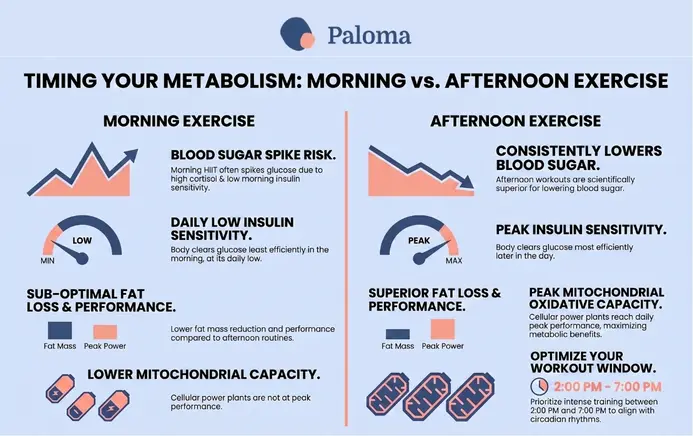
The data paints a clear and concerning picture. In a randomized crossover trial, researchers found that morning HIIT sessions increased the 24-hour average glucose concentration measured by a continuous glucose monitor (CGM) to 6.9. When the same workout was performed at 4:00 pm, glucose levels dropped to a healthier 6.2. This isn't just a temporary spike during the workout; it is a sustained elevation that persists throughout the day.
This metabolic mismatch is driven by the "Dawn Phenomenon." In the early hours, your body’s cortisol levels peak to mobilize energy for the day, signaling the liver to dump glucose into the bloodstream. For those with insulin resistance, the body is already struggling to clear this surge. Adding the massive stress of a HIIT session on top of this cortisol peak compounds the issue, forcing the liver to release even more glucose into a system already oversaturated.
Crucially, this timing also shifts thyroid markers. The study noted that afternoon exercise was associated with elevated TSH level and reduced thyroxine (T4) concentrations, suggesting that the "Afternoon Advantage" isn't just about sugar—it’s about a total systemic recalibration of your metabolic hormones.
If you have Hashimoto's disease

Hashimoto's thyroiditis is an autoimmune condition that gradually impairs your thyroid gland’s ability to produce thyroid hormone. What many people with Hashimoto's don't realize is how deeply the thyroid intersects with your circadian system.
Thyroid hormones regulate the speed of virtually every metabolic process, including the cellular machinery that powers the mitochondria, which this research focused on. When thyroid output is low, mitochondrial function is impaired, and the day-night rhythm of mitochondrial capacity can be further compromised.
People with Hashimoto's also frequently experience elevated inflammation, disrupted cortisol patterns, insulin resistance, and fatigue — all of which map directly onto the metabolic profile described in this research as making morning high-intensity exercise counterproductive.
Practical guidance for Hashimoto's patients
- Consider shifting your moderate- to high-intensity workouts to the afternoon (roughly 2 pm – 7 pm) to align with your body's natural peak in insulin sensitivity and mitochondrial capacity.
- Morning movement is still valuable — a gentle walk, stretching, or yoga is unlikely to trigger the cortisol-driven glucose spike that high-intensity morning exercise can.
- Pay attention to your fatigue patterns: many people with Hashimoto's feel their best in mid-to-late afternoon. This may reflect your natural circadian peaks — scheduling workouts at that time could significantly improve both performance and recovery.
- Discuss exercise timing with your healthcare provider, alongside your thyroid hormone optimization — both factors can work synergistically to improve your energy and metabolic health.
If you have hypothyroidism
Whether caused by Hashimoto's, thyroid surgery, radioactive iodine, or other factors, hypothyroidism creates a metabolic environment strikingly similar to the one this paper describes in type 2 diabetes. Thyroid hormone -- specifically triiodothyronine (T3), the active form -- directly regulates AMPK and SIRT1. These are cellular energy sensors and clock-regulating proteins that were central to this research. Low thyroid hormone dampens these pathways, reducing mitochondrial oxidative capacity and impairing your body's ability to switch cleanly between burning carbohydrates and fats.
The "dawn phenomenon" can be particularly pronounced in hypothyroid individuals, who already have impaired glucose clearance. High-intensity morning exercise under these conditions may compound morning hyperglycemia, contributing to energy crashes, brain fog, and weight resistance that so many hypothyroid patients know all too well.
Practical guidance for hypothyroidism patients
- Shift your hardest workouts — strength training, cardio intervals, high-effort classes — to the afternoon or early evening when possible, ideally between 2 pm and 7 pm.
- If you consistently feel exhausted after morning exercise and struggle to lose weight despite effort, a timing mismatch may be a contributing factor.
- Post-meal afternoon exercise is particularly effective for blood sugar regulation — a 20–30-minute brisk walk after lunch or dinner reduces glucose spikes, and the afternoon advantage makes this an especially powerful habit.
- Ensure your thyroid medication is adequately optimized: even well-timed exercise cannot fully compensate for undertreated hypothyroidism. Ask your doctor about a full thyroid panel, including free T3, and optimized thyroid hormone replacement therapy.
If you are in perimenopause or menopause

The hormonal upheaval of perimenopause and menopause creates a pattern of circadian disruption that closely mirrors what happens in type 2 diabetes. Declining estrogen destabilizes insulin signaling, shifts fat storage toward abdominal fat, impairs mitochondrial function, and disrupts sleep — itself a powerful time-giver that anchors circadian rhythms. Hot flashes and night sweats further disrupt and fragment your sleep, and poor sleep is one of the strongest drivers of circadian misalignment identified in this research.
Practical guidance for perimenopausal and menopausal women
- Prioritize afternoon exercise for higher-intensity efforts — this is when insulin sensitivity and mitochondrial capacity peak, helping counteract the metabolic shifts associated with estrogen decline.
- Strength training in the afternoon is particularly valuable during menopause, as it preserves muscle mass – which is protective against insulin resistance -- and appears to benefit most from the afternoon timing window.
- Address sleep disruption: since poor sleep is a primary driver of circadian misalignment, treating night sweats and sleep disturbance may enhance the benefits of timed exercise.
- If morning is your only practical window, opt for lighter-intensity movement (walking, easy swimming) rather than HIIT or heavy lifting, which are most prone to the cortisol-driven glucose effects discussed in this research.
- Consider discussing your natural body clock—known as your chronotype—with your provider. Research cited in this paper suggests that aligning exercise with your body clock may further enhance your metabolic results.
If you are struggling with hormonal weight gain
One of the most important contributions of this research is its explanation of why conventional weight-loss advice so often fails people with metabolic and hormonal disruption. When your internal clock is misaligned, your body's ability to burn fat efficiently is impaired at the cellular level. Mitochondrial inflexibility — the inability to switch cleanly between burning glucose and burning fat — is a hallmark of the disrupted metabolism described in this paper, and it doesn't respond well to simply eating less and moving more at arbitrary times.
The research offers a concrete, actionable insight: afternoon exercise, particularly at moderate to high intensity, can begin to restore mitochondrial rhythm. One study cited showed that two weeks of afternoon HIIT (but not morning HIIT) increased skeletal muscle mitochondrial content and improved lipid profiles — changes that make the body more capable of burning fat as fuel.
Practical guidance for women with hormonal weight gain
- Reframe your relationship with morning exercise: it is not a failure to skip the 6 am class. For many people with disrupted metabolism, afternoon exercise is biologically more effective.
- Pair afternoon exercise with meals whenever possible. Exercising 30 to 90 minutes after a meal takes advantage of elevated circulating glucose and insulin signaling to maximize fuel burning.
- Prioritize exercise consistency over timing. The research makes it clear that long-term exercise training improves cardiometabolic health regardless of when it is performed. Timing is an optimization, but not a prerequisite.
- Be realistic about your natural body clock. If you are a natural morning person and evening exercise reliably disrupts your sleep, the sleep disruption will harm your circadian health more than the timing benefit helps.
- Consider tracking how you feel: a continuous glucose monitor or simple energy diary can help you observe your own responses to exercise at different times and make genuinely personalized decisions.
Beyond the lab: Fat loss and peak performance
Apart from lab values, the findings underscore results most people are actually looking for: body composition. A 2021 study found that after 12 weeks, the differences in "real-world" outcomes were impossible to ignore!
The "headline" statistic is fat mass. The afternoon exercise group achieved a significant reduction of around 2.65 lbs (1.2 kg), whereas the morning group lost a negligible .4 lbs (.2 kg).
Afternoon exercises also experienced a higher "metabolic afterburn" and a more efficient use of calories. This is the key to overcoming "Mitochondrial Inflexibility"—a hallmark of metabolic damage where the body loses the ability to switch cleanly between burning carbohydrates and fat. Moving your workout to the afternoon helps restore the biological rhythm necessary to flip that fat-burning switch.
.webp)
What's still unknown — and why it matters
The researchers are candid about the gaps in current evidence. Most intervention studies have been conducted in men. Women may respond somewhat differently to exercise timing, and limited data suggest that women maintain better glycemic control across exercise times than men do. This does not mean, however, that timing is irrelevant.
Chronotype — whether you are naturally a morning person or a night owl — has rarely been incorporated into exercise timing studies, despite evidence that aligning exercise with your natural preference may improve results. Still, more research is needed on the effects of exercise timing on long-term reductions in inflammation, mitochondrial restoration, and metabolic flexibility.
What is clear enough to act on now: the timing of exercise is not arbitrary. Your body's internal clock shapes how it responds to physical stress, and working with that clock — not against it — may be one of the most accessible tools available for improving metabolic health! You don't need a new drug, a different diet, or more willpower. You might just need to move your workout a few hours later!
A note from Paloma
The emerging science on exercise timing reinforces a bigger truth: metabolism isn’t just about what you do—it’s about when, how, and in what context your body is functioning. For people dealing with insulin resistance, thyroid dysfunction, perimenopause/menopause, weight loss struggles, or other metabolic challenges, these nuances can make a meaningful difference.
At Paloma Health, we take this complexity seriously. Optimizing metabolic health goes beyond a single intervention, such as exercise timing. It often requires a coordinated approach that includes:
- Comprehensive thyroid testing and personalized treatment to optimize thyroid function
- Metabolic and weight loss support, including GLP-1 medications when appropriate
- Nutrition and lifestyle guidance tailored to your physiology
- Support from clinicians who understand the interplay between hormones, metabolism, and your daily rhythms
If you’re navigating fatigue, weight changes, blood sugar issues, thyroid concerns, or other hormonal imbalances, becoming a Paloma patient gives you access to a team and tools designed to help you connect the dots—and take practical, evidence-based steps toward better metabolic health.
Because when your care is aligned with how your body actually works, small changes can start to deliver bigger results!
.webp)
<h2 id="faqs">Frequently asked questions</h2>
Is it bad to exercise in the morning?
No—any movement is beneficial. The research suggests that high-intensity morning workouts may not be ideal for people with metabolic issues, but light activity like walking or yoga is still a great way to start the day.
Why does afternoon exercise work better for metabolism?
In the afternoon, your body tends to be more sensitive to insulin and better at using glucose for energy, which helps improve blood sugar control and energy production.
What types of exercise are best in the afternoon?
Moderate- to high-intensity workouts—such as strength training, interval training, or faster-paced cardio—appear to deliver the greatest metabolic benefits when done later in the day.
Does this apply to everyone, or only to people with health conditions?
The effect is strongest in people with metabolic challenges (such as diabetes or thyroid issues), but even healthy individuals may see some benefits from aligning their exercise with their body clock.
Can morning workouts raise blood sugar?
Yes, in some people—especially those with insulin resistance—morning high-intensity exercise can temporarily raise blood sugar levels due to elevated cortisol levels.
What if I can only work out in the morning?
That’s completely fine. Consistency matters more than timing. If mornings are your only option, consider doing lower-intensity exercise and focusing on staying active regularly.
How does this relate to thyroid conditions like Hashimoto’s?
Thyroid disorders can disrupt metabolism and energy production. Afternoon exercise may better support energy levels, reduce fatigue, and improve how your body uses fuel.
Is walking after meals helpful?
Yes—especially in the afternoon or evening. A short walk after eating can help reduce blood sugar spikes and improve overall metabolic health.
Does exercise timing affect weight loss?
It can. Afternoon exercise may improve your body’s ability to burn fat and regulate blood sugar, which can support weight management—especially in people with hormonal imbalances.
Should I change my workout schedule right away?
You don’t need to overhaul everything overnight. If you’re curious, try shifting a few workouts to the afternoon and see how your energy, performance, and recovery respond.
%20(1).webp)
.webp)
.webp)
%20(1).webp)
%20(1).webp)


