



.webp)
In this article
- The new DIY lab era
- About direct-to-consumer lab testing
- The typical DTC testing journey
- Types of tests commonly sold direct-to-consumer
- Consumer drivers: what’s pulling people in
- Technology and market trends: what’s enabling it
- Potential benefits of direct-to-consumer testing
- Risks, limitations, and controversies
- Real-world scenarios: when DTC testing helps—and when it doesn’t
- Genetic and pharmacogenomic testing
- Checklist: Choosing a direct-to-consumer testing service
- When your DTC results arrive
- Integrating DTC results with your ongoing care
- The future of DTC testing
- A note from Paloma
- Frequently asked questions (FAQ)
If you’ve ever been tempted to order your own thyroid panel, cholesterol test, or “food sensitivity” kit online, you’re not alone. Direct-to-consumer (DTC) lab testing has exploded in recent years, promising fast answers, transparent pricing, and more control over your health—all without having to wait for a doctor’s appointment. But as empowering as these services can be, they also come with limitations that you absolutely need to understand.
The new DIY lab era
Not long ago, if you wanted lab work, there was only one route: make an appointment, see a doctor, get a paper slip, head to a lab, and wait for results to filter back through the clinic. Today, you can sit on your couch, tap a few buttons, pay with a credit card, and have a test kit at your door in days—or even walk into a lab’s blood draw center without a doctor’s order, depending on your state.
Direct-to-consumer (DTC) lab testing – also called direct access testing (DAT) or patient-initiated testing – flips the traditional model by letting you order many tests yourself, without seeing a clinician first. These services market themselves as tools for “health optimization,” “biohacking,” or “taking charge” of your health. For many people, that’s genuinely helpful. For some, it can cause confusion, unnecessary anxiety, or false reassurance.
Let’s take a look at what you’re really buying when you order your own lab tests, how to choose wisely, and how to avoid common pitfalls.
About direct-to-consumer lab testing

At its core, DTC lab testing means you, the consumer, initiate the order and pay for the tests yourself, usually through a website or app, instead of having your doctor order them as part of a medical visit.
There are several types of DTC testing.
- Home lab tests -- Pregnancy tests, ovulation kits, and some COVID antigen tests can be performed and interpreted entirely at home
- DTC home lab kits – Blood spot, saliva, stool, dried urine, or cheek swab test samples are collected at home and mailed to a central lab
- DTC lab tests – You select tests or panels, and then go to a laboratory’s blood draw facility for the actual testing
When you browse a DTC testing site, you may see all of these mixed together: nutrient panels, hormone tests, microbiome kits, genetic risk reports, and more. The fact that they sit side by side on a website doesn’t mean they all have the same level of evidence, accuracy, or clinical usefulness.
The typical DTC testing journey
While each company does things a bit differently, the basic steps look like this:
You pick a test or panel.
You browse a web page or online catalog: “Thyroid panel,” “heart health,” “food sensitivity,” “sleep and stress,” and so on.
You pay upfront.
Most DTC tests are out-of-pocket, though some may allow you to use HSA/FSA dollars. Prices range from relatively affordable single tests to costly bundles.
You collect a sample.
There are two main models:
- At-home collection: Finger-prick blood spot, saliva, urine, stool, or cheek swab you collect yourself and mail back.
- In-person draw: You purchase online, then visit a partner lab or draw center for a standard venous blood draw.
The sample goes to a lab.
Reputable companies use CLIA-certified labs (CLIA is the U.S. set of standards for clinical labs). Many also hold additional accreditation from organizations like CAP (College of American Pathologists). This is one of the key things to check when you’re evaluating quality.
You get your results online.
Typically, you’ll access your results in a web portal or app. You might see:
- Raw numbers with reference ranges and flags.
- Color-coded charts (green “normal,” yellow “borderline,” red “high/low”).
- Brief explanations or “insights.”
- Optional telehealth consults or brief clinician reviews.
You decide what to do next.
This is where the real-world impact happens—do you shrug off a “high” result, panic over a “borderline” value, order more tests, start supplements, or talk with your doctor?
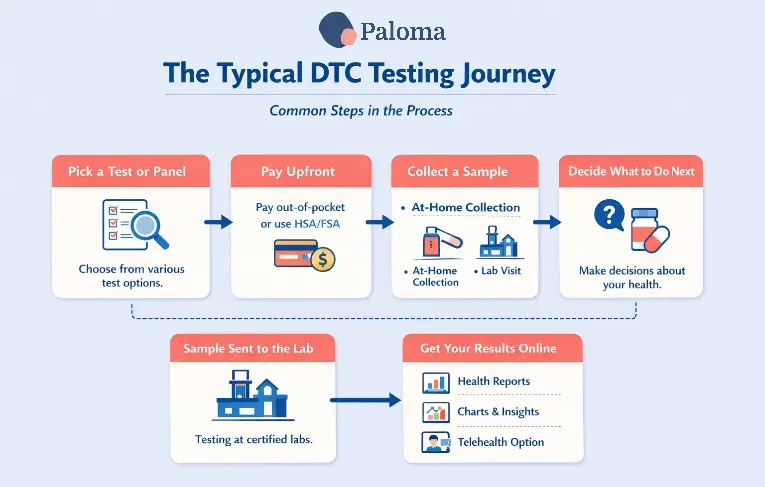
Understanding this flow helps you see where things can go really right—or really wrong.
Types of tests commonly sold direct-to-consumer
You’ll likely encounter:
- Thyroid tests: Thyroid panels, including thyroid-stimulating hormone (TSH), free thyroxine (free T4), free triiodothyronine (free T3), thyroid peroxidase (TPO) antibodies, and reverse T3 (RT3)
- Hormone tests: Pregnancy tests, ovulation tests, and tests measuring reproductive hormones, including estrogen, progesterone, testosterone, luteinizing hormone (LH), and follicle-stimulating hormone (FSH)
- Adrenal hormones: including DHEA and cortisol
- Nutrients: Various vitamin and mineral levels, including vitamin D, B12, magnesium, iron, and iodine
- General wellness panels: Basic metabolic panels, lipid profiles, hemoglobin A1C, and similar markers
- Infectious disease tests: COVID-19, influenza (flu), combined COVID/flu/RSV, some sexually transmitted infection (STI) panels, HIV, hepatitis, and more.
- Food sensitivity/intolerance tests: IgG-based tests that identify foods and substances causing allergic or intolerance symptoms
- Microbiome and gut health panels: Stool tests that offer insights into your gut flora
- Genetic testing, pharmacogenomic tests: Ancestry, disease risk, carrier status, genetic tests for particular gene variations, and sometimes how you metabolize certain medications.
The key takeaway: not all DTC tests are created equal. Some measure well-understood markers used in mainstream medicine. Others are more experimental or marketed as “wellness” products, without sufficient evidence to guide treatment.
.webp)
Limited offer
20% off your first Thyroid Test

Consumer drivers: what’s pulling people in
- Convenience and speed: No phone tag, no waiting months for an appointment, no taking time off work. You can order tests on your schedule, complete sample collection quickly, and get results back within days.
- Upfront pricing: Traditional healthcare prices can be notoriously opaque. With DTC lab testing, you usually see the full price before you pay. For people with high deductibles or no insurance, that transparency is appealing.
- Privacy and less stigma: For sensitive issues—sexually transmitted diseases, fertility, hormone concerns, sexual health—being able to order and review results from home feels safer and less embarrassing.
- Desire for control and self-tracking
Wearables, health apps, and wellness culture have primed many of us to track various health parameters, like steps, heart rate, sleep, blood sugar, and diet. Lab tests are an extension of that self-monitoring mindset.
- Frustration with feeling dismissed: People who’ve been told “your labs are normal” despite ongoing symptoms may turn to DTC tests, hoping to uncover something that was missed.
Technology and market trends: what’s enabling it

A few shifts have made DTC testing not just possible, but scalable:
- Improved lab tech and miniaturized collection devices: Labs can now process large volumes of mailed-in samples from all over the country, including tiny blood spots and saliva tubes.
- Digital platforms and telehealth: Secure portals and video visits make it easy to deliver results and follow-up consults across state lines (within regulatory limits).
- The normalization of at-home testing: The COVID-19 pandemic made people much more comfortable with swabbing, sampling, and testing at home. That lowered the psychological barrier to mailing in a stool or blood sample.
- Personalized health: “Optimize your hormones” and “know your numbers” are common messaging, and lab tests are marketed as the data backbone of this approach.
Put simply, DTC lab testing emerged at the intersection of consumer frustration and technological possibility—and that combination isn’t going away anytime soon.
Potential benefits of direct-to-consumer testing
When done well and used wisely, DTC offers meaningful advantages.
- Improved access to basic labs: If you live in an area with few providers, can’t get timely appointments, or don’t have a regular primary care clinician, DTC tests can help you access screening for thyroid, menopause, cholesterol, blood sugar, and many common conditions.
- Early detection and monitoring: Regular checks of key markers (like TPO antibodies for autoimmune Hashimoto’s or hemoglobin A1C for blood sugar) can pick up risk patterns earlier—especially if you haven’t been able to get tests through traditional channels.
- Motivation and engagement: Seeing numbers change—like TSH dropping or vitamin D rising—can be very motivating. Having direct access to your results may also make you more engaged in lifestyle changes.
- Faster answers to specific questions: If you’re curious whether your iron or B12 is low, or you want a thyroid panel quickly while waiting for a specialist, DTC lab testing can provide valuable health information sooner.
Risks, limitations, and controversies
Direct-to-consumer tests can create problems if the results are of poor quality, misinterpreted, or used in place of appropriate medical care.
Test quality and clinical validity
Two big concepts matter here:
- Analytical validity: Does the test accurately measure what it says it measures? For example, if a finger-prick blood spot test says your vitamin D is 25, would a standard lab draw show essentially the same number? If yes, analytical validity is decent. If not, you may be making decisions based on bad data.
- Clinical validity: Does the biomarker actually reflect a real health risk or condition, and do we know what to do about it? For example, we have strong evidence that high LDL cholesterol is associated with cardiovascular risk and that lowering it can reduce that risk. But for many “optimization” markers, we don’t have the same level of evidence that shifting the number actually improves outcomes.
Interpretation challenges and emotional impact
Even if a test is technically accurate, interpreting it correctly is another story.
- False reassurance: “Normal” lab results don’t always mean you’re in the clear. Some conditions aren’t easily detected with standard labs, especially early on or without the right tests. If you have problematic symptoms but normal DTC lab results, you still need a proper medical evaluation.
- Unnecessary anxiety: Lab values can vary from person to person, and reference ranges are statistical tools, not moral judgments. Slightly high or low results may be normal for you, or may be influenced by timing, hydration, medications, menstrual cycle, or lab variations. Without context, “red” or “high” flags can be frightening.
- Over-testing and overdiagnosis: If you keep testing and retesting without a clear reason, you’re more likely to find incidental abnormalities that will never cause harm—but may lead to more tests, scans, procedures, and worry. Sometimes the biggest risk in medicine is not from disease, but from the cascade triggered by ambiguous findings.
- Lack of personalized interpretation: A single number can mean different things to a 25-year-old athlete and a 70-year-old with multiple chronic conditions. Algorithms and generic “insights” can’t fully replace clinical judgment from a practitioner who knows your history.
Regulatory and legal gray zones
The regulatory landscape for DTC testing is complicated and evolving. A few essential points:
- Lab standards: In the U.S., most clinical labs must follow CLIA (Clinical Laboratory Improvement Amendments) rules, which set minimum quality standards for lab testing. Reputable DTC companies will clearly state that their partner labs are CLIA-certified, and often CAP-accredited.
- Test oversight: Some tests, particularly higher-risk diagnostic tests and many genetic health risk tests, fall more clearly under federal oversight and may need specific review and authorization. Others are marketed as “wellness” tests and may not require the same level of scrutiny, even if you treat the results as medical information.
- State laws: Some states restrict or prohibit direct access testing without a clinician’s involvement. Others allow it freely. This is why certain services aren’t available in all 50 states, or why you may see disclaimers about state-specific limitations.
Your takeaway is that regulation doesn’t automatically guarantee usefulness or clarity—and lack of strict regulation doesn’t automatically mean a test is useless. You still have to do your homework.
Privacy and data use
Lab results and genetic data are some of the most sensitive information you own. When you use a DTC testing company, you’re trusting them with that data. Here are some key questions:
- Who owns your data?
Read the privacy policy and terms of service. Some companies reserve the right to use de-identified data for research, product development, or partnerships with third parties.
- Can your data be shared?
Even when de-identified, datasets can sometimes be re-identified, especially when genetic information is involved. Some companies allow you to opt out of specific uses; others may not.
- Can you delete your data?
Look for policies that describe how to close your account, delete results, and request the destruction of samples.
- What about insurance and employment?
Laws in many countries offer some protections against genetic discrimination in health insurance and employment. Still, loopholes may exist, and protections may not apply to life, disability, or long-term care insurance. Even when illegal, data misuse remains a concern.
When you click “I agree,” you’re not just ordering a test—you’re entering into a contractual relationship regarding your data. Treat it with the same seriousness you would a financial contract.
.webp)
Real-world scenarios: when DTC testing helps—and when it doesn’t
Sometimes the best way to understand the pros and cons is to look at examples.
Helpful scenarios
- Monitoring a known condition between visits: You’ve already been diagnosed with Hashimoto’s hypothyroidism, and in addition to thyroid hormone replacement, you’re making anti-inflammatory dietary changes to target your antibody levels. You want to check your numbers in three months without an extra appointment. A well-chosen DTC thyroid panel, with your clinician’s knowledge, is reasonable.
- Limited access to care: You don’t have a regular doctor, you’re between insurance plans, or you live far from clinics. You’re curious about baseline markers such as blood sugar, cholesterol, and thyroid function. Using a reputable DTC service for a focused set of tests, and then seeking medical follow-up as needed, is better than doing nothing at all.
- A motivated “data person” using tests as one tool: You’re engaged, you read critically, and you already work with a clinician who is open to reviewing external lab results. You use DTC testing to track a few specific biomarkers over time, knowing they are just one piece of a bigger health puzzle.
Risky or less appropriate scenarios
- Using DTC testing instead of urgent care: You have chest pain, severe shortness of breath, neurological symptoms, or other red flags. Ordering lab tests online and waiting for a kit is not safe or appropriate. You need a prompt in-person evaluation!
- Self-diagnosing complex conditions: You suspect autoimmune disease, cancer, serious heart disease, or another complex or serious condition. No matter how advanced a DTC panel looks, you cannot reliably diagnose or rule out such conditions without a thorough medical workup.
- Making big treatment decisions solo: Starting, stopping, or changing prescription medications based solely on your own interpretation of DTC results is risky. Even something that seems straightforward—like taking higher doses of vitamin D or iron—can be harmful if done incorrectly.
Genetic and pharmacogenomic testing
Genetic and pharmacogenomic tests deserve extra caution:
- Family implications: Your genetic results may reveal information about relatives who did not consent to testing, such as carrier status or disease risks.
- Unexpected findings: Some tests can uncover increased risk for severe conditions (for example, certain cancers or neurodegenerative diseases). Before doing these tests, consider how you’d feel about learning that information and whether you’d want a genetic counselor involved.
- Medication response: Pharmacogenomic tests can sometimes provide helpful information on how you metabolize certain drugs, but they’re not a stand-alone guide to prescribing. Clinician input is essential.
Checklist: Choosing a direct-to-consumer testing service
If you decide DTC testing fits your situation, choosing carefully is your best protection. Here is a checklist of questions to ask before you order your tests.
1. Is the lab properly certified?
Look for statements that the lab has CLIA certification and ideally is accredited by a reputable body (such as CAP). If you can’t easily find this information, that’s a red flag.
2. What evidence supports the test?
Does the company provide references or explain why they measure certain markers and how those markers relate to health outcomes? Be wary of vague claims like “assesses inflammation” without specifics.
3. How are results interpreted?
Will you just get raw numbers, or do you have access to:
- Plain-language explanations.
- Examples of what different ranges might mean.
- Options to talk with a clinician or qualified professional?
4. What’s included in the price?
Does the fee cover:
- The test kit and return shipping.
- Lab analysis.
- Repeat testing if your sample is unusable.
- A telehealth consultation or a written report?
5. What are the limitations?
Ideally, the company will clearly state what the test cannot do—such as diagnosing a specific disease, replacing standard medical screening, or serving as the sole basis for treatment decisions.
6. What is the privacy policy?
Look for:
- Whether your data can be sold, shared, or used for research.
- Whether it’s de-identified and, if so, under what circumstances it might be re-identified.
- Security measures and data retention.
7. What are the terms of service?
Specifically:
- How can you delete your account and data.
- Disclaimers about test limitations and liability.
- Conditions under which your data may be disclosed (for example, legal requests).
If the policies are extremely vague, hard to find, or full of language that feels one-sided, think twice.
When your DTC results arrive
Your first reaction may be excitement, fear, relief, or confusion. The real value of any lab test isn’t the number on the page; however, it’s what you do with it. Here’s how to approach the results constructively:
Take a breath and read slowly.
Don’t make snap decisions based on a single flag or color code. Review:
- The numeric value.
- The reference range.
- Any explanatory notes.
Look for trends, not just snapshots
One isolated value can be misleading. If possible, compare your DTC results with previous labs performed by your clinician to see whether a number is stable, trending up, or trending down.
Identify “urgent” vs. “non-urgent” concerns.
Some results (e.g., extremely high blood sugar or very abnormal kidney function) may require prompt medical evaluation. Many others can be addressed at your next routine appointment.
Avoid self-prescribing major changes.
Starting new medications, big supplement regimens, or extreme diets solely based on one DTC report is risky. Use the information as a conversation starter with a professional, not as an automatic DIY care plan.
Integrating DTC results with your ongoing care

Integrating DTC test results into your ongoing care is where the best of both worlds can truly come together. Start by sharing your results with your clinician—bring printed copies or digital files to your next appointment and open the conversation collaboratively, for example: “I ordered these tests because I was curious about X. Can we review them together?”
It’s also important to be transparent about why you chose to order the tests in the first place. If you felt rushed, dismissed, or unheard, saying so can open the door to more honest communication and may help your clinician better tailor care to your needs.
From there, work together to determine next steps. Discuss which findings are meaningful, whether additional evaluation is needed, and if any tests should be repeated using your clinician’s preferred laboratory.
Ultimately, DTC tests are best used as a complement—not a replacement—for professional care. They can offer helpful data points, but they don’t substitute for a thorough medical history, physical examination, and clinical judgment.
The future of DTC testing
The future of direct-to-consumer testing is moving quickly, and it’s worth pausing to consider where this space is headed—and what that means for you.
On the technology side, innovation is accelerating. At-home sampling devices are becoming more accurate and easier to use, with advances like improved dried blood spot collection reducing errors and friction. Testing panels are expanding beyond single data points to include approaches that blend genetics, proteomics, metabolomics, and even microbiome data. At the same time, artificial intelligence and machine learning are increasingly being used to translate this flood of information into personalized risk scores and recommendations. These developments could make DTC tests far more useful—but they also raise the stakes. As data becomes more complex, thoughtful, expert interpretation becomes not just helpful, but essential.
Alongside innovation come critical questions about ethics, equity, and access. Will direct-to-consumer testing narrow health gaps—or widen them if only well-resourced, tech-savvy individuals can use these tools effectively? How do we protect people who are searching for answers from misleading or predatory marketing? And can regulation keep pace with rapid innovation while still allowing genuinely beneficial tools to reach the public?
In this evolving landscape, being an informed consumer will allow you to play a decisive role. By asking thoughtful questions, demanding transparency, and insisting on evidence-based claims, you can help steer the industry toward a future that is not only more advanced but also more responsible and equitable.
A note from Paloma

At Paloma, we believe better health starts with better data—and knowing how to use it.
.webp)
That’s why we offer two powerful DTC methods to access high-quality lab testing from home or via local labs. Paloma’s at-home thyroid test kits make it easy to conveniently and accurately measure the markers that matter most for thyroid health, without long waits or inconvenient appointments. For broader needs, Paloma also partners with JustLabs, our direct-to-consumer lab service, which gives you access to a wide range of diagnostic tests drawn at certified Quest Diagnostics labs across the U.S.
Whether you test at home or in a lab, quality and accuracy come first. All Paloma and JustLabs testing is processed through CLIA-certified laboratories, meeting the same standards used by hospitals and physician offices. That means your results are reliable, clinically meaningful, secure and private, and suitable for medical decision-making—not just “wellness” snapshots.
But numbers alone don’t tell the whole story. What truly sets Paloma apart is what happens after your results arrive. Paloma’s licensed practitioners specialize in thyroid and hormonal health, as well as related conditions, including menopause and weight management. Paloma providers can help you understand your test interpretation in the context of your symptoms, medical history, and goals.
Together, you and your Paloma practitioner can turn test results into an actionable, personalized treatment plan. That may include optimizing thyroid medication, addressing hormone shifts during perimenopause or menopause, identifying metabolic roadblocks to weight loss, or recommending targeted lifestyle and nutritional strategies that actually work with your biology.
With Paloma, testing isn’t the end of the journey—it’s the beginning of smarter, more personalized care.
Frequently asked questions (FAQ)
What exactly is direct-to-consumer lab testing?
It’s lab testing you order and pay for yourself—usually online—without a traditional doctor’s order, with results delivered directly to you through a portal or app.
How is it different from regular lab testing?
Instead of seeing a clinician first for a lab slip, you choose tests on your own, often with upfront pricing and home collection options, though the samples are still processed in certified clinical labs.
What types of tests can you order with DTC testing?
You’ll see thyroid and hormone panels, general wellness labs (like cholesterol, HbA1c, vitamin D), some STI and infectious disease tests, food sensitivity and microbiome panels, and genetic or pharmacogenomic tests.
What are the main benefits of DTC lab testing?
Key benefits include convenience, faster access, price transparency, privacy for sensitive issues, and the ability to monitor known conditions or track markers between regular medical visits.
What are the biggest risks or limitations of DTC lab testing?
Risks include variable test quality, questionable “wellness” panels, misinterpreted results, unnecessary anxiety or false reassurance, over-testing, and potential privacy and data-use concerns.
Are all DTC tests accurate and clinically useful?
No. Some measure well-established markers using high-quality methods, while others—such as some IgG food-sensitivity tests—lack strong evidence and may not be as helpful in guiding diagnosis or treatment.
Can you use DTC tests to diagnose yourself instead of seeing a doctor?
This is strongly discouraged. DTC tests can provide data points, but cannot replace a thorough medical history, physical exam, and professional interpretation for diagnosis and treatment decisions.
How can you tell if a DTC company is reputable?
Look for CLIA-certified labs, clear explanations of what tests can and cannot do, realistic marketing, transparent pricing, and robust, easy-to-find privacy and terms-of-service policies.
What should you do when my results come back?
Review them calmly, note any patterns or red flags, avoid making big DIY changes, and plan to share the report with your clinician to decide together what matters and what follow-up is needed.
How do you use DTC testing alongside your regular healthcare?
Use it as a complement—bring results to appointments, explain why you ordered them, and work with your clinician to integrate the findings into a broader care plan rather than acting on the numbers alone.


%20(1).webp)


