



.webp)
In this article
It starts subtly. Maybe you wake at 3 a.m. for no obvious reason, heart ticking a little fast, and can't get back under. Maybe your partner mentions, gently, that you kicked the covers off again, drenched. Maybe you're just... tired, in a bone-deep way that a good pillow can't fix. For millions of women in their 40s and 50s, this is the quiet, disorienting soundtrack of perimenopause: sleep, once reliable, becomes unpredictable and then openly hostile.
It's not your imagination, and it's not just "getting older." Research increasingly shows that the menopausal transition itself, independent of chronological age, reshapes how women sleep. A 2025 review in the Journal of Clinical Medicine notes that perimenopause affects 80% to 90% of women and that the onset or worsening of sleep disorders is one of its most prevalent features, driven by a tangle of hormonal, vasomotor, and psychological changes.
Here's what's really going on beneath the sheets, and, more importantly, what you can do about it.
Estrogen and progesterone aren't just reproductive hormones. They're deeply woven into how your brain regulates temperature, mood, and the sleep-wake cycle itself. Research on the biology of perimenopausal sleep shows that female sex hormones interact directly with the circadian system: women have more estrogen and progesterone receptors in the brain's master clock, the suprachiasmatic nucleus, than men do, and animal studies suggest gonadal hormone shifts can alter circadian rhythmicity directly.
As estrogen declines and fluctuates during perimenopause, several things happen at once. Melatonin secretion tends to drop, and postmenopausal women often show an advanced circadian phase, meaning more fragmented sleep and earlier waking. Estrogen replacement, by contrast, has been shown in polysomnography studies to increase both slow-wave and REM sleep, while boosting total sleep time and cutting the number of nighttime awakenings.² Progesterone has its own sedating, almost anti-anxiety-like effect, working on GABA receptors in the brain, the same system targeted by many sleep medications, and it also acts as a respiratory stimulant, which matters more than you might think (more on that below).
Layered on top of these direct hormonal effects on the brain is a more visceral trigger: hot flashes. A hot flash is essentially an exaggerated heat-dissipation response, causing skin blood vessels to dilate and sweat glands to fire, and it typically lasts three to ten minutes. Landmark research has found that severe hot flashes are strongly linked to chronic insomnia and related sleep disorders, and large studies confirm that the number of nighttime awakenings tracks closely with how often hot flashes occur during sleep.⁴ It's a vicious loop: hormonal decline triggers hot flashes, hot flashes fragment sleep, and fragmented sleep worsens mood and daytime function, which can, in turn, intensify how flashes are perceived.
One reason hot flashes become so disruptive has to do with what's known as the brain's thermoneutral zone—the narrow temperature range your hypothalamus considers "comfortable." Estrogen helps keep that range stable. As estrogen levels fluctuate and eventually decline, the thermoneutral zone narrows dramatically. Even tiny increases in body temperature can trigger an exaggerated cooling response, sending blood rushing to the skin, activating sweat glands, and jolting you awake. In other words, your brain begins treating perfectly normal temperature changes as if they were overheating emergencies.
Hormonal changes may also make the body's stress-response system more active at night. As estrogen declines, researchers believe the hypothalamic-pituitary-adrenal (HPA) axis becomes more sensitive, allowing nighttime cortisol—the body's primary stress hormone—to remain higher than it should. Elevated cortisol encourages wakefulness rather than sleep, making it harder not only to fall asleep again after an awakening but also to reach the deep, restorative sleep your brain and body need.
Large population studies bear this out. In the landmark Study of Women's Health Across the Nation (SWAN), which followed more than 3,000 midlife women for eight years, sleep discomfort was reported by 34.3% of perimenopausal women compared with 28.0% of premenopausal women.³ A separate meta-analysis of 24 studies found the odds of sleep disturbance were 60% higher in perimenopausal women, 67% higher in postmenopausal women, and more than double in women who underwent surgical menopause, relative to premenopausal women. Interestingly, when researchers use objective tools like polysomnography rather than just self-report, the differences are often less dramatic, though late-perimenopausal and postmenopausal women do show more high-frequency brainwave activity during sleep, a marker of what scientists call cortical hyperarousal, suggesting the brain stays more "switched on" even during rest.
Many women describe menopausal insomnia in the same way: "I'm exhausted, but my brain won't stop." Scientists increasingly think that feeling reflects genuine changes in the brain rather than simply stress or worry. Declining estrogen affects multiple systems involved in sleep regulation, including temperature control, stress hormones, calming neurotransmitters, and the brain's wakefulness circuits. Together, these changes can create a state researchers call hyperarousal, in which the brain remains unusually alert even when your body desperately needs sleep. Understanding that this has a biological basis—not a personal failing—can be reassuring, and it also helps explain why successful treatment often involves addressing the underlying hormonal changes rather than simply taking a sleeping pill.
Ask any perimenopausal woman what's disrupting her nights, and insomnia tops the list almost every time. It's most often a problem of sleep maintenance rather than falling asleep, which tracks with the hot-flash connection: many women drift off fine, only to be jolted awake by a wave of heat, then lie there, wired, unable to settle back down.
One multinational study of over 6,000 midlife women found that roughly 42% screened positive for insomnia symptoms during perimenopause. Psychiatric symptoms compound the picture. Research has found that during the menopausal transition, women experiencing vasomotor symptoms are more than four times as likely to report depression as well, even with no prior history of it, and depression and poor sleep tend to feed each other in a bidirectional spiral.⁵ That's not simply because poor sleep affects mood. Estrogen also helps regulate important brain chemicals, including serotonin and norepinephrine, which influence mood, body temperature, and the sleep-wake cycle. As hormone levels fluctuate, these neurotransmitter systems become less stable, helping explain why insomnia, anxiety, depression, and hot flashes so often appear together during the menopausal transition.
Case study 1: “My exhaustion had two culprits, not one!”
M., 46, came to her Paloma provider exhausted and frustrated after eight months of falling asleep easily but waking two to three times a night, often drenched in sweat with her heart pounding. She'd started keeping a running sleep log of "night wakings" on her phone, convinced something was seriously wrong. Her Paloma provider reviewed her history of menstrual periods (increasingly irregular over the past year), her sleep diary, and a full hormone panel, which confirmed she was in perimenopause but also turned up an unexpected finding: mildly elevated TSH consistent with subclinical hypothyroidism, a condition that can itself worsen fatigue, mood, and sleep quality and is easy to miss when symptoms are chalked up to "just menopause."
Her provider started her on a low dose of levothyroxine to correct her thyroid function, alongside hormone replacement therapy, namely low-dose transdermal estrogen (estradiol) with cyclic micronized progesterone to address her hot flashes and support sleep onset. Follow-up labs at six weeks showed her TSH normalizing, and by that same visit, her night sweats had dropped from nightly to occasional. By her three-month follow-up, with both her thyroid levels and hormones balanced, she was sleeping five to six unbroken hours most nights and told her provider she felt like she'd "gotten her brain back," not just her sleep.
Insomnia gets most of the attention, but obstructive sleep apnea (OSA) is the more dangerous, more overlooked player in the menopause-sleep story. Before menopause, women have roughly one-third the OSA prevalence of men; after menopause, that gap narrows dramatically, with some cohort studies estimating up to a threefold increase in OSA risk. A large European population study analyzing blood hormone levels directly found that women with lower estrogen and progesterone were significantly more likely to snore and report apnea symptoms and sleep disturbances; researchers note that women with polycystic ovary syndrome, a condition marked by comparatively low levels of female sex hormones, are also at greater risk of developing sleep apnea, reinforcing the hormonal link.⁷
The mechanism traces back to progesterone's role as a respiratory stimulant and its effect on the muscles that keep the upper airway open. Small clinical studies have found that administering estrogen and progesterone to postmenopausal women with OSA can decrease apnea and hypopnea events during sleep. However, results across trials have been inconsistent enough that hormone therapy is not considered a primary treatment for diagnosed sleep apnea. Weight redistribution after menopause, including a shift toward abdominal fat, and declining levels of the appetite hormone leptin, may also play a role.
The stakes are real. Sleep apnea is a well-established risk factor for high blood pressure, heart failure, and stroke, and one study found women with symptoms of sleep-disordered breathing are significantly less likely than men to be diagnosed or treated. If you snore, wake gasping or choking, or feel excessively sleepy during the day despite adequate time in bed, it's worth raising sleep apnea specifically with your provider rather than assuming it's "just" menopausal insomnia.
Less common but still notable: restless legs syndrome (RLS), an uncomfortable, crawling urge to move the legs that worsens at rest, and periodic limb movements during sleep. These conditions tend to increase in prevalence with age generally, and their relationship to menopause specifically is murkier than that of insomnia or OSA; some research finds RLS correlates with vasomotor symptoms but not directly with menopausal status. Hormone therapy has not shown consistent benefit for RLS symptoms, even when it improves overall sleep quality.
It's worth knowing the difference between an occasional rough night and a pattern worth treating. The sleep difficulties to watch for include: difficulty staying asleep three or more nights a week for over three months; waking drenched in sweat with a racing heart; loud snoring, gasping, or witnessed pauses in breathing; an uncomfortable, restless sensation in the legs at night; and daytime consequences like brain fog, irritability, or falling asleep unintentionally. Any combination of these is a reasonable trigger to talk with a clinician, ideally one with menopause-specific training, since general sleep advice doesn't always account for the hormonal piece of the puzzle.
Hormone therapy
Hormone therapy is often the most direct route when hot flashes and night sweats are the main sleep disruptor. Low-dose estrogen, with or without progesterone, has been shown across multiple studies to address estrogen loss, improve subjective sleep quality, and reduce nighttime awakenings, largely by controlling vasomotor symptoms. That said, the evidence isn't unanimous. A widely cited review found more than ten studies showing meaningful sleep benefit from hormone therapy, but at least five did not. Because of the more complex risk-benefit profile identified by the Women's Health Initiative, including cardiovascular and breast cancer considerations, most guidelines recommend hormone therapy for women with prominent hot flashes rather than as a blanket insomnia treatment, at the lowest effective dose for the shortest reasonable duration, decided individually with a clinician.
Non-hormonal treatments
Non-hormonal medications have a role too, particularly for women who can't or prefer not to use hormone therapy. Certain antidepressants, including low-dose paroxetine, venlafaxine, and escitalopram, can meaningfully reduce hot flashes and are especially useful when mood symptoms overlap with sleep problems. However, they aren't primarily sleep drugs. Gabapentin has specific evidence for improving both hot flashes and the sleep disruption they cause, with one placebo-controlled study using detailed sleep-quality scoring finding real benefit. Short-term use of prescription sleep aids like eszopiclone has also shown benefit in randomized trials of perimenopausal insomnia, improving both sleep and next-day functioning. It’s important to note, however, that these are generally intended for short-term rather than indefinite use.
Another newer class of prescription sleep medications, called orexin receptor antagonists, is attracting growing interest. Rather than acting like traditional sleeping pills that broadly slow brain activity, these medications work by temporarily blocking orexin, one of the brain's primary wakefulness signals. Because researchers believe menopausal hormone changes may increase nighttime hyperarousal, medications targeting this pathway may prove especially useful for some women. However, more research is still needed, specifically in menopausal populations.
For diagnosed obstructive sleep apnea, continuous positive airway pressure (CPAP) remains the gold-standard treatment, and it shouldn't be substituted with hormone therapy, which has not reliably reduced apnea events in controlled trials.
For women wary of medication, several complementary approaches have genuine research behind them. Soy isoflavones, plant compounds that weakly mimic estrogen, have shown statistically significant reductions in both hot flashes and insomnia symptoms in randomized controlled trials of postmenopausal women, making them one of the better-supported "natural" options rather than just folk wisdom.
Cognitive behavioral therapy for insomnia (CBT-I)
Cognitive behavioral therapy for insomnia (CBT-I) deserves special mention because the evidence for it is now genuinely strong, not just plausible. A landmark randomized trial published in JAMA Internal Medicine found that telephone-delivered CBT-I significantly improved sleep quality in perimenopausal and postmenopausal women with hot flashes, and the effect held up at six months, regardless of whether hot flashes themselves improved. A 2025 systematic review and meta-analysis pooling 11 randomized trials and nearly 1,000 menopausal women confirmed this: CBT-I produced significant improvements in both sleep quality and insomnia severity, with benefits holding steady whether delivered face-to-face or remotely, and whether followed up at a few weeks or up to a year later. Newer research has gone a step further, testing versions of CBT adapted specifically for menopause (sometimes called CBT-Meno or CBT-MI) that address both insomnia and nighttime hot flashes together, with early trials showing these tailored programs outperform standard menopause education for sleep, mood, and hot-flash interference. In short: this is not a fringe therapy. Major clinical reviews now describe CBT-I as the preferred first-line, non-drug treatment for menopausal insomnia, largely because, unlike medication, its benefits tend to persist well after treatment ends.
Other complementary strategies with more modest but reasonable evidence include mindfulness-based stress reduction, acupuncture (with mixed but occasionally promising trial results for hot flashes), and paced breathing techniques practiced at the first sign of a flash.
Case study 2: “My snoring sent my husband to the guest room!”
R., 54, three years past her final period, told her Paloma provider she felt like she was "sleeping but not resting." She was waking multiple times a night, feeling overheated. Her husband had mentioned she'd started snoring more than usual and was sleeping in the guest room. R. was dragging by mid-afternoon despite spending eight hours in bed. She had also experienced some weight gain. She assumed it was just hormonal fluctuations, and something she had to live with. Her Paloma provider walked through her full symptom picture, confirming her hot flashes, night sweats, and lighter, more fragmented sleep were consistent with postmenopausal hormonal decline, and noted that dropping estrogen and progesterone can also relax airway muscle tone, which likely explained the new snoring.
Her provider started her on hormone therapy, transdermal estradiol paired with oral micronized progesterone at bedtime, selected in part because progesterone acts as a natural respiratory stimulant and has been shown to support airway muscle tone in addition to its sedative effect. Within a month, R.'s husband reported the snoring had noticeably quieted, and R. said her night sweats were nearly gone. By two months in, she was sleeping through most nights without waking, her afternoon energy crashes had disappeared, and she felt like she'd finally gotten her rest, her evenings – and her husband – back!

Lifestyle adjustments are often dismissed as too simple to matter, but the data suggest otherwise. In the SWAN Sleep Study, women who consistently engaged in high-intensity physical activity had measurably better sleep quality, continuity, and depth than less active peers. A separate year-long trial comparing moderate exercise to gentle stretching found both improved sleep quality in postmenopausal women, with benefits tracking increases in overall activity level.
Beyond exercise, a few sleep hygiene adjustments consistently show up in the research and clinical guidance:
- Cool the bedroom and layer bedding so night sweats are easier to manage without a full wake-up.
- Keep a consistent sleep-wake schedule, even on weekends, since circadian regularity becomes more fragile during the transition.
- Limit alcohol and caffeine, particularly in the afternoon and evening, as both can worsen hot flashes and fragment sleep architecture.
- Address weight and body composition changes, since menopausal shifts in fat distribution are linked to higher OSA risk.
- Build a wind-down routine that avoids screens and stress-inducing tasks in the hour before bed, and incorporates relaxation techniques, supporting the same principles CBT-I formalizes.
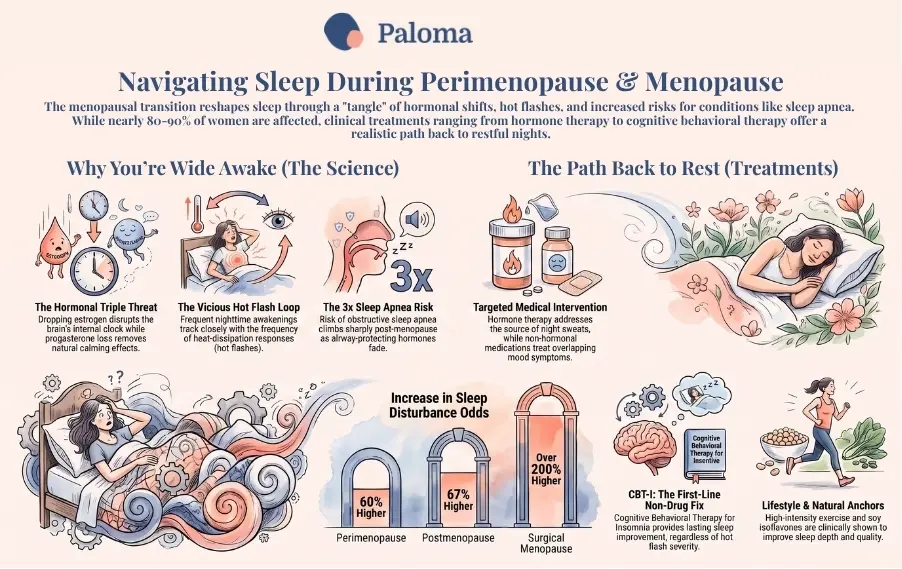
Menopausal sleep disruption isn't a character flaw, a discipline problem, or something to simply grit your teeth through for a few years. It has identifiable biological drivers, from shifting estrogen and progesterone to hot flashes to changes in airway muscle tone, and a growing, genuinely rigorous evidence base behind treating it. Whether that means a conversation with your provider about hormone therapy, a course of CBT-I, a consistent exercise habit, or some combination of all three, the sleepless nights of perimenopause are not a life sentence. They're a symptom, and a treatable one.

Researchers continue to explore new ways to treat menopausal insomnia by targeting the underlying biology rather than simply inducing sleep. Newer therapies aimed at the brain's wakefulness pathways, more personalized hormone treatments, and approaches that better align the body's circadian rhythms are all under active investigation. While these therapies are still evolving, they reflect a growing understanding that menopause-related insomnia is a distinct biological condition—not simply a normal part of aging.
If sleepless nights, hot flashes, or that "sleeping but not resting" feeling sound familiar, you don't have to sort it out on your own. Paloma Health connects women in perimenopause and menopause with providers who specialize in this menopause transition, not just general wellness advice. Paloma’s approach to your care includes a real evaluation of your hormone levels, symptom history, and sleep patterns, followed by a personalized treatment plan that can include hormone therapy when it's the right fit. Paloma's telehealth model means you can meet with a provider, get labs drawn, and start treatment without ever leaving home, with ongoing follow-up to fine-tune your plan as your body changes. Sleep isn't something to white-knuckle through for a decade. If it's been disrupted, that's worth a conversation, and Paloma is built to have it with you.
Why does menopause wreck my sleep even if I've always slept well?
Declining and fluctuating estrogen directly disrupts your circadian rhythm and lowers melatonin, while dropping progesterone removes its natural calming, sleep-promoting effect on the brain. It's not aging catching up with you; it's a specific hormonal shift with a specific biological signature.
Are night sweats actually the reason I keep waking up?
Often, yes. Hot flashes are strongly linked to chronic insomnia, and research shows the number of times you wake at night tracks closely with how often flashes strike during sleep.
Could my "insomnia" actually be sleep apnea?
It's worth ruling out, especially if you snore, gasp, or feel exhausted despite a full night in bed. Obstructive sleep apnea risk rises sharply after menopause as estrogen and progesterone's protective effect on the airway fades.
Is hormone therapy the only real fix?
No, though it's often the most direct one when hot flashes are driving the disruption. Non-hormonal options like gabapentin, certain antidepressants, and cognitive behavioral therapy for insomnia (CBT-I) all have solid evidence behind them too.
What is CBT-I, and does it actually work for menopause?
CBT-I is a structured, short-term therapy that retrains sleep habits and thought patterns, and it now has strong trial evidence specifically in menopausal women. A major randomized trial found its benefits held steady for six months, whether or not hot flashes themselves improved.
Can natural remedies like soy isoflavones really help?
They're one of the few "natural" options with genuine randomized trial support, showing real reductions in both hot flashes and insomnia. They're not a guaranteed fix for everyone, but they're far from just folk wisdom.
How do I know if my sleep problem is "bad enough" to see someone?
If you're losing sleep three or more nights a week for over three months, or dealing with drenching sweats, snoring, or daytime brain fog, that's a pattern worth addressing, not something to push through. Left untreated, it can affect your mood, memory, and even cardiovascular health.
Does exercise actually make a difference?
Yes, and the data is fairly convincing. Women who consistently engaged in high-intensity activity in the SWAN Sleep Study had measurably better sleep quality, continuity, and depth than less active peers.
Why did my provider check my thyroid when I came in for sleep problems?
Thyroid dysfunction can mimic or worsen the exact fatigue, mood, and sleep issues common in perimenopause, so it's easy to miss if only menopause is considered. Catching and treating it, alongside any hormonal changes, can make a real difference in how you sleep and feel.
Is this something I just have to live with for years?
Not at all. Menopausal sleep disruption has identifiable biological causes and a genuinely strong, evidence-based set of treatments, so with the right evaluation, real improvement is very achievable.


%20(1).webp)
.webp)


