



.webp)
In this article
Have a conversation about menopause today, and testosterone comes up almost as often as estrogen. A recent cardiovascular-safety analysis found that testosterone prescribing for U.S. women increased 2.6-fold between 2016 and 2025, with the sharpest climb after 2021 — to the point that as many as 1 in 280 midlife women now carries a testosterone prescription.
That surge is documented in an analysis published in the American Journal of Preventive Cardiology, which found prescribing is concentrated in women ages 45 to 64, roughly half of whom already had documented cardiometabolic risk factors. Much of the momentum has been driven by social media, celebrity testimonials, and a genuine, overdue reckoning with how poorly menopause has historically been treated. But prescribing trends and evidence don't always move at the same speed.
The honest answer to “should you use testosterone during menopause” is: it depends on your symptoms, your labs, your goals — and, as we'll get into, your thyroid. This piece walks through what testosterone actually does in the female body, who might benefit from testosterone replacement therapy, what the newest research says, and the surprisingly important relationship between testosterone and thyroid conditions like Hashimoto's disease. If you've been wondering whether a testosterone prescription is your missing piece, or whether your fatigue and brain fog have more to do with your thyroid, you're in the right place — and our guide to understanding perimenopause, menopause, and hormone therapy is a good companion read.
Signs, symptoms, and indications
What low testosterone can feel like
Testosterone isn't a “male hormone” that happens to show up in women — it's one of the most abundant active hormones in the female body. Premenopausal women actually produce roughly three times more testosterone than estrogen, made in the ovaries, adrenal glands, and through peripheral conversion. Levels peak in a woman's 20s and then decline gradually and continuously from there, unlike the sharper drop estrogen takes at menopause.
When testosterone runs low, women commonly report the following symptoms of testosterone deficiency:
- Persistent low sex drive or reduced sexual responsiveness
- Unexplained fatigue that doesn't resolve with sleep
- Low mood, flat affect, or reduced motivation
- Loss of muscle strength and tone
- A general sense of diminished vitality or well-being

The trouble is that nearly every one of these symptoms overlaps with perimenopause, menopause, depression — and, notably, hypothyroidism. That overlap is exactly why testosterone shouldn't be the first place to look before ruling out other, more common, and more treatable causes, including thyroid dysfunction, iron deficiency, sleep disorders, and mood conditions. Our guide to 12 surprising symptoms of thyroid disease is a useful place to start ruling out other causes.
What testosterone is actually approved to treat
Here's where the “should you” question gets its real answer. According to the Global Consensus Position Statement on the Use of Testosterone Therapy for Women, endorsed by ten major medical societies including the International Menopause Society and The Endocrine Society, the only evidence-based indication for testosterone therapy in women is hypoactive sexual desire disorder (HSDD) — persistent, distressing low sexual desire — in postmenopausal women. The statement explicitly notes that evidence is insufficient to support testosterone for energy, cognition, mood, weight, or general well-being, despite how often it's marketed for exactly those things.
The statement also recommends against testosterone replacement with pellet implants and injections in women, largely because these formulations make it difficult to control dosing and keep testosterone within the normal physiologic female range — overshoot is common and comes with real risks like acne, unwanted hair growth, and voice changes. There is currently no testosterone product formulated and approved specifically for women in the United States. Treatment, when appropriate, typically means careful off-label dosing of a product approved for men, at a small fraction of the male dose.
What recent research shows
The prescribing surge and the safety-data gap
The sharp rise in testosterone prescribing for midlife women has outpaced the safety research needed to support it. As noted above, roughly half of women prescribed testosterone already had documented cardiometabolic risk factors, which makes it more important — not less — to understand how testosterone affects cardiovascular risk in women, a question that, unlike in men, remains largely unanswered.
At The Menopause Society's 2025 Annual Meeting, researchers cautioned that the evidence for testosterone's effects on muscle, bone, mood, and cognitive decline in women remains inconsistent and incomplete, and that measuring testosterone in women is itself technically difficult, since standard immunoassays weren't built for the low concentrations found in the female body.
What the evidence supports — and what it doesn't
To be fair to testosterone: research reviewed in the Global Consensus Position Statement found consistent, moderate benefits for sexual desire, arousal, pleasure, and orgasm when testosterone was added to menopausal hormone replacement therapy in postmenopausal women with HSDD. Some earlier placebo-controlled research, including a trial from Monash University researchers, suggested testosterone may protect verbal memory in postmenopausal women not using estrogen therapy — but larger confirmatory trials for cognition, bone, and muscle outcomes still don't exist.
That's the current state of the science: real, replicated benefits for one specific problem (HSDD), and promising but unproven signals for nearly everything else it's being marketed for.

The deep dive: testosterone and your health in perimenopause and menopause
Bone density and muscle mass
Testosterone contributes to bone formation and helps maintain lean muscle mass. Researchers have long known that women lose both bone density and muscle at an accelerated rate around the menopause transition. The PAMELA study, a randomized controlled trial from Monash University's Women's Health Research Program, was designed specifically to test whether restoring testosterone to premenopausal levels via a topical cream could slow this loss in postmenopausal women — a question the field still doesn't have a definitive answer to. Estrogen remains the best-studied and most effective hormone therapy for preventing menopausal bone loss; testosterone's role, if any, in bone health is still being defined.
Mood, cognition, and brain fog
Because testosterone receptors are present throughout the brain, researchers have explored their role in mood, motivation, and memory. Earlier placebo-controlled research suggested a possible protective effect on verbal memory, and clinicians who prescribe testosterone off-label often report patient-described improvements in motivation and mental clarity. But expert consensus still classifies the cognitive and mood evidence as insufficient to recommend testosterone for these purposes. If brain fog and mood changes are your primary complaint, it's worth ruling out thyroid dysfunction first — our guide to understanding “peri-brain” and the connection to depression during perimenopause are both worth a look, since hypothyroidism is a well-documented, very treatable cause of both, with an evidence base far more robust than testosterone's for these specific symptoms.

Libido and sexual well-being
This is testosterone's best-supported use in women. For postmenopausal women with HSDD that's causing real distress — and after ruling out other causes like relationship changes, vaginal dryness, medication side effects, depression, and thyroid dysfunction — testosterone therapy added to hormone therapy has consistently shown modest but meaningful improvements in desire, arousal, and satisfaction.
The testosterone, hypothyroidism, and Hashimoto's connection
How thyroid hormone and testosterone are linked
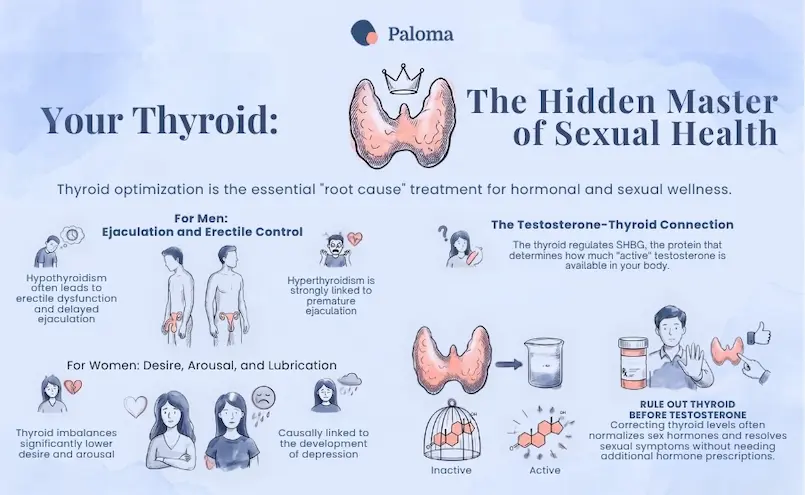
Testosterone doesn't operate independently of the thyroid — it's part of the same interconnected endocrine network. Thyroid hormone helps regulate the hypothalamic-pituitary-gonadal axis, the signaling chain that governs sex hormone production, and it directly affects how the liver produces sex hormone-binding globulin (SHBG). This protein transports testosterone through the bloodstream and determines how much is biologically “available” versus bound and inactive. A study published in the European Journal of Epidemiology found genetic evidence that thyroid function has a causal relationship with sex hormone levels — this isn't just correlation; it's a direct biological link. When you're weighing testosterone options, it's worth reading our explainer on whether hypothyroidism reduces testosterone levels to better understand the mechanics of these hormonal changes.
What the Hashimoto's research found
This connection becomes especially relevant for the millions of women who develop Hashimoto's thyroiditis — the autoimmune condition responsible for most hypothyroidism cases — right around the time they're going through perimenopause and menopause. A study published in Endokrynologia Polska specifically examined postmenopausal women with Hashimoto's thyroiditis and found that those with overt hypothyroidism (elevated TSH) had significantly higher total and free testosterone levels than both euthyroid Hashimoto's patients and healthy postmenopausal controls — the first study of its kind to document this pattern.
That's a striking finding for anyone assuming thyroid disease lowers testosterone across the board: in postmenopausal women specifically, undertreated Hashimoto's may push testosterone higher, not lower, complicating any conversation about whether testosterone therapy is even the right next step. Separately, a 2024 study in the Journal of Affective Disorders found that testosterone levels play a measurable role in the pathway connecting hypothyroidism to depression in women — suggesting that correcting thyroid function may be an important, often-overlooked step in addressing mood and hormonal symptoms together. If Hashimoto's is on your radar, our guide to TPO antibodies and Hashimoto's disease explains what those labs mean.
Why SHBG is the hidden variable
SHBG is the detail that makes thyroid-testosterone interpretation so tricky. A comprehensive 2025 review of SHBG's diagnostic potential explains that SHBG typically drops when thyroid function is low and rises when thyroid function is high. This shift changes how much total versus free testosterone shows up on a lab report — sometimes masking the true clinical picture entirely. A review in Sexual Medicine Reviews similarly found that thyroid hormone derangements affect sexual function through this same hormonal cascade in both men and women. In practice, this means a testosterone level, on its own, is nearly meaningless without also knowing your thyroid status.
Getting the order of operations right
Research on the broader thyroid-sex hormone relationship consistently reaches the same conclusion: correcting thyroid dysfunction often normalizes downstream sex hormone measures and resolves associated symptoms, including sexual dysfunction, without needing separate testosterone therapy at all. A classic study in the Journal of Andrology demonstrated this decades ago, showing that treating hypothyroidism with thyroid hormone helped normalize SHBG and testosterone values. A more recent review in Translational Andrology and Urology specifically recommends evaluating thyroid function before starting testosterone treatment, because an undiagnosed or undertreated thyroid condition can be the actual root cause hiding behind a testosterone complaint. In other words: if you have Hashimoto's or any form of hypothyroidism and you're wondering about testosterone, thyroid optimization deserves to happen first — or at minimum, alongside any testosterone conversation. Understanding whether hormone replacement therapy is safe for you is a good next read.
Your next steps
Here are some questions to ask your provider:
- Has my thyroid ever been fully evaluated — TSH, free T4, free T3, and TPO antibodies — not just TSH alone?
- Could my fatigue, brain fog, or low libido be explained by an undiagnosed or undertreated thyroid condition before we consider testosterone?
- If testosterone is appropriate for me, what formulation keeps me within the normal physiologic female range, and how will we monitor it?
- What are the realistic, evidence-based benefits I should expect, and what hasn't been proven yet?
Tests worth requesting
If you and your provider are exploring low testosterone, a complete hormonal picture typically includes total and free testosterone, SHBG, and — critically — a full thyroid panel including TSH, free T4, free T3, and thyroid peroxidase (TPO) antibodies to screen for Hashimoto's. At-home thyroid testing is now widely accessible, which makes it easier to get a baseline before your appointment rather than waiting months for answers.
If weight changes are part of your picture too, it's worth reading about the connection between hypothyroidism and weight. If you're still sorting out whether you're in perimenopause at all, our piece on signs that perimenopause is ending and our roundup of 11 perimenopause myths, debunked can help you get oriented. Joint pain is another commonly overlapping symptom worth ruling in or out — see our guide to joint pain in perimenopause and menopause.

A note from Paloma
At Paloma Health, we see firsthand how often testosterone, thyroid symptoms, and menopause overlap and get tangled together — and how frustrating it is to be told your labs are “normal” when you don't feel like yourself. Our approach starts with a comprehensive evaluation of hypothyroidism and Hashimoto's, because for so many women experiencing perimenopause and menopause symptoms, an underactive thyroid or undertreated Hashimoto's is quietly driving sexual health symptoms -- such as fatigue, low libido, mood changes, and brain fog -- that get blamed on hormones in general.
From there, our clinicians can help you understand whether testosterone, thyroid optimization, or both are the right path forward — with home blood tests, virtual visits, and ongoing support so you're not left guessing about your hormonal shifts. We also know that getting the right care during perimenopause and menopause can come with real obstacles, from dismissive appointments to conflicting advice — which is exactly why we built a model designed around whole-person hormonal health, not a single lab value. You deserve a full hormonal picture, not just one number on one report.
Struggling with Menopause Symptoms? Speak with a Certified Medical Professional via Video Chat
Get answers and treatments in minutes without leaving home - anytime. Consult with a U.S. board-certified provider who treats menopause and hypothyroidism via high-quality video. Insurance accepted.
ScheduleFrequently asked questions
Can women take testosterone during menopause?
Yes, in specific circumstances. Testosterone therapy is most strongly supported for postmenopausal women with a distressing, persistent drop in sexual desire known as HSDD, after other causes have been ruled out.
What are the signs of low testosterone in women?
Common signs include low sex drive, persistent fatigue, low mood, reduced muscle strength, and a general sense of diminished well-being. Because these overlap heavily with menopause and thyroid symptoms, testing is the only reliable way to know.
Is testosterone therapy FDA-approved for women?
No product is currently FDA-approved specifically for testosterone therapy in women in the United States. When prescribed, it's typically an off-label, carefully dosed use of a product approved for men.
Can hypothyroidism affect testosterone levels?
Yes. Thyroid hormone influences sex hormone-binding globulin and the signaling pathways that regulate testosterone production, so an underactive or autoimmune thyroid condition can shift testosterone levels and symptoms.
Does Hashimoto's disease raise or lower testosterone?
Research in postmenopausal women specifically found that those with overt hypothyroidism from Hashimoto's thyroiditis had higher testosterone levels than euthyroid patients or healthy controls, which runs counter to common assumptions.
Should I treat my thyroid before starting testosterone?
Many experts recommend evaluating and optimizing thyroid function first, since correcting an underlying thyroid problem can resolve fatigue, low libido, and mood symptoms without testosterone therapy at all.
Is testosterone safe for the heart?
This remains an open question specifically for women. Prescribing has risen sharply in recent years, often in women who already have cardiometabolic risk factors, while dedicated cardiovascular safety data in women still lags behind.
Does testosterone help with menopause brain fog?
Some earlier studies suggested a possible benefit for verbal memory, but current expert consensus considers the evidence for cognition insufficient to formally recommend testosterone for this purpose.
What tests should I ask for if I suspect low testosterone?
Ask for total and free testosterone, SHBG, and a complete thyroid panel — TSH, free T4, free T3, and TPO antibodies — since thyroid status directly affects how testosterone results should be interpreted.
Can testosterone pellets or injections be used safely in women?
Major medical societies specifically recommend against pellets and injections for women because they make it difficult to keep testosterone within a safe, physiologic range, increasing the risk of side effects like acne and unwanted hair growth.


.webp)


.webp)
.webp)


