



.webp)
In this article
Weight gain after menopause is something many women face — and it isn’t just about calories. The hormonal shifts that happen during menopause change where your body stores fat, how hungry you feel, and even how your metabolism works. This combination can make it harder to lose weight and easier to gain it, especially around your belly. Left unchecked, this weight gain increases the risk of heart disease, diabetes, and other health problems that many women worry about as they age.
But there’s growing news on the horizon: new research suggests that combining hormone therapy with a powerful weight-loss medication called tirzepatide may help women lose more weight and improve their health. Let’s break down what that means and explore the science behind it.
Menopause is the time in life — typically in your 40s or early 50s — when your ovaries stop producing as much estrogen and progesterone, the hormones that regulate your menstrual cycle. This hormonal shift can trigger a range of symptoms:
- Hot flashes and night sweats
- Mood swings or irritability
- Sleep disturbances
- Vaginal dryness
- Changes in metabolism and fat distribution
Reduced estrogen also impacts how your body handles fat and insulin, the hormone that helps control blood sugar. That’s one reason belly fat tends to become more of a concern after menopause, even if your diet and activity level stay the same.
Researchers know that this shift contributes to an increase in obesity and cardiometabolic risk (problems like high blood pressure, cholesterol changes, and insulin resistance) in women during midlife and beyond.
Hormone replacement therapy — often called HRT — is a medical treatment that delivers estrogen, with or without progesterone, to the body to replace hormones no longer made during and after menopause. Its most common use is to relieve uncomfortable menopause symptoms such as hot flashes, night sweats, and vaginal dryness.
How HRT works
- Estrogen relieves symptoms: Estrogen helps smooth out hormonal ups and downs that cause physical and emotional symptoms of menopause.
- Protects bone health: Estrogen therapy lowers the risk of osteoporosis (bone thinning).
- Other effects: Some women experience improved sleep, mood, and even metabolic function.
But like any medicine, HRT isn’t risk-free. Depending on your personal and family medical history and the form of hormones you use, HRT can slightly increase the risk of blood clots, stroke, and some types of cancer if used long-term. That’s why decisions about starting HRT should always include a conversation with your healthcare provider.
Tirzepatide is a newer medicine that has generated significant excitement in obesity care. Originally developed to treat type 2 diabetes (under the brand name Mounjaro), it has proven highly effective for weight loss even in people without diabetes. The FDA-approved brand-name tirzepatide for weight loss is Zepbound.
How tirzepatide works
Tirzepatide is part of a class of drugs called incretin-based therapies. It activates two different receptors in the body:
- GIP (glucose-dependent insulinotropic polypeptide)
- GLP-1 (glucagon-like peptide-1)
By stimulating both, tirzepatide helps:
- Reduce appetite
- Increase feelings of fullness
- Improve insulin sensitivity
- Lower blood sugar
These combined effects help many people eat less and lose more weight over time. (PMC)
What the research shows
Extensive clinical trials like SURMOUNT-1 have shown that tirzepatide can help people lose up to 20% or more of their body weight, which is far more than most older weight-loss medications.
Meta-analyses (studies that combine many trials) also confirm that tirzepatide leads to significantly greater weight loss than older drugs in the same class, including semaglutide.
Here’s where things get especially interesting for postmenopausal women.
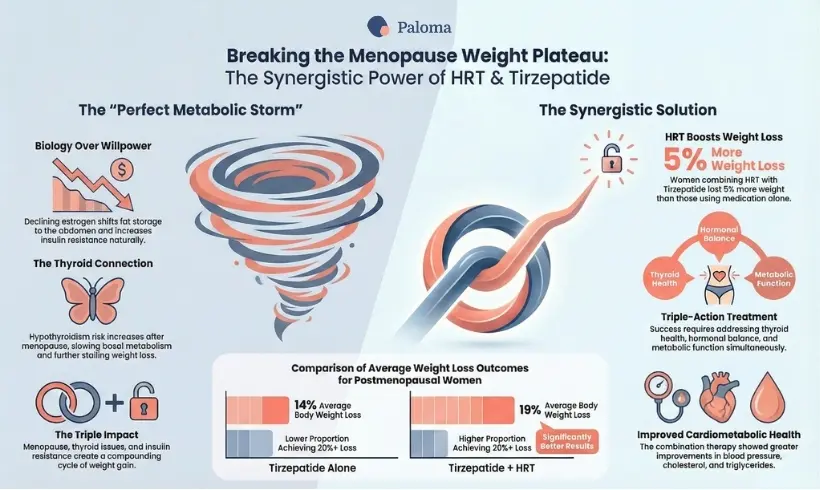
A study of postmenopausal women with overweight or obesity, published in the Lancet Obstetrics, Gynaecology, & Women’s Health in early 2026, found that women taking tirzepatide plus hormone replacement therapy lost more weight than women taking tirzepatide alone.
In this observational study, women who used HRT while taking tirzepatide:
- Lost nearly 19% of body weight on average
- Had a greater proportion achieving 20%, 25%, and even 30% total weight loss
- Showed improvements in heart- and metabolism-related lab measures, like blood pressure and triglycerides
By contrast, women who took tirzepatide without HRT lost about 14% of their body weight on average in the same timeframe.
This research suggests that hormone therapy might boost the weight-loss effects of tirzepatide in postmenopausal women — though scientists caution that cause and effect aren’t yet proven because the study wasn’t randomized.
There are a few reasons why HRT could enhance tirzepatide’s effects.
Changes in appetite and metabolism
Estrogen influences how your the brain regulates hunger and fullness, and how the body metabolizes nutrients. Supporting your estrogen levels through HRT may help your brain and body respond better to tirzepatide’s appetite-suppressing effects.
Better sleep and symptom relief
Menopause often disrupts sleep. Improved sleep from hormone therapy may make it easier for you to stick with lifestyle changes and medication regimens, indirectly supporting weight loss.
Energy and activity levels
Some women find that HRT improves overall energy levels, which can boost physical activity levels—an essential part of long-term weight management.
It’s important to note that not all women will experience the same benefits. Given your medical history and hormonal profile, your response to therapy can vary.
<h2 id="menopause-thyroid">Why hypothyroidism becomes more common after menopause — and why it matters for weight loss</h2>
Why hypothyroidism becomes more common after menopause — and why it matters for weight loss
For many women in midlife, menopause isn’t the only hormonal shift happening. Another quiet but powerful player often enters the picture: the thyroid gland.
The risk of developing hypothyroidism — a condition where your thyroid does not produce enough thyroid hormone — increases significantly during perimenopause and after menopause. In fact, women over 50 are far more likely than younger women or men to be diagnosed with an underactive thyroid, and many cases go undetected for years.
This matters because thyroid hormones regulate metabolism, energy production, body temperature, and how efficiently your body burns calories. When thyroid hormone levels are too low, the body essentially runs in slow motion.
Why hypothyroidism is more common in midlife women
There are several reasons hypothyroidism becomes more prevalent during this stage of life:
- Autoimmune risk increases with age: The most common cause of hypothyroidism is Hashimoto’s disease, an autoimmune condition. Autoimmune disorders disproportionately affect women and often emerge or worsen during times of hormonal change, and as women age.
- Estrogen and thyroid hormones are closely linked: Estrogen influences how thyroid hormones circulate and are used in the body. As estrogen levels fluctuate and decline during perimenopause and menopause, thyroid function can become less stable.
- Symptoms overlap with menopause: Fatigue, weight gain, brain fog, depression, hair thinning, and cold sensitivity are common in both menopause and hypothyroidism. As a result, thyroid problems are often missed or dismissed as “just menopause.”
If you’re trying to lose weight after menopause and nothing seems to work — even with diet changes, exercise, or weight-loss medications — untreated or undertreated hypothyroidism may be part of the problem.
Here’s how it complicates weight management:
Slower metabolism
Thyroid hormones help regulate your basal metabolic rate — the number of calories your body burns at rest. When thyroid hormone levels are low, your body burns fewer calories, even if your food intake hasn’t changed.
Increased fat storage
Hypothyroidism promotes fat storage, especially visceral (abdominal) fat—the kind most closely linked to insulin resistance and heart disease.
Fatigue that limits activity
Low energy, muscle weakness, joint stiffness, and fatigue can make exercise feel exhausting or impossible, reducing daily movement and calorie burn.
Reduced response to weight-loss efforts
Many women with hypothyroidism report that:
- Dieting leads to minimal results
- Weight loss is slow or plateaus quickly, known as metabolic adaptation
- Weight is easily regained
Even powerful medications like tirzepatide may be less effective if thyroid hormone levels are not properly optimized.
For many women, menopause and hypothyroidism don’t occur in isolation. Together, they can create a perfect metabolic storm:
- Declining estrogen increases insulin resistance
- Hypothyroidism further slows metabolism
- Weight gain increases inflammation
- Inflammation worsens insulin resistance
This cycle can make weight loss feel nearly impossible without addressing all three factors: hormones, thyroid health, and metabolic function.
This is one reason why some postmenopausal women feel frustrated when they’re prescribed a weight-loss medication but don’t see the results they expected — the medication may be working. Still, the hormonal foundation isn’t fully supported.
Tirzepatide works by improving insulin sensitivity, reducing appetite, and increasing feelings of fullness. But thyroid hormones influence how efficiently your cells use energy.
If your thyroid hormone levels are:
- Too low
- Poorly converting T4 to the active T3 hormone
- Or inadequately dosed
Your body may not respond as robustly to metabolic treatments, including GLP-1 or dual-agonist medications like tirzepatide.
This doesn’t mean tirzepatide won’t work — it often still helps — but outcomes may improve when thyroid function is properly evaluated and treated, especially in postmenopausal women.
If you’re navigating menopause and considering how to manage your weight, here are some key takeaways:
✔ You’re not alone
Menopause naturally changes your body’s physiology, and weight gain is common — not because of a lack of willpower, but because of biological shifts in hormones, metabolism, and fat distribution.
✔ HRT can be more than symptom relief
While hormone therapy is traditionally prescribed for symptoms like hot flashes or night sweats, it may also play a role in metabolic health, including weight regulation — especially when paired with modern medications like tirzepatide.
✔ Medications like tirzepatide are powerful tools
Tirzepatide is one of the most effective medications available today for obesity and weight management. It’s supported by extensive clinical trials demonstrating substantial body weight reduction and improvements in heart-related risk factors.
✔ Talk with your healthcare provider
Discuss your options with a clinician who understands your health history. Personalized care — including whether HRT, tirzepatide, and thyroid medication are right for you — should include shared decision-making based on benefits and potential risks.

Menopause doesn’t have to mean inevitable weight gain. Cutting-edge research suggests that combining hormone therapy, optimal thyroid treatment, and tirzepatide may help postmenopausal women lose more weight and improve cardiometabolic health than tirzepatide alone.
At Paloma Health, we specialize in caring for women whose health concerns sit at the intersection of thyroid disease, hormones, and metabolism.
Paloma offers:
- Expert-led hypothyroidism care, including convenient at-home thyroid testing and individualized treatment plans
- Support for women in perimenopause and menopause, recognizing how hormonal shifts affect thyroid function and weight
- Medical weight-loss options, including support for GLP-1 and dual-agonist medications like tirzepatide
- Integrated, virtual care, making it easier to manage complex conditions without juggling multiple providers
Paloma’s approach is straightforward:
When thyroid health, hormones, and metabolism are evaluated and treated together, women feel better — and results improve!
If you’re navigating hypothyroidism, menopause, and weight changes all at once, you’re not alone — and you don’t have to piece together care on your own.
Why is weight gain so common after menopause?
Declining estrogen affects metabolism, insulin sensitivity, and fat distribution, making weight gain — especially around the belly — more likely.
What is tirzepatide?
Tirzepatide is a prescription medication that helps regulate appetite and blood sugar, leading to significant weight loss in many people.
How effective is tirzepatide for weight loss?
Clinical trials show average weight loss of 15 to 20% or more, making it one of the most effective obesity medications available.
What is hormone replacement therapy (HRT)?
HRT replaces estrogen (and sometimes progesterone) to relieve menopause symptoms and support bone, metabolic, and overall health.
Does hormone therapy help with weight loss?
On its own, HRT isn’t a weight-loss treatment, but new research suggests it may enhance the effects of medications like tirzepatide.
Why does hypothyroidism matter during menopause?
Hypothyroidism slows your metabolism, increases fatigue, and makes weight loss harder — and the condition becomes more common in women during midlife.
Can hypothyroidism reduce the effectiveness of weight-loss medications?
Yes. If thyroid hormone levels aren’t well controlled, weight-loss medications may be less effective.
Should all postmenopausal women use HRT and tirzepatide?
No. These treatments aren’t right for everyone and should be considered based on your individual health history and medical guidance.
What’s the best approach to weight loss after menopause?
A personalized plan that addresses thyroid health, hormones, metabolism, lifestyle factors, and — when appropriate — medication.
How can Paloma Health help?
Paloma provides integrated care for hypothyroidism, menopause, and weight management, helping women address the root causes — not just the symptoms.
GLP-1 Medications & Hypothyroidism
Struggling with weight loss and hypothyroidism? GLP-1 medications may help. This guide explains how they work, why they’re helpful for thyroid patients, and how to use them safely.


.webp)

.webp)


