



.webp)
In this article
Somewhere between the hot flashes and the sleepless nights, you may notice something stranger and harder to explain: gums that bleed when nothing about your brushing routine has changed. A mouth that feels like it's lined with cotton by mid-afternoon. A metallic taste that shows up for no reason and refuses to leave. Like many women, you may chalk it up to stress, a new toothpaste, or "just getting older." But you probably won't think to connect it to menopause — and neither, often, does your doctor or dentist.
That disconnect is bigger than it sounds. About 75 million women are in perimenopause, menopause, or post-menopause right now in the U.S., and the CDC estimates that approximately 1.3 million U.S. women enter menopause each year. Among women 50 and older, a Delta Dental report found that 84% were unaware that menopause can affect oral health, and nearly 90% were unaware of specific oral health risks tied to menopause, such as increased tooth decay, gum disease, loss of jawbone density, and tooth loss. Your mouth, it turns out, is one of the most sensitive barometers of hormonal change in the entire body — and it's also one of the most overlooked.
Your estrogen levels don't just regulate your menstrual cycle. Receptors for estrogen are scattered throughout your gums, the lining of your cheeks and tongue, the salivary glands, and even the bone that anchors your teeth in your jaw. That's because estrogen plays a direct role in keeping keratinocytes and fibroblasts — the cells responsible for renewing and strengthening the tissue of your mouth — healthy and actively dividing.
When estrogen production falls during perimenopause and menopause, that renewal process slows down. Oral tissue thins and becomes more fragile, saliva production drops, and the bone that supports your teeth can lose density in much the same way the rest of your skeleton does. A 2025 review reported that post-menopausal women are, as a group, at meaningfully higher risk for periodontitis, tooth loss, altered taste, oral lichen planus, and reduced jawbone density — changes tied directly to the drop in estrogen and related bone loss, but compounded by age, medication use, and how someone is managing other menopause symptoms.
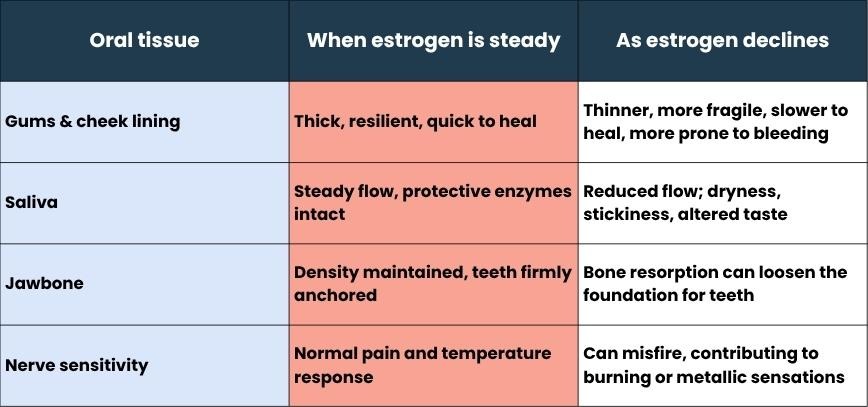
Experts who study this transition tend to group menopausal oral symptoms into three overlapping categories, and it's worth knowing all three because they often show up together and can quietly make each other worse.
Periodontitis (gum disease)
Periodontitis is inflammation that has moved past the gumline and started to damage the bone and connective tissue holding teeth in place. In one clinical study of post-menopausal women, nearly 16% had periodontitis, and over three-quarters reported some kind of oral mucosal change. Estrogen decline is thought to drive this partly by shifting the balance of bacteria in the mouth toward more aggressive, disease-causing species, and partly by weakening the tissue meant to defend against them.
Xerostomia (dry mouth)
Saliva is easy to take for granted until it's gone. It buffers the acids that cause cavities, washes away food debris, and helps prevent the overgrowth of yeast and bacteria. Because your salivary glands carry estrogen receptors, less estrogen circulating in the body translates fairly directly into less saliva. One national survey found that 51% of women say they've noticed a change in their teeth or gums over the years — but most never made the connection to menopause at all.
Burning mouth syndrome
This one is the strangest of the three: a persistent burning, tingling, or scalded feeling on the tongue, lips, or roof of the mouth, often with no visible cause. It disproportionately affects women in the perimenopausal age range, with research estimating it occurs in roughly 10% to 40% of women during this window. Thinner oral tissue and hormone-driven changes in how nerves process sensation are both thought to play a role, and stress or low mood — already common companions of menopause — can make the burning feel more intense.
Nutritionist and menopause specialist Amanda Serif frames it as your mouth trying to get your attention. Here are the five signals she flags as most worth noticing:
- Bleeding gums that show up even when your brushing and your oral hygiene habits haven't changed — a sign of inflammation, not necessarily poor hygiene.
- Dry or sticky saliva, which can start two to three years before your last period as estrogen and progesterone begin their decline.
- A burning sensation or a bitter, metallic taste that lingers, especially if it's new and persistent.
- Loosening teeth or a sense of instability, which can reflect the same bone-density changes affecting the rest of your skeleton.
- Signs that things happening in your mouth may be connected to your metabolism — inflamed gums can let oral bacteria into the bloodstream, a pathway increasingly linked to insulin resistance and cardiovascular risk.
Osteoporosis is often discussed in terms of hips and spines, but the jaw is bone, too, and it isn't exempt. As estrogen falls, the cells that break down bone (osteoclasts) start to outpace the cells that build it back up (osteoblasts), and that imbalance shows up in the alveolar bone — the ridge of jawbone that holds your teeth in their sockets — just as it does elsewhere in the body. Reduced density here doesn't usually manifest as pain. Instead, it can surface as a tooth that feels slightly mobile, a denture that no longer fits quite right, or gum recession that exposes more of the tooth root than before. Because there's rarely a dramatic symptom, this is often the menopausal dental change most likely to go unnoticed until it's fairly advanced.
.webp)
If you've never heard your doctor or dentist bring up menopause and dental health in the same conversation, you're far from alone. Even though more than half of a typical dental practice's female patients are affected by menopause to some degree, dedicated training on the topic is rare in both dental and medical education, which leaves patients to connect the dots on their own — if they connect them at all. Add to that a research base still working to catch up: the most comprehensive recent scoping review on the subject included only 30 studies across the entire body of literature on menopause and oral health published between 2019 and 2024, spanning saliva, gum disease, bone, and the oral microbiome.
The result is a genuine blind spot in midlife care. You'll likely be routinely counseled about bone density, cardiovascular risk, and vaginal and skin changes during your menopausal transition. Still, oral health rarely makes that list — even though the biological mechanism (estrogen withdrawal acting on hormone-receptive tissue) is exactly the same one driving those better-known symptoms.
Part of the problem is structural: dentistry and hormonal health sit in separate silos of the healthcare system, with separate training tracks, separate visit schedules, and rarely any shared documentation between them. A dentist may notice a patient's gum recession accelerating without knowing she started perimenopause eighteen months earlier; a physician prescribing hormone therapy for hot flashes may never think to ask whether her patient has mentioned a new metallic taste to anyone. Closing that gap doesn't require new technology or new medications — it mostly requires patients feeling empowered to say the word "menopause" out loud in the dental chair, and for your practitioners on both sides to ask the question in the first place.
The evidence here is promising but not a slam dunk. One of the largest and longest-running studies on the subject followed more than 42,000 post-menopausal women and found that those currently using hormone therapy had a lower risk of tooth loss than non-users — a finding the researchers linked to estrogen's protective effect on bone. More recent research similarly found that women on hormone replacement therapy (HRT) had significantly lower odds of periodontitis than women who weren't, although HRT didn't appear to change how severe the disease was once it developed. A separate analysis of national health data from Korea found that post-menopausal women who had ever used hormone replacement therapy were meaningfully more likely to have retained a fuller set of natural teeth.
What this doesn't mean is that hormone therapy is a guaranteed fix for dry mouth, bleeding gums, or burning mouth syndrome — the research on those specific symptoms is far more mixed, and individual response varies widely. It does mean that oral health is a legitimate part of the conversation to have with your prescriber if you're weighing whether hormone therapy makes sense for you, alongside the more commonly discussed factors like bone density and hot flashes.
None of this is inevitable decline — it's a set of specific, mostly preventable mechanisms, and there's a lot you can do about each one.
Tighten up the basics
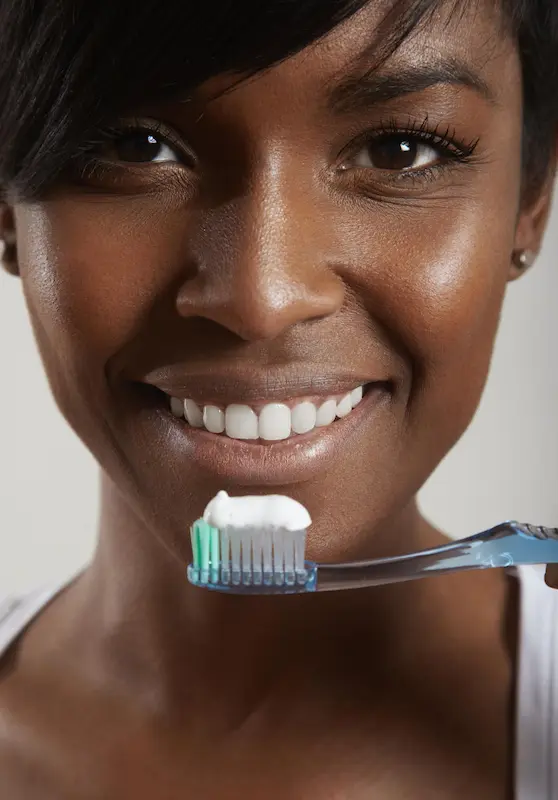
- Brush twice daily with a fluoride toothpaste and floss once a day — unglamorous, but it's still the single best defense against the bacterial shift that fuels periodontitis.
- Ask your dentist about a high-fluoride varnish or gel if you're noticing new sensitivity or dryness, and consider more frequent professional cleanings and dental care during this transition.
- Tell your dentist you're in perimenopause or menopause, even if they don't ask — it changes what they should be watching for.
Eat and drink for your gums and bones
- Vitamin C from citrus, peppers, and berries supports the collagen that keeps gum tissue strong; omega-3s from walnuts, flax, chia, and oily fish support the body's anti-inflammatory response.
- Calcium, vitamin D, vitamin K2, and magnesium work together for bone density — think Greek yogurt, calcium-set tofu, sardines, leafy greens, nuts, and seeds.
- B vitamins, iron, folate, and zinc are linked to taste changes and burning mouth; eggs, fish, poultry, tofu, and leafy greens are good sources.
- Crunchy produce like apples and carrots helps stimulate saliva flow while you chew; frequent water and herbal tea keep things moving the rest of the day.
Manage dry mouth directly
- Sugar-free gum or lozenges stimulate natural saliva flow without feeding cavity-causing bacteria.
- Cut back on sugary foods and drinks, which become more damaging when there's less saliva around to buffer them.
- Ask your dentist or pharmacist about saliva-stimulating products, and mention persistent dryness to your doctor — in more severe cases, prescription options exist to help restore comfortable saliva flow.
Loop in the rest of your care team
- If you're on hormone therapy, or considering it, ask your prescriber whether it's likely to affect your oral symptoms specifically.
- If a burning sensation, taste change, or looseness in a tooth lasts more than two weeks, get it checked rather than waiting it out — early evaluation heads off bigger problems later.
Your mouth isn't separate from the rest of what's happening in your body during perimenopaue and menopause — it's one of the clearest windows into it. The thinning tissue, the dry patches, the bleeding gums, and the slowly shifting bone density are all part of the same hormonal story playing out everywhere else, just in a place most of us were never taught to look. None of it has to catch you off guard, and none of it has to be managed quietly on your own. The more women who bring it up — to their dentist, their doctor, and each other — the faster this becomes a normal, well-understood part of menopause care instead of a footnote.
There's one more piece of the puzzle worth naming: menopause isn't the only hormonal shift that can leave your mouth feeling dry, your gums more fragile, or your taste buds off. An underactive thyroid can produce nearly identical symptoms — fatigue, dry mouth, puffy tissue, even a metallic taste — and thyroid conditions become significantly more common in the same decade most women are moving through perimenopause and menopause. That overlap makes it easy to chalk everything up to "just menopause" when your thyroid may be part of the story too.
That's exactly the kind of overlap we built Paloma Health to untangle. Our at-home thyroid test kit checks TSH, free T4, free T3, and thyroid antibodies from a simple finger-prick sample — no lab visit required — and every result is reviewed by a physician and returned with a plain-language explanation of what it means for you. If your levels point to a thyroid issue, you can meet with one of our thyroid doctors virtually to build a treatment plan tailored to your labs, your symptoms, and your goals, with ongoing care to track how things change over time.
You don't have to guess whether it's menopause, your thyroid, or both. Testing gives you an answer — and an answer gives you a plan that works!
Is it normal for my gums to bleed more during perimenopause even though I haven't changed anything about how I brush?
Yes, and it's one of the most common early signals of the transition. Falling estrogen makes gum tissue more permeable and more reactive to the same amount of plaque it used to tolerate without complaint, so bleeding can increase even when your hygiene routine hasn't slipped at all. It's still worth mentioning to your dentist, since new bleeding is also the easiest early sign of periodontitis to catch and treat before it progresses.
Could my dry mouth actually be a medication side effect instead of menopause?
It could be both at once, and that's exactly why it's worth a conversation rather than a guess. A wide range of common midlife medications — for blood pressure, mood, sleep, or allergies — list dry mouth as a side effect, and menopause tends to compound the dryness those medications already cause. Bringing your full medication list to a dental visit helps your dentist distinguish between medications and adjust their recommendations accordingly.
Does burning mouth syndrome ever go away on its own?
For some women, symptoms ease as hormone levels stabilize in postmenopause; for others, they persist and need targeted management. Because it can also signal nutrient deficiencies, uncontrolled blood sugar, or an unrelated oral condition, it's worth a formal evaluation rather than waiting it out indefinitely, especially if it's been going on for more than a couple of weeks.
I'm not interested in hormone therapy. Does that mean I'm stuck with worse oral health?
Not at all. Hormone therapy shows a protective association with tooth retention and periodontal health in several studies, but it's one lever among many — not a prerequisite for a healthy mouth. Rigorous hygiene, more frequent professional cleanings, targeted nutrition, and prompt attention to new symptoms all work independently of whether you choose hormone therapy.
How do I bring this up with my dentist if they've never mentioned menopause before?
Simply say it out loud at your next visit: that you're in perimenopause or menopause, and that you'd like your cleaning and exam to take that into account. Given how rarely this topic comes up in dental training, most patients end up starting the conversation — and most dentists are glad when they do.
Can menopause increase my risk of cavities?
Yes. Reduced saliva production during menopause means your mouth has less natural protection against acids and cavity-causing bacteria, increasing the likelihood of tooth decay. Staying well hydrated, using fluoride products, and addressing persistent dry mouth can help lower that risk.
Should I see my dentist more often during menopause?
Some women benefit from more frequent cleanings and exams during perimenopause and menopause, especially if they develop dry mouth, gum inflammation, or early signs of periodontal disease. Your dentist can recommend a schedule based on your individual risk factors and oral health changes.
Are bleeding gums during menopause always caused by hormone changes?
Not necessarily. While declining estrogen can make gum tissue more sensitive and prone to inflammation, bleeding gums can also signal periodontal disease or other dental problems that require treatment. If bleeding persists, it's important to schedule a dental evaluation rather than assuming it's simply part of menopause.
Can good oral health improve my overall health during menopause?
Yes. Healthy gums reduce chronic inflammation and may help lower the spread of oral bacteria into the bloodstream, which researchers have linked to conditions such as cardiovascular disease and diabetes. Taking care of your mouth is an important part of supporting your health throughout the menopausal transition.


%20(1).webp)
.webp)


