


.webp)
In this article
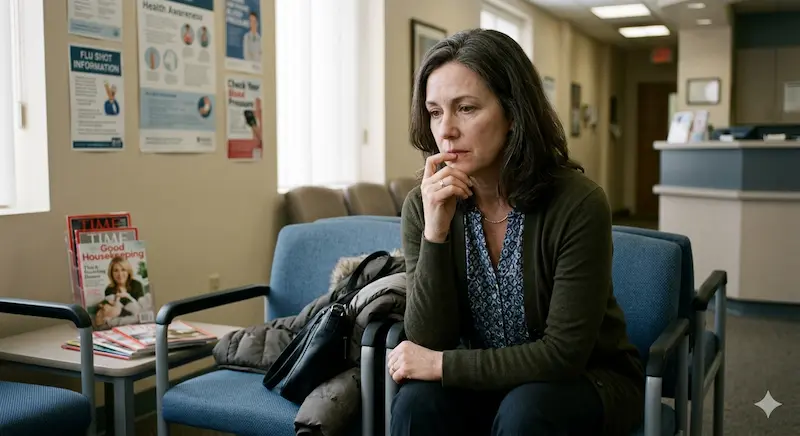
There’s a special kind of exhaustion that doesn’t show up on lab tests.
It’s not just the kind of fatigue where you hit snooze three times and still wake up feeling like you ran an overnight marathon. It’s not just the brain fog that has you opening the fridge and forgetting why you’re there, again. It’s something deeper—and, frankly, more maddening.
It’s the utter exhaustion of not being believed!
Over the years, I’ve heard from thousands of fellow patients—mostly women—who share a strikingly similar story. They go to their doctor, explain that something feels off, and walk out with a version of: “Good news! Everything is normal.”
And yet…nothing feels normal.
Welcome to one of the most frustrating experiences in modern healthcare settings: Everything checks out on paper, your doctor is happy, and you’re left thinking: Why do I feel like this? I call it the invisible patient problem. And for many of us, it becomes a chronic condition in its own right.
Let’s start with the thyroid, because if I had a dollar for every time someone was told their thyroid is “normal” while they feel like a ghostly version of themselves, I could probably fund a small research institute.
Hypothyroidism is one of the most common—and commonly misunderstood—conditions out there. Patients show up with a classic list of symptoms: fatigue, weight gain, depression, constipation, dry skin, hair thinning, and that unmistakable sense that their internal “battery” is permanently stuck at 12%.

But then comes the lab result.
TSH: within range.
For many providers, the translation is easy: “Case closed.”
Except…not so fast!
Reference ranges are based on population averages, not your personal “best functioning” setting. Being “in range” doesn’t automatically mean “optimal,” and it certainly doesn’t mean symptom-free.
And yet, this is where the conversation often ends…prematurely.
You may be told you’re fine. Or “you’re probably stressed.” You’re advised to get more sleep. Or “you just need to take better care of yourself.”
Which is a bit like telling someone with a flat tire, “Well, technically the car still has four wheels, so you’re good.”
You wouldn’t accept that from a car mechanic. Why should you have to accept it from health care professionals?
Here’s where it gets complicated—and honestly, both heartbreaking and infuriating.
When you’re told once that everything is normal, you might push back. When you’re told twice, you start to wonder. By the third or fourth time, a quiet thought creeps in:
What if it’s just me? What if it’s “in my head?”
I’ve seen this happen over and over again. Smart, capable, intuitive women begin to second-guess their own bodies. They minimize their symptoms when describing them. They add disclaimers:
“I know this sounds silly, but…”
“You’re going to think I’m nuts, but…”
“Maybe it’s just stress, but…”
“I’m probably overreacting…”
You’re not overreacting. You’re reacting to something real.
But when the system doesn’t validate your reality, self-doubt rushes in to fill the gap.
Let’s talk about weight for a minute.
Specifically, the deeply unhelpful advice that has probably been given to you—or someone you know—at some point:
“You just need to eat less and move more.”
Now, to be fair, this advice isn’t entirely wrong in a general, textbook sense. But in the real world—especially for people dealing with hypothyroidism, perimenopause, or both—it’s wildly incomplete.

I hear from women all the time who are doing everything right. And I was in this same place myself! Tracking our food intake, prioritizing protein, doing strength training, walking daily…basically living the lifestyle social media keeps telling us will fix everything.
And yet, the scale doesn’t move. Or worse, it creeps up!
When we ask for help, we’re often met with skepticism. The unspoken assumption is obvious: “YOU must not be trying that hard!”
But weight gain in these contexts isn’t just about calories. It’s about hormones.
Thyroid hormones regulate cellular metabolism. Estrogen shifts influence where and how your body stores fat. Insulin sensitivity changes. Cortisol gets involved (because of course it does).
In other words, your body is not a simple math equation.
So, when we’re told to “just eat less,” the real message is:
“This is YOUR fault!”
And that’s not just unhelpful—it’s harmful.
Now let’s add another layer: perimenopause.
If you think you’ll recognize it when it starts, I have news for you. It’s not usually that dramatic, movie-version hot flash moment where you fling open a window in January, or suddenly end up drenched in sweat during a meeting.

More often, symptoms are subtle. Sneaky, even.
- You’re more anxious than usual
- Your sleep is suddenly terrible for no clear reason
- Your periods get a little weird—but not that weird
- You gain weight, especially around your midsection, despite doing all the “right” things
- Your patience? Let’s just say it’s…less abundant.
So, you go to your doctor and say, “Something feels off.”
And if you’re in your late 30s or early 40s, there’s a decent chance you’ll hear:
“Well, you’re too young for perimenopause.”
Except—you’re not!
Perimenopause can start years before menopause officially arrives. (Note: menopause is considered over 12 months after your last period.) But because our definitions are outdated and training hasn’t quite caught up, many women are left struggling in a hormonal limbo.
And here’s the kicker: even when perimenopause is acknowledged, treatment is often…reluctant.
There’s a lot of “let’s wait and see.”
That sounds reasonable…until you realize that “waiting” can mean years of poor sleep, mood swings, metabolic changes, and feeling like a stranger in your own body!
Waiting puts your health—and your life—on hold, whether you like it or not!
Then there’s hair loss.
It might seem “just cosmetic” to some, but for most women, hair loss can be devastating! Hair is highly visible—it’s one of the first things people notice about us. It frames our faces, signals our health, and, yes, it carries a lot of our identity. When it starts thinning or falling out, the change isn’t just physical—it’s emotional.
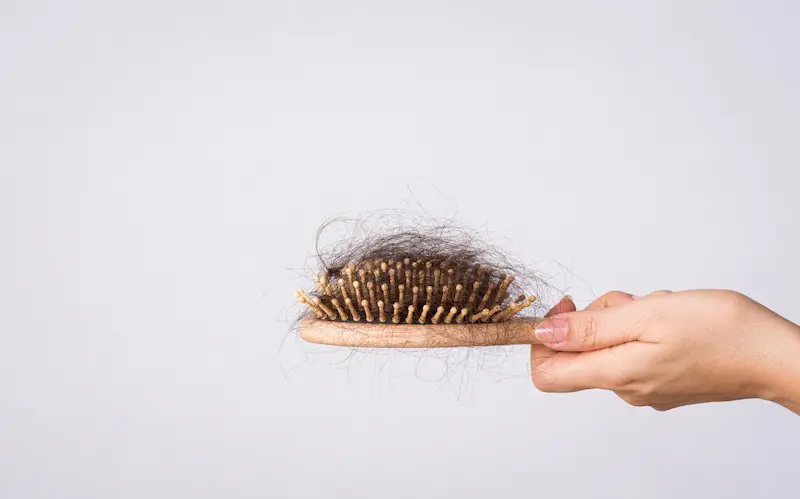
I’ve heard from countless women who describe hair loss as one of the hardest things they’ve had to face. It can feel like a betrayal: your body is changing in a way you can’t control, and every mirror and every shower drain seems to remind you of it. Early in my own thyroid journey, I lost what I estimate to be about 80% of my hair! My usually thick ponytail ended up being the width of a pencil! I even needed drain cleaner to unclog my shower!
Some women hide under hats or scarves. Others cut it short, thinking it would make it “less noticeable.” Many report feeling self-conscious, embarrassed, or even depressed. (In my case, I spent about a year putting my skimpy hair into a sparse bun, and then hiding it under a clip-on messy bun!)
Finally, there comes a day when you bring it up to your doctor.
And too often, the response is something along the lines of:
“It’s just cosmetic.”
“It’s part of aging.”
“There’s not much we can do.”
Or, like the doctor told me years ago when I raised the issue: “It’s stress! You’re just stressed out because you’re losing hair!” (Talk about medical gaslighting! Yes, I was stressed out about losing my hair, but the stress was due to the hair loss, not the cause of it!)
So, let’s push back on this!
Hair loss isn’t vanity. It’s visibility. It’s how your body signals that something is off—whether it’s thyroid imbalance, hormonal shifts, nutrient deficiencies, or autoimmune changes. And dismissing it as “cosmetic” or “just aging” not only invalidates a very real emotional impact—it risks missing an important clue about your health.
The truth is, losing hair can be crushing to confidence, self-image, and emotional well-being. For women navigating thyroid disease or perimenopause, it’s often one of the earliest and most noticeable signs that something needs attention. And it deserves to be taken seriously.
Dismissing it outright doesn’t just invalidate the profound emotional impact—it can also mean missing an important piece of the diagnostic puzzle.
Individually, these moments of dismissal might seem small.
A comment here. A shrug there. A “you’re fine” when you don’t feel fine.
But over time, they add up.
You start to hesitate before making appointments. You rehearse what you’re going to say so you sound “reasonable enough.”You leave things out because you don’t want to be seen as difficult.
And gradually, your world gets smaller. You feel more invisible. Not because your symptoms aren’t real—but because the effort to be heard starts to feel like too much.
This is why I say that feeling unheard becomes its own chronic condition, an invisible illness on its own.
It affects how you show up.
It affects the care you receive.
It affects your health outcomes in ways we don’t always measure.
Here’s the thing: most patients are not expecting miracle cures or instant answers.
What we want is surprisingly simple.
We want to be listened to—without interruption, without assumption, without that subtle glance at the clock.
We want our symptoms taken seriously, even when the cause isn’t immediately obvious.
We want a provider who is willing to say, “I don’t have all the answers yet, but I believe you—and we’ll figure this out together,” instead of medical gaslighting.
That kind of patient-centered care and partnership is incredibly powerful. And, unfortunately, it’s still far too rare.

If we’re going to fix this—and we should—there are a few shifts that need to happen.
- Healthcare providers need to move beyond rigid reliance on “normal” ranges and start looking at the whole person.
- Everyone -- providers and patients alike -- needs to learn more about perimenopause and understand that it doesn’t magically start at a specific birthday.
- The medical system needs to stop reducing complex hormonal imbalances to a matter of willpower and calorie math.
- Our practitioners need to treat our symptoms as meaningful, not trivial.
- And above all, they need to listen. Not just to respond—but to understand
Because when a patient says, “Something is wrong,” that should be the beginning of the conversation – not the end of it.
If you’ve read this and thought, “This is me,” I want you to hear the following, clearly:
- You are not imagining things.
- You are not overreacting.
- And you are not alone.
Your body is giving you information. Your job is to listen to it—and, when necessary, insist that others do too.
Yes, advocacy can be exhausting. (Trust me, I know.) But it’s also powerful.
So ask the follow-up questions. Request the deeper conversation. And seek out providers who make you feel heard, not hurried. Because the goal is not just to be “within range.”
The goal is to feel like yourself again and to live well.
And that starts with being seen and heard.

I’ve been passionate about the model of patient-centered care at Paloma Health because it was designed, from the ground up, to solve this very problem.
At Paloma, the starting point isn’t, “Are your labs normal?”
It’s, “How are you actually feeling?”
That may sound simple, but in today’s healthcare landscape, it’s actually revolutionary!
Paloma’s healthcare professionals are trained to look beyond a single TSH number and consider the full picture—a complete thyroid hormone panel, symptoms, history, patterns, and how thyroid health intersects with other hormonal transitions, such as perimenopause and menopause. There’s an understanding that “in range” isn’t the same as “well,” and that patients don’t live their lives based on lab reports alone.
There’s also time—something that’s become increasingly rare in traditional care. Time to talk. Time to connect the dots. Time to raise your medical concerns. Time during medical appointments to ask the follow-up questions you never have time to ask in most settings.
And perhaps most importantly, there’s a partnership with healthcare professionals.
Patients aren’t dismissed or minimized—they’re engaged. Our symptoms are treated as meaningful data, not inconveniences. Concerns like weight changes, fatigue, mood shifts, and yes, even hair loss, are taken seriously and addressed as part of a larger whole.
Paloma also recognizes something the broader system often misses: that thyroid health doesn’t exist in a vacuum. It overlaps with metabolic health, reproductive hormones, and stress, as well as lifestyle and nutritional guidance in complex ways. Addressing one piece without the others rarely works.
This more comprehensive, patient-centered approach doesn’t just improve outcomes—it changes the patient experience. It makes "invisible illness" a thing of the past. It eliminates medical gaslighting.
It replaces frustration with clarity.
It trades isolation for support and patient advocacy.
And invisibility is transformed into recognition!

.jpg)
.webp)


%20(1).webp)


