


Picture yourself walking down a gentle hill. Then the last step turns out to be a drop. According to a new study, that’s roughly what happens inside your body at menopause.
For decades, menopause has been described as a slow, steady slide. In October 2026, researchers at Israel’s Weizmann Institute of Science published a study in Nature Medicine that challenges that idea. They looked at more than 300 million lab tests and found that at a woman’s final menstrual period, many body systems change at once. They called it a “physiological cliff.”
If you have Hashimoto’s or hypothyroidism, or you’re in your 40s and wondering why your body suddenly feels different, this research matters. Here’s what the study found, what it means for your hormonal health, thyroid and weight, and the lab tests worth getting before you reach the edge.
What is the menopause cliff?
Menopause is the point 12 months after your last period. Most US women reach it around age 51 or 52. The years leading up to it are called perimenopause, and they can last a long time.
Menopause has always been hard to study for a simple reason. Almost nobody records the date of their last period. So most research has followed small groups of women for many years and tried to piece the timeline together.
How the researchers did it
The Weizmann team, led by Glen Pridham, Yoav Hayut, and Uri Alon, borrowed a math tool from astronomy called deconvolution. Astronomers use it to sharpen blurry pictures of stars. Here, it sharpened the blur caused by women reaching menopause at different ages. That let the team match each woman’s lab results with her final period.
They used two large datasets. One was the US National Health and Nutrition Examination Survey (NHANES), from 1999 to 2022. The other was health records from Clalit, an insurer that covers about half of Israel, including 1.3 million women aged 30 to 70, from 2004 to 2024. According to the paper, that added up to more than 300 million lab tests. In the US group, the typical age at the last period was 50.
What they found at the last period
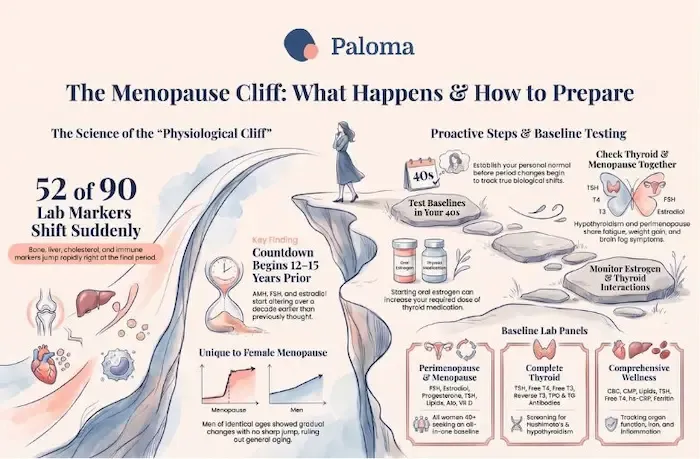
In the US data, 52 of 90 routine lab tests showed a sudden, step-like jump right at the final period. The changes showed up in bone, liver, kidney, blood fats, blood chemistry, and immune markers, all around the same time.
The biggest shifts were in systems that respond strongly to estrogen: bone, liver, cholesterol handling, and fluid balance. The authors wrote that most of the jumps moved in the direction of higher disease risk. And the US and Israeli results lined up closely, even though the two groups were very different.
Menopause isn’t a gentle taper. For many lab markers, it’s a step that happens all at once.
The countdown starts more than a decade early
This was the part that surprised many experts. The hormones that drive menopause start changing long before the cliff.
- Anti-Müllerian hormone (AMH), a marker of your egg supply (also known as ovarian reserve), starts falling faster about 15 years before the last period.
- Follicle-stimulating hormone (FSH) starts rising faster about 14 years before.
- Estradiol, the main form of estrogen, starts dropping faster about 12 years before.
Doctors have usually said these changes start 3 to 7 years before menopause. The study puts the start of the FSH and estradiol changes about 7 years earlier than past research found. Hormone levels also swing up and down more in the final decade. So if your last period comes at 51, your hormones may have started shifting in your late 30s.
Men didn’t show the cliff
The team ran the same analysis on men of the same ages. Their lab values changed slowly over time, with no sudden jump. That points to menopause itself, not just getting older, as the cause.
Hormone therapy softened the drop
Women using menopausal hormone replacement therapy (HRT) had smaller jumps in many markers, especially bone, liver, and kidney tests. Overall, 39 of 80 tests differed between women who used HRT and women who didn’t. The bigger a test’s jump at menopause, the more HRT seemed to smooth it out. The team saw a similar pattern in more than 9,000 Israeli women who were prescribed HRT.
There was one exception. Women on HRT had higher C-reactive protein (CRP), a marker of inflammation. The authors say that fits with research showing oral estrogen, but not the patch, raises CRP as it passes through the liver.
This part of the study was observational, and only about 9% of US women used MHT. Women who choose hormone replacement therapy may be healthier to start with. The authors themselves say randomized trials are needed to prove MHT causes the difference.
Disagreement about the word “cliff”
Not every expert likes the "cliff" label. As ScienceAlert reported, Martha Hickey of the University of Melbourne, who wasn’t involved, said the cliff framing could alarm women. Andrew Shelling of the University of Auckland called the results interesting but not conclusive. The authors also list limits of their own. The data are a snapshot of many women at one time, not the same women followed for years, and menopause status was self-reported. The study also doesn’t show that every lab shift causes disease or needs treatment.
We think that’s worth keeping in mind. But still, a cliff you can see coming is much less scary than one you can’t.
Signs and symptoms you may be nearing the cliff
No single test can tell you your last period is next month. But your body usually drops hints. Common hormonal transition signs of late perimenopause include:
- Periods that come further apart, or long gaps (i.e., 60 days or more) between periods
- Heavier or less predictable bleeding (here’s more on heavy periods in your 30s and 40s)
- Hot flashes, night sweats, and other vasomotor symptoms
- Trouble falling asleep or staying asleep
- Mood swings, anxiety, or low mood
- Brain fog and forgetfulness, also known as “peri-brain”
- Weight gain around the middle, even when your habits haven’t changed
- Joint aches, dry skin, and thinning hair
Here’s the catch. Many of these also point to an underactive thyroid. Fatigue, brain fog, weight gain, low mood, and hair thinning can come from either one, or both. That’s why so many women get misdiagnosed in this window. Paloma has a helpful guide to the difference between thyroid symptoms and menopause, plus a list of 10 surprising symptoms of perimenopause and menopause.
What happens when you go over the cliff
The study tracked lab results and also looked at how often women developed certain health problems. Here’s what changes around the final period, and what it could mean for you.
Your bones start losing density faster
Bone markers, including calcium and bone alkaline phosphatase, jumped at the last period. After the last period, osteoporosis rates in women started climbing faster, far outpacing men of the same age. That matches earlier findings from the Study of Women’s Health Across the Nation (SWAN), which showed that bone loss speeds up about a year before the final period and stays fast for a few years after.
Your cholesterol shifts
Blood fat markers were among the biggest changes. This metabolic dysregulation lines up with an earlier SWAN study showing that total cholesterol, LDL (“bad”) cholesterol, and apolipoprotein B rise sharply within a year of the final period, and that age alone doesn’t explain it. In the new study, heart attack and stroke rates also climbed faster after menopause. So did several other health problems the team tracked, including diabetes and liver disease. The American Heart Association now calls the menopause transition a key window for heart disease prevention.
Liver and kidney markers change
Liver enzyme tests jumped, along with markers tied to fluid balance, like sodium and blood osmolality. Kidney filtering markers like creatinine changed only a little.
Inflammation and immune markers move
White blood cell markers and C-reactive protein (CRP), a common sign of inflammation, also shifted. The researchers even saw blood lead levels rise. That’s likely because lead stored in your bones gets released as bone breaks down faster.
One change for the better
Not everything gets worse. Iron, hemoglobin, and red blood cell counts improved, and anemia became less common. That makes sense, since there’s no more monthly blood loss with menstrual periods.
Mood and sleep take a temporary hit
In the year after the last period, 19% of women had moderate to severe depression symptoms, compared with 11% over the next 24 years. Trouble falling asleep and not getting enough sleep also rose for a while. On average, these effects faded. But the authors note that some women do have depression that lasts after menopause, so get help if your mood doesn’t lift.

The thyroid connection: Hashimoto’s, hypothyroidism, and weight gain
For Paloma readers, this is where it can get even more personal. The menopause cliff lands right in the years when thyroid problems are most likely to show up.
What the study found about the thyroid
Free T4 and free T3, the thyroid hormones themselves, showed no detectable jump in the final period, and overall thyroid tests changed relatively little. The authors described thyroid outcomes as only weakly affected by menopause. But the research also found that after menopause, the gap between women and men in thyroid problems keeps getting wider, with women pulling further ahead.
So menopause doesn’t seem to flip a thyroid switch overnight. Instead, the two overlap in time. And each one can make the other harder to spot and harder to treat.
Why thyroid problems rise in midlife
Thyroid conditions are common in women, and they get more common with age. In a large US survey, thyroid antibodies were more common in women and increased with age. TSH, the main thyroid screening test, also creeps up as we get older. One review of postmenopausal women estimated that about 23% have mild (subclinical) thyroid disease, and most of those cases are underactive.
In 2024, the European Menopause and Andropause Society issued its first position statement on thyroid disease and menopause. The message was clear: the symptoms overlap so much that diagnosis often gets delayed, and women need a careful, personal approach. Paloma covers this overlap in depth in the connection between perimenopause, menopause, Hashimoto’s, and hypothyroidism.
Hashimoto’s and the immune shift
Hashimoto’s is an autoimmune disease, and it’s the most common cause of hypothyroidism in the US. Estrogen and progesterone help regulate the immune system. As they swing and fall, they may affect how autoimmune conditions like Hashimoto’s start, progress, or flare. The new study’s finding that immune and inflammation markers jump at the last period fits with that idea, although it didn’t test Hashimoto’s directly.
If you’ve never had your thyroid antibodies checked, perimenopause is a good time to do it. Positive TPO or thyroglobulin antibodies can show up years before your TSH goes out of range. Not sure which one you’re dealing with? Read perimenopause or Hashimoto’s: how to tell the difference.
The weight gain double whammy
Weight gain is one of the most frustrating parts of this stage, and it’s not in your head. SWAN data found that the rate of fat gain nearly doubled in the menopause transition, from about 1% a year to about 1.7%, starting roughly two years before the final period. At the same time, lean muscle started to shrink. The number on the scale may not change much, but your shape does, with more fat around your middle. Less muscle also means a slower metabolism.
Hormones play a part too. Another SWAN study found that metabolic syndrome became more common as women moved through menopause, regardless of age. Metabolic syndrome is a cluster of belly fat, high blood sugar, high blood pressure, and unhealthy cholesterol.
Now add your thyroid. Research shows that even small differences in thyroid function, within the normal range, are linked to differences in body weight. So a woman with undertreated hypothyroidism who reaches the menopause cliff can get hit twice. Paloma explains more about weight loss after 40 and the hormonal obstacles and whether HRT and tirzepatide can help with weight loss after menopause.
If you have Hashimoto’s, menopause and a sluggish thyroid can push your weight, cholesterol, and energy the wrong way at the same time.
Cholesterol is where thyroid and menopause collide
Low thyroid hormone slows how your liver clears LDL cholesterol. Menopause raises LDL too. Put them together, and cholesterol can climb fast. If your cholesterol jumps in your late 40s, check your thyroid before assuming it’s only menopause. Learn more about how hypothyroidism is linked to high cholesterol and hyperlipidemia’s connection to hypothyroidism.
If you take thyroid medication and start estrogen
This one matters. Oral estrogen raises a blood protein that binds thyroid hormone, leaving less of it free to work. In a New England Journal of Medicine study, women on levothyroxine who started estrogen saw their free T4 drop and their average TSH rise from 0.9 to 3.2. Several needed a higher thyroid dose.
If you start, stop, or change hormone therapy, ask your provider to recheck your thyroid labs in about 6 to 12 weeks. Paloma’s guide to preparing for perimenopause when you’re hypothyroid has more tips.
How to prepare: Your baseline labs before the cliff
The most useful lesson from this study is about timing. The authors say their findings stretch the window for spotting changes, and for preventive care, to almost a decade before menopause. If the big changes happen at your final period, you need to know your numbers before then. A baseline gives you and your provider something to compare against. That way, you can spot a real change instead of guessing.
Paloma partner JustLabs lets you order lab panels online without a doctor’s visit. A physician authorizes each order; you get your blood drawn at a Quest Diagnostics location. Your results usually arrive securely to your computer in a few business days. JustLabs is self-pay and highly affordable, often costing less than your insurance co-pay. JustLabs testing is generally HSA- and FSA-eligible. Here are the recommended panels based on the study findings.
If the big changes happen at your final period, you need to know your numbers before then.
Perimenopause & Menopause Blood Test Panel
This panel is the best all-in-one starting point. Your Perimenopause & Menopause Blood Test Panel should include: FSH, estradiol, progesterone, free and total testosterone, TSH, a standard lipid panel, hemoglobin A1c, and vitamin D. That covers most of the “before the cliff” checklist in one blood draw, and no fasting is needed.
Complete Thyroid Panel
If you have Hashimoto’s or hypothyroidism, or you have thyroid symptoms, TSH alone isn’t enough. A Complete Thyroid Panel checks TSH, free T4, free T3, reverse T3, and TPO and thyroglobulin antibodies.
Comprehensive Wellness Panel
The Comprehensive Wellness Panel tracks many of the exact systems that jumped in the study. It includes a complete blood count, a comprehensive metabolic panel (liver, kidney, glucose, calcium, and electrolytes), lipids, TSH, free T4, hemoglobin A1c, vitamin D, high-sensitivity CRP, and ferritin. You’ll need to fast for this one.
Advanced Heart Health Panel
Since LDL and apolipoprotein B rise sharply at menopause, a basic cholesterol test may not tell the full story. The Advanced Heart Health Panel adds ApoB, lipoprotein(a), homocysteine, and high-sensitivity CRP to a full lipid panel.
Vitamin D, 25-hydroxy
Vitamin D helps your body absorb calcium, which matters more as bone loss speeds up. It’s included in the first and third panels above, or you can order a vitamin D test on its own. Keep in mind that blood tests can’t measure bone density. For that, ask your provider about a DEXA scan.
Your next steps
- Know where you are. Track your cycles, and note skipped periods, heavier bleeding, and new symptoms. Gaps of 60 days or more often mean you’re in late perimenopause, closer to the cliff.
- Get your baseline labs now. If you’re 40 or older, don’t wait for symptoms. Start with the Perimenopause & Menopause panel, and add the Complete Thyroid Panel if you have or suspect thyroid disease.
- Retest on a schedule. Recheck once a year during perimenopause and the first few years after your last period, or sooner if your symptoms change. Compare your results to your own past numbers, not just the normal range.
- Don’t blame everything on menopause. If you have fatigue, weight gain, brain fog, or rising cholesterol, rule out a thyroid problem first.
- Recheck your thyroid when your hormones change. If you take thyroid medication, starting or changing estrogen can raise the dose you need.
- Talk about hormone therapy early. New guidance from the American College of Obstetricians and Gynecologists in October 2026 supports hormone therapy as a first-line option for hot flashes and night sweats in eligible women. Benefits tend to outweigh risks for women under 60 or within 10 years of menopause who don’t have reasons to avoid it.
- Protect your bones and muscles. Physical exercise is essential. Lift weights or do resistance exercise and strength training, get enough protein, calcium, and vitamin D, and ask about a bone density (DEXA) scan. Paloma’s lifestyle changes for an easier menopause with hypothyroidism and healthy habits for an easier perimenopause are good places to start.
- Watch your heart numbers. Ask for ApoB and Lp(a) at least once, and keep an eye on your blood pressure. If you have hypothyroidism, read about thyroid medication and heart disease.
A note from Paloma
At Paloma Health, we see this overlap every day. Many of our members come to us with Hashimoto’s or hypothyroidism and then find perimenopause piling on top. Others come in for hot flashes or weight gain and learn their thyroid is part of the story. As our guide to common symptoms in perimenopause, menopause, and hypothyroidism shows, it’s often hard to tell them apart without the right labs.
Our providers treat both. A Paloma membership gives you online visits with thyroid and hormone specialists, personalized care for hypothyroidism, Hashimoto’s, perimenopause, and menopause, plus lab orders and prescription management in one place. We also accept most major insurance plans. Getting your baseline is easy with our at-home thyroid blood test kit or a JustLabs panel.
Every woman who lives long enough will reach this point. But you don’t have to go over the edge blind. Start your thyroid and menopause care with Paloma, and let’s get your numbers in place while you still have time.
understand the connection
Perimenopause, Menopause, and Hypothyroidism
Gain insights into how these conditions are linked and how to manage your health effectively.

Frequently asked questions
What is the menopause cliff?
It’s the term researchers used for sudden, step-like changes in dozens of lab tests at a woman’s final period. A 2026 Nature Medicine study found that 52 of 90 routine tests jumped at that point.
When do menopause changes really start?
Hormones like AMH, FSH, and estradiol start changing faster 12 to 15 years before the last period. That’s much earlier than the 3 to 7 years doctors usually cite.
Is the menopause cliff dangerous?
Not by itself, and the study doesn’t show that every lab shift causes illness. But changes like rising cholesterol and faster bone loss raise long-term risks that are worth tracking.
Does menopause cause hypothyroidism?
The study didn’t find a sudden jump in thyroid hormone levels at the final period. But thyroid disease becomes more common with age, and the two conditions often overlap and share symptoms.
Can perimenopause make Hashimoto’s worse?
Shifts in estrogen and progesterone may affect autoimmune activity, including Hashimoto’s. If your symptoms change in your 40s, it’s smart to recheck your thyroid labs and antibodies.
Why am I gaining weight around my middle?
Research shows fat gain nearly doubles and muscle starts to shrink during the menopause transition. An underactive thyroid can add to this, so test both.
Which lab tests should I get before menopause?
A good baseline includes a full thyroid panel, lipids, hemoglobin A1c, vitamin D, and hormones like FSH and estradiol. Liver, kidney, and inflammation markers add helpful context.
Can a blood test tell me when my last period will be?
No single test can predict the exact date. FSH and estradiol swing a lot in perimenopause, so your cycle pattern and symptoms matter just as much.
Does hormone therapy prevent the cliff?
Women using hormone therapy had smaller jumps in many markers, especially bone, liver, and kidney tests. But the finding was observational and still needs testing in trials, so talk with your provider about whether it fits your health history.
Should I adjust my thyroid medication during menopause?
You might, especially if you start oral estrogen, which can raise your levothyroxine needs. Have your TSH and free T4 rechecked about 6 to 12 weeks after any hormone change.