

In this article
On October 15, 2026, the American College of Obstetricians and Gynecologists (ACOG) published Clinical Practice Guideline No. 13 in the journal Obstetrics & Gynecology. It replaces the group’s 2014 guidance and, according to ACOG’s announcement, is its most comprehensive menopause guidance to date. The guideline was developed by ACOG’s gynecology practice committee, and it grades the evidence behind every major treatment for three symptom groups: hot flashes and night sweats, sleep disturbance, and mood changes. As Contemporary OB/GYN’s detailed breakdown explains, each recommendation is rated by strength and by the quality of the research behind it, drawing on studies published between 2013 and early 2024.
ACOG is putting real weight behind the topic. The entire November 2026 issue of Obstetrics & Gynecology is devoted to menopause, with articles on sleep disruption, hormonal options in perimenopause, the cardiometabolic effects of menopause, estrogen therapy and breast cancer risk, and how social factors shape menopause care. ACOG President Dr. Camille Clare said symptoms can be debilitating enough to disrupt women’s health, family life, and careers, and stressed that women need access to, and insurance coverage for, evidence-based care as menopause misinformation keeps spreading.
The guideline also doesn’t stand alone. Just one week earlier, the American College of Physicians published its own guideline in Annals of Internal Medicine, also recommending menopausal hormone therapy (MHT) as first-line treatment for hot flashes. MedPage Today’s report framed ACOG’s update as joining a growing cross-specialty consensus. Harvard’s Dr. JoAnn Manson, a past president of the Menopause Society, told the outlet that professional societies increasingly agree symptoms should be treated with hormones as the first choice, and that too many women still suffer through symptoms in silence.
Why HRT fell out of favor, and why it’s back
In 2002, early results from the Women’s Health Initiative (WHI) linked some forms of hormone replacement therapy to small increases in breast cancer and cardiovascular risk. Prescriptions plummeted, boxed warnings stayed on many products for two decades, and a generation of women was told to “tough it out.” Later analyses painted a far more nuanced picture, especially for women in their 40s and 50s. The FDA moved to remove the boxed warnings about heart disease, breast cancer, and dementia, and updated labeling followed in early 2026. Now, ACOG wants to ease two decades of fear about menopausal hormone therapy and promote a paradigm shift in how medical groups talk about it. (If you’ve been wondering whether HRT is safe for you, you’re not alone.)
“Menopausal hormone therapy is safe and certainly effective for many newly menopausal women.
— Robert Kauffman, MD, MSCP, guideline coauthor
Coauthor Dr. Bruce Pier noted in ACOG’s release that misconceptions about the risks have made some clinicians reluctant to prescribe hormone replacement therapy and some patients reluctant to try it. The new guidance aims to address this by thoroughly reviewing the evidence to support honest, individualized conversations.
Menopause symptoms: Hot flashes, sleep, and mood
Menopause is officially reached 12 months after your final menstrual period. Natural menopause happens at an average age of about 50 in the United States, according to ACOG, while menopause induced by surgery, chemotherapy, or radiation can arrive much earlier. The transition leading up to natural menopause, perimenopause, usually begins in your 40s, though it can start in your thirties and last four to eight years. Symptoms can begin years before your final period and continue for years after it. About 2 million US women begin menopause each year. Here’s what the new guideline focuses on, and what it doesn’t.
Hot flashes and night sweats
Between 50% and 92% of women in menopause experience vasomotor symptoms, the medical term for hot flashes and night sweats. (ACOG now recommends use of the term “hot flush,” because the wave of heat across the face, neck, and chest isn’t a quick flash; it typically lasts one to five minutes.) And it’s not a short phase. The landmark Study of Women’s Health Across the Nation (SWAN) found that frequent hot flashes lasted a median of 7.4 years, and more than a decade for women whose symptoms started early in perimenopause. Black women reported the longest duration, around 10 years.

Sleep disruption
Between 16% and 66% of US women report menopause-related sleep problems. Many are driven by night sweats that jolt you awake, but sleep can also suffer from anxiety and hormonal shifts. Poor sleep then feeds fatigue, irritability, and the “peri-brain” fog so many women describe.
Mood changes
More than one-third of perimenopausal and postmenopausal women worldwide report depressive symptoms. Hormonal fluctuations can make you more vulnerable to depression during perimenopause and to new or worsening anxiety, even if you’ve never experienced either before.
Symptoms this guideline doesn’t cover
The new guidance doesn’t address genitourinary syndrome of menopause, which includes vaginal dryness, painful sex and low libido, and recurrent urinary tract infections. ACOG plans to issue separate guidance on these issues in 2027. Menopause can also bring joint pain, skin and hair changes, heart palpitations, and other surprising symptoms that are worth raising with your clinician.
Inside the new 2026 ACOG guidelines
ACOG rated each recommendation as either “strong” (benefits clearly outweigh harms, and most patients should receive it) or “conditional” (the right choice depends on your situation and preferences). Here are the highlights.
Hormone therapy earns a strong recommendation
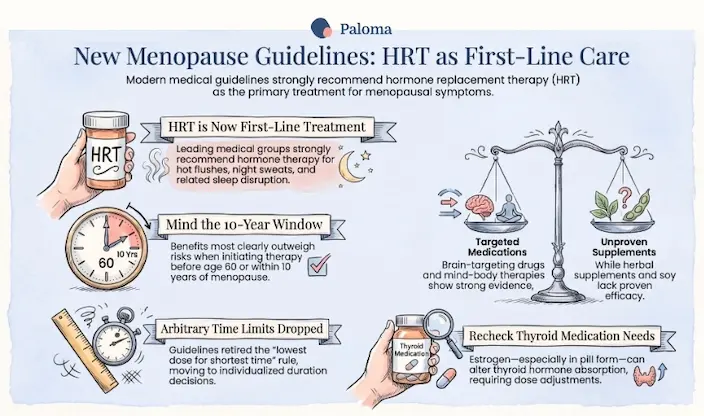
For women without contraindications, ACOG strongly recommends systemic hormone replacement therapy for hot flashes and for sleep disturbances caused by them. If you have a uterus, that means estrogen plus a progestogen, which protects the uterine lining. If you’ve had a hysterectomy, estrogen alone is fine. ACOG also conditionally supports a combination of conjugated estrogens and bazedoxifene (sold as Duavee), which replaces the progestogen and may suit women who get breakthrough bleeding or breast tenderness from progestogens.
Timing: the 10-year window
When menopausal hormone therapy is chosen, ACOG strongly recommends starting before age 60 or within 10 years of menopause. The decision should be shared between you and your clinician and should weigh your age, medical history, symptoms, goals, and baseline risks of heart disease, breast cancer, and blood clots. The guideline points clinicians to tools such as the American College of Cardiology’s heart risk calculator and the National Cancer Institute’s breast cancer risk tool. Some experts, including the Menopause Society’s Dr. Stephanie Faubion, told The New York Times they would have liked clearer guidance on what to do with those risk scores.
Goodbye to “lowest dose for the shortest time”
The 2014 guidance urged the lowest effective dose for the shortest possible time. The new guideline drops that blanket rule. Instead, decisions about when and how to stop should be individualized and revisited regularly, and some women may reasonably continue past 60 to manage persistent symptoms. One safety rule stays firm: any persistent or unscheduled bleeding after starting hormones should be evaluated.
Strong nonhormonal options
For women who can’t or prefer not to take hormones, ACOG gave two medication classes strong recommendations. SSRIs and SNRIs (certain antidepressants) can ease both hot flashes and depressive symptoms. Low-dose paroxetine (7.5 mg) is the only antidepressant FDA-approved for hot flashes, and fluoxetine and paroxetine should generally be avoided if you take tamoxifen. Neurokinin receptor antagonists are a newer class that calms the brain’s overheated temperature center. Fezolinetant (Veozah) worked as early as day 1 in the SKYLIGHT trials, and elinzanetant (Lynkuet) reduced both hot flashes and sleep disturbances in the OASIS 1 and 2 trials. Both require liver function monitoring. Gabapentin, taken at bedtime, is a conditional backup option.
Mind-body and lifestyle approaches
ACOG conditionally recommends cognitive behavioral therapy (CBT), mindfulness-based programs, exercise, clinical hypnosis, and acupuncture for various combinations of hot flashes, sleep, mood, and anxiety. They can be used on their own, but because the evidence is weaker than for medication, ACOG generally recommends them alongside hormonal or nonhormonal medication. Still, they’re low-risk and can make a meaningful difference.
“What’s changing is the breadth of options that we now have.”
— Catherine Cansino, MD, MPH, chair of ACOG’s guideline committee, speaking to NPR

What the guideline doesn’t support
The evidence doesn’t support phytoestrogens such as soy isoflavones or herbal supplements. ACOG warns that these products are easy to buy and heavily marketed, yet the FDA doesn’t regulate them or test them for safety, effectiveness, or purity. (For a balanced look at what may help around the edges, see our guide to natural treatments for perimenopause and menopause.) Clonidine isn’t recommended as a primary treatment, and oxybutynin’s cognitive side effects limit its use in women over 65. Importantly, hormone replacement therapy isn’t recommended to prevent heart disease or dementia in women without symptoms. It’s a treatment for women with a clear reason to use it.
A call to close gaps in care
The guideline also tackles inequities. Dr. Cansino said racial, cultural, and socioeconomic factors shape both how women experience menopause and the care they receive, and MedPage Today noted ACOG’s attention to women of color and other marginalized groups whose symptoms and treatment experiences may differ. ACOG is also calling for earlier, more thorough menopause education so women can recognize symptoms and seek help sooner.
Hormone therapy and your symptoms: a deeper look
Why estrogen cools hot flashes
Your brain’s thermostat sits in the hypothalamus. When estrogen drops, a group of neurons there becomes overactive, driven partly by a chemical messenger called neurokinin B. The result is a narrower comfort zone: a tiny rise in core temperature triggers a full-blown flash, sweating, and a racing heart. Restoring estrogen calms those neurons, which is why hormone therapy works so well. Neurokinin receptor antagonists target the same pathway from a different angle.
How well does it work?
According to the evidence reviewed in the ACOG guideline, estrogen with or without a progestogen cut hot flash frequency by more than half compared with placebo and reduced severity even more. In a network analysis of 32 randomized trials, a skin-applied estradiol plus a progestogen ranked as the most effective option. For sleep, a meta-analysis of 15 trials involving more than 27,000 women linked menopausal hormone therapy to better self-reported sleep quality, with the biggest effects from transdermal and 17β-estradiol regimens. That aligns with the Menopause Society’s position statement, which calls hormone therapy the most effective treatment for hot flashes.
Revisiting the Women’s Health Initiative
Nearly two-thirds of WHI participants were 60 or older, well past the age when most women start hormones for symptoms. A Cochrane review of 19 trials involving more than 40,000 women found that starting hormone replacement therapy before 60 or within 10 years of menopause was linked to a lower risk of coronary heart disease and no increase in stroke, though blood clot risk was higher. Starting more than 10 years after menopause carried higher clot and stroke risks. An 18-year follow-up of the WHI trials found that hormone therapy did not increase the risk of death from any cause.
What about breast cancer?
Breast cancer risk depends on the type of therapy. In long-term WHI follow-up, estrogen alone (used by women without a uterus) was associated with lower breast cancer incidence and mortality. In comparison, estrogen combined with the synthetic progestin used in the trial was associated with higher incidence. Longer duration may add some risk, which is exactly why ACOG asks clinicians to assess your baseline risk and revisit the decision over time.
Patch, gel, or pill: route matters
How estrogen enters your body changes its risk profile. Oral estrogen passes through the liver first, which raises clotting factors. A large BMJ study of more than 80,000 women found that oral hormone replacement therapy increased blood clot risk, while transdermal patches, gels, and sprays were not associated with higher risk. That’s why skin-based options are often preferred for women with higher clot risk. Dr. Cansino has noted that a current shortage of transdermal estrogen shows how much demand has grown, so ask about alternatives if your pharmacy is out. You may also hear about bioidentical hormones; FDA-approved estradiol and micronized progesterone are bioidentical and well studied.
Mood, depression, and hormones
ACOG found the evidence insufficient to recommend hormone therapy specifically for menopause-related depression. If depression is your main symptom or meets the criteria for major depression, it should be treated according to standard depression guidelines, where SSRIs and SNRIs shine. Many women still find that better sleep and fewer night sweats lift their mood.
If you have a thyroid condition
Thyroid disease and menopause often arrive together, and their symptoms overlap: fatigue, brain fog, weight changes, sleep problems, mood shifts, and irregular periods. Menopause may even influence autoimmune conditions like Hashimoto’s. If you’re hypothyroid, preparing for perimenopause means getting your thyroid checked before you blame everything on hormones, or vice versa.
There’s also an important medication interaction. A classic study in the New England Journal of Medicine found that women on thyroid hormone who started oral estrogen needed higher thyroxine doses because estrogen raises levels of the protein that binds thyroid hormone in the blood. This effect is mainly seen with oral estrogen. If you start, stop, or switch hormone therapy, ask to have your TSH and free thyroid hormone levels rechecked within the first few months. Learn more about managing hypothyroidism alongside hormone replacement therapy.
Your next steps
Guidelines are only useful if they can factor into your actual care. Here’s how to put this news to work.
- Track your symptoms for two weeks. Note how many hot flashes you have each day, how often you wake at night, your mood, and any period changes. Concrete data makes your appointment far more productive.
- Know your risk profile. Gather your personal and family history of blood clots, stroke, heart disease, breast or uterine cancer, and liver disease. Bring recent blood pressure and cholesterol numbers, and ask your clinician to run heart and breast cancer risk calculators with you.
- Ask direct questions. Am I a good candidate for hormone therapy? Which form fits my risk profile? Do I need a progestogen? How will we decide when to reassess or stop?
- Consider the delivery method. If you have higher clot risk, a migraine history, or other concerns, ask whether a patch, gel, or spray makes more sense than a pill.
- Mind the window. If you’re under 60 or within 10 years of menopause and struggling, don’t wait years to ask. Your options are broadest now.
- Check your thyroid. Get a baseline thyroid panel before starting HRT, and a recheck after, especially if you take levothyroxine.
- If hormones aren’t for you, ask about alternatives. Fezolinetant, elinzanetant, SSRIs or SNRIs, and gabapentin all have evidence behind them. Pair any treatment with exercise, mindfulness, or CBT for insomnia.
- Report bleeding and schedule reviews. Tell your clinician about any unexpected bleeding, and plan to review your treatment at least yearly.
- Use trusted patient resources. ACOG has published a patient book, Menopause: What Your Ob-Gyn Wants You to Know, and offers free patient education on its Every Stage Health site.
- Be skeptical of hype. Skip unregulated supplements and social media promises. Our list of perimenopause myths is a good reality check, and our guide to signs perimenopause is ending can help you understand where you are in the transition.
A note from Paloma
Too many women still struggle to find effective menopause care, and the new guidelines only help if you have a clinician who knows how to apply them. At Paloma Health, our clinicians specialize in thyroid and hormonal health and understand how the two intersect in midlife. Through convenient video visits, we offer personalized perimenopause and menopause care, including hormone replacement therapy prescribed in the form that fits you, from patches and gels to pills and vaginal rings.
Because hormone replacement therapy can shift thyroid medication needs, we recommend rechecking thyroid levels in the first few months after starting HRT, and our at-home thyroid test kit makes that easy. If you’re in perimenopause and under 50, read our guide to treating perimenopause with HRT. Paloma works with most major insurance plans, so check your coverage or schedule a free consultation call to find out whether we’re the right fit.

understand the connection
Perimenopause, Menopause, and Hypothyroidism
Gain insights into how these conditions are linked and how to manage your health effectively.

Frequently asked questions
What are the new ACOG menopause guidelines?
They are ACOG’s updated recommendations for treating hot flashes, night sweats, sleep problems, and mood symptoms of menopause, published in October 2026. They strongly recommend menopausal hormone therapy for most women with these symptoms and outline strong nonhormonal alternatives for those who can’t use hormones.
Is hormone replacement therapy safe?
For most healthy women under 60 or within 10 years of menopause, experts now agree the benefits of HRT outweigh the risks. It isn’t right for everyone, especially women with a history of blood clots, stroke, or certain cancers, so a personal risk review is essential.
Am I too old to start hormone therapy?
ACOG recommends starting before age 60 or within 10 years of menopause, when the benefit-risk balance is most favorable. Starting later carries higher risks of stroke and blood clots, so nonhormonal options are often a better first step.
How long can I stay on hormone replacement therapy?
There’s no longer a one-size-fits-all time limit. You and your clinician should review your symptoms and risks regularly, and some women reasonably continue past 60 for persistent symptoms.
Is an estrogen patch safer than a pill?
For blood clot risk, research suggests skin-applied estrogen is safer because it bypasses the liver. Patches, gels, and sprays are often preferred for women at higher risk of clots.
Do I need progesterone if I take estrogen?
If you have a uterus, yes, because a progestogen protects the uterine lining from cancer. If you’ve had a hysterectomy, estrogen alone is usually appropriate.
What can I take if I can’t use hormones?
ACOG strongly recommends neurokinin receptor antagonists such as fezolinetant and elinzanetant, as well as certain SSRIs or SNRIs. Gabapentin, CBT, mindfulness, exercise, hypnosis, and acupuncture are additional options.
Does hormone therapy help with depression or anxiety?
ACOG found the evidence insufficient to recommend hormones specifically for menopause-related depression. Depression should be treated with proven approaches like SSRIs, SNRIs, and therapy, though better sleep from hormone therapy may help mood indirectly.
Will hormone therapy affect my thyroid medication?
It can, especially oral estrogen, which may increase the amount of levothyroxine you need. Plan to have your thyroid levels rechecked in the first few months after starting or changing hormone therapy.
Do supplements like soy or black cohosh work for hot flashes?
ACOG concluded that evidence doesn’t support the safety or effectiveness of phytoestrogens or herbal supplements for menopause symptoms. Because supplements aren’t FDA-tested for purity or effectiveness, talk with your clinician before relying on them.