




In this article

If you live with hypothyroidism or you're navigating perimenopause or menopause, you probably know the feeling. You wake up tired, hit a wall by mid-afternoon, and lose your train of thought mid-sentence. Meanwhile, the scale creeps up even though you haven't changed how you eat.
These symptoms are real, and they're common. In a survey of more than 5,000 people being treated for hypothyroidism who reported brain fog, nearly 8 in 10 said they experienced it frequently, and fatigue and forgetfulness were the symptoms they most closely tied to it. Fatigue and weight gain are also among the most frequent complaints thyroid patients bring to their doctors. And during the menopause transition, fluctuating estrogen brings its own cognitive fuzziness, often called "peri-brain."
So it's no surprise that many of us lean on caffeine to get through the day. According to industry survey data, 93% of Americans consume caffeine, and a quarter consume it three or more times a day. Coffee in the morning, a latte at 2 p.m., an energy drink before the gym. It works…until it doesn't.
The hidden costs of too much caffeine
Caffeine is one of the most studied substances on the planet, and in moderate amounts (generally up to about 400 mg a day for healthy adults, or roughly four cups of brewed coffee), it's safe for most people. But when you rely on it to paper over exhaustion, the downsides pile up:
- Jitters, anxiety, and a racing heart. Higher doses can trigger nervousness and palpitations, symptoms that overlap with thyroid over-replacement.
- Disrupted sleep. In a study in the Journal of Clinical Sleep Medicine, 400 mg of caffeine taken even six hours before bed cut total sleep time by about an hour, and participants didn't notice.
- The crash-and-refill cycle. Tolerance builds, the afternoon slump deepens, and skipping a dose brings withdrawal headaches.
- Medication interference. Coffee can reduce absorption of levothyroxine when you drink it with or shortly after your pill.
- Unpredictable effects. Depending on your genes, caffeine's half-life ranges from about 2 to 12 hours, so one person's 3 p.m. coffee is gone by bedtime while another's is still circulating at midnight.
Poor sleep then worsens brain fog, fatigue, cravings, and weight gain, the very symptoms you were trying to fix. That's the gap a newer ingredient, paraxanthine, is trying to fill.

What is paraxanthine?
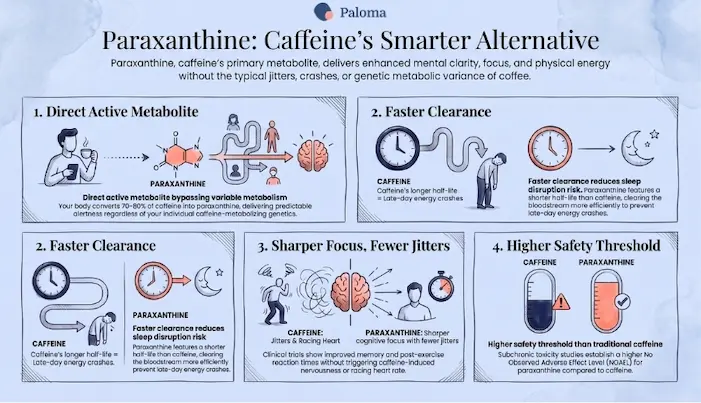
Paraxanthine (chemical name 1,7-dimethylxanthine) is the main compound your body makes when it breaks down caffeine. A liver enzyme called CYP1A2 converts roughly 70% to 80% of the caffeine you consume into paraxanthine, with the rest becoming theobromine and theophylline. If you drink coffee, you already have paraxanthine in your bloodstream, and it's responsible for a good share of the alertness you feel.
Paraxanthine also occurs naturally in tiny amounts in some foods, such as green coffee beans, citrus flowers, and orange blossom honey. However, the paraxanthine in today's supplements, gummies, coffees, and energy drinks is manufactured and sold as a stand-alone ingredient. As The Conversation reports, a growing number of beverage and supplement brands, including a celebrity-backed, caffeine-free energy drink, now feature it, and mainstream health outlets are weighing paraxanthine against caffeine.
The pitch is simple: skip the middleman. Taking paraxanthine directly means its effects don't depend on how quickly your liver processes caffeine, and you avoid caffeine's other byproducts.
If you drink coffee, you already have paraxanthine in your bloodstream. The real question is whether taking it on its own is better.
What the research says
The science on paraxanthine is promising but early. Here's where it stands.
Sharper memory and attention
In a 2021 randomized, placebo-controlled trial, a single 200 mg dose of paraxanthine improved short-term memory, reaction time, and sustained attention for up to six hours in healthy adults. A follow-up dose-response study found benefits for memory, reasoning, and attention at doses as low as 50 to 100 mg, with no reported side effects. A Texas A&M dissertation pulling this research together concluded that 100 and 200 mg doses worked best. And a 2025 trial found that 200 mg boosted self-reported energy, focus, productivity, and fullness after a meal.
A head-to-head with caffeine
A 2024 study in the Journal of the International Society of Sports Nutrition gave 12 trained runners paraxanthine, caffeine, both, or a placebo before a 10-km run. After the run, the caffeine group made more errors on a test of mental flexibility. In comparison, the paraxanthine group improved its correct responses and made significantly fewer fatigue-related errors than the caffeine group. Paraxanthine also produced faster post-run reaction times than placebo, and combining it with caffeine added nothing. Caffeine increased reports of racing heart, shortness of breath, and nervousness; paraxanthine did not.
Fewer jitters, but still a stimulant
In animal research, paraxanthine produced stronger stimulant effects on activity than caffeine, and it appears to be less anxiety-provoking. It also seems to boost nitric oxide signaling, which may help explain why it nudges blood pressure up less. But in a study comparing the two in people, both compounds raised diastolic blood pressure, adrenaline, and free fatty acids, with similar effects at the higher dose. Paraxanthine may be gentler, but it isn't a free pass.
A shorter stay in your system
In a classic pharmacokinetic study, paraxanthine had a shorter half-life and cleared from the blood faster than caffeine. That could mean less lingering stimulation at bedtime, although no trial has directly measured paraxanthine's effect on sleep.
Early safety signals
In a 2023 toxicology study, rats given high doses of paraxanthine for 90 days fared better than those given equivalent doses of caffeine, and deaths occurred only in the high-dose caffeine group. Separate research suggests paraxanthine has low abuse potential and doesn't drive caffeine's dependence-related effects.
Paraxanthine vs. caffeine at a glance
| Caffeine | Paraxanthine | |
|---|---|---|
| What it is | Natural stimulant in coffee, tea, cocoa, and energy drinks | Caffeine's main breakdown product; now sold on its own |
| Processing | Must be converted by the liver; speed varies by genetics and hormones | Already in its active form |
| Half-life | Highly variable, about 2 to 12 hours | Shorter than caffeine's |
| Side effects | Jitters, anxiety, palpitations, sleep disruption | Fewer reported in small trials; still raises blood pressure and adrenaline |
| Evidence base | Decades of large human studies | A handful of small, short, mostly industry-funded trials |
Paraxanthine and hypothyroidism
Potential upsides
If you're hypothyroid, fatigue and brain fog can linger even when your labs look "normal." A stimulant that sharpens focus with fewer jitters and less sleep disruption could, in theory, be a better fit than a third cup of coffee. Because paraxanthine skips caffeine's conversion step, its effects may also be more predictable, especially if you're a naturally slow caffeine metabolizer.
Cautions for thyroid patients
- Protect your medication. Coffee is a well-documented levothyroxine blocker, and no one has studied paraxanthine's effect on absorption. Take your thyroid pill on an empty stomach and wait at least 60 minutes before any stimulant drink or supplement. Review other things that can affect your thyroid medication.
- Ask about formulation. If morning timing is a struggle, ask your clinician whether a liquid or gel-cap option such as Tirosint or Thyquidity could work for you. Research presented at the Endocrine Society's annual meeting found that coffee didn't affect absorption of a liquid levothyroxine.
- Watch for overstimulation. If you take a higher dose of thyroid hormone, use T3, or have a history of palpitations or heart rhythm problems, adding any stimulant can tip you toward a racing heart, anxiety, tremor, or insomnia.
- Skip it with an overactive thyroid. If you have hyperthyroidism or Graves' disease, avoid stimulants unless your doctor approves.
- Don't mask undertreatment. If you need stimulants just to function, your thyroid treatment may need adjusting. Paraxanthine can't fix low T3, but these strategies for conquering thyroid brain fog can help.
Paraxanthine in perimenopause and menopause
Caffeine is a double-edged sword in midlife. A Mayo Clinic study of more than 1,800 women found that caffeine was linked to fewer mood, memory, and concentration problems in perimenopausal women, but to more bothersome hot flashes and night sweats after menopause. Paraxanthine hasn't been studied in midlife women at all (the runner trial included just one woman), so whether it shares caffeine's hot flashes downside or contributes to other menopausal symptoms is unknown.
Sleep comes first
Night sweats and insomnia already chip away at sleep during the transition, one of many surprising symptoms of perimenopause and menopause. Paraxanthine's shorter half-life could be an advantage, but only if you take it early in the day.
If you use HRT or hormonal birth control
Estrogen slows caffeine breakdown. In a study of postmenopausal women starting estradiol, their CYP1A2 enzyme converted caffeine into paraxanthine about 29% more slowly after eight weeks, so caffeine lingered longer. Because paraxanthine skips that first conversion step, it may be easier to dose predictably if you're on hormone replacement therapy. Paraxanthine is still cleared partly by the same enzyme, though, so estrogen's effect on it hasn't been established.
Paraxanthine and weight loss
Paraxanthine is increasingly marketed for metabolism and appetite. In a 2024 dose-response study, 21 adults took a placebo or 100, 200, or 300 mg of paraxanthine. The 200 mg dose increased resting energy expenditure compared with placebo, and hunger rose less over the next three hours, without changing blood pressure or fat breakdown. The researchers described the boost as roughly 100 extra calories over three hours.
That's a modest effect from a single dose, and no long-term weight-loss trials exist. If you're struggling with weight, the basics of weight loss with hypothyroidism and optimizing your thyroid-driven metabolism will matter far more. If you take a GLP-1 medication, keep in mind that adding an appetite-suppressing stimulant could make it harder to eat enough protein, which is essential for preserving muscle. Learn more about a holistic approach to GLP-1 drugs.
Also beware of "fat burner" blends that stack paraxanthine with caffeine, guarana, yerba mate, or synephrine. The combined stimulant load can be significant.

The hormone connection
- Stress hormones. Both caffeine and paraxanthine raise adrenaline. If your HPA axis is already overtaxed by chronic stress, poor sleep, or autoimmunity, any stimulant adds to the load and can potentially trigger hormonal changes.
- Estrogen. CYP1A2, the enzyme that processes caffeine, also helps metabolize estrogen. That shared pathway is one reason HRT and birth control slow caffeine clearance.
- Thyroid hormones. Research on caffeine and thyroid function is mixed. A large analysis of national health data found no overall link between caffeine intake and TSH, though patterns varied by metabolic health. Paraxanthine's effect on thyroid hormones hasn't been studied.
- Brain health. Early lab and animal research suggests paraxanthine may protect brain cells and support brain-derived neurotrophic factor (BDNF), but human evidence is lacking.
The caveats: what we don't know yet
Before you swap your latte for a paraxanthine capsule, keep these limitations in mind:
- Small, short studies. Most trials involve a dozen or two young, healthy participants, mostly men, taking one dose or a week of doses.
- Industry funding. Several of the key cognition and exercise studies were funded by the company that sells the leading branded paraxanthine ingredient, and some authors hold related patents.
- No data in our patients. There are no studies in people with thyroid disease, women in perimenopause or menopause, or pregnant or breastfeeding women.
- Multi-ingredient products. Many drinks pair paraxanthine with other stimulants, sweeteners, or nootropics, which muddies the picture.
Experts writing in The Conversation note that large, independent head-to-head trials are still missing and recommend treating paraxanthine much like caffeine, counting it toward your total daily stimulant intake.
Paraxanthine may be a smarter stimulant, but no stimulant can fix an undertreated thyroid or an unaddressed hormone imbalance.
Your next steps
- Audit your intake. For one week, track every source of caffeine: coffee, tea, soda, energy drinks, pre-workouts, and chocolate. Most people underestimate their total.
- Find the root cause. Persistent fatigue deserves a full workup. A complete thyroid panel (TSH, free T4, free T3, and TPO antibodies) is a smart place to start, along with iron, vitamin D, and B12.
- Protect your thyroid medication. Take levothyroxine first, with water only, and wait at least 60 minutes before coffee, energy drinks, or stimulant supplements.
- If you try paraxanthine, start low. Studies found benefits at 50 to 100 mg. Take it before noon, and don't stack it with caffeine, since research found no added benefit from the combination.
- Read labels carefully. Choose single-ingredient, third-party-tested products and watch for hidden caffeine, guarana, yerba mate, or synephrine.
- Track how you feel. Note your heart rate, sleep quality, anxiety, and hot flashes. Stop if you notice palpitations, chest discomfort, or worsening insomnia.
- Know when to skip it. Avoid paraxanthine if you're pregnant or breastfeeding, have hyperthyroidism, a heart rhythm disorder, uncontrolled high blood pressure, or an anxiety disorder, unless your doctor approves.
- Build the foundation. Prioritize seven to nine hours of sleep, morning daylight, protein at every meal, hydration, and thyroid-friendly exercise. These are the most reliable energy boosters.
A note from Paloma
If you're relying on caffeine, or wondering whether paraxanthine is the answer, your body may be telling you something. At Paloma Health, we specialize in uncovering why you feel exhausted, foggy, and stuck, whether the cause is hypothyroidism, Hashimoto's, your menopausal transition, or all of the above.
Start with our at-home thyroid blood test kit, which measures TSH, free T4, free T3, and TPO antibodies. Our thyroid doctors look beyond "normal" ranges and prescribe the full range of treatments, including levothyroxine, T3, natural desiccated thyroid, and compounded medications. If you're navigating the menopause transition, our perimenopause and menopause care includes hormone therapy tailored to you. For stubborn weight, our medical weight-loss program offers GLP-1 options alongside thyroid optimization, and our nutritionists can help you build an energy-supporting eating plan.
Ultimately, your energy shouldn't come from a can or a capsule. Become a Paloma member and get to the root of your symptoms.


