



.webp)
In this article
When you start a GLP-1 or GIP medication like semaglutide (Ozempic, Wegovy) or tirzepatide (Mounjaro, Zepbound), success is almost always measured one way: the number on the scale. Fewer pounds, a smaller size, a lower BMI. But that number can't tell you what you actually lost. A ten-pound drop could be almost entirely fat — or it could include several pounds of muscle, the tissue your body relies on for strength, balance, and a healthy metabolism.
That distinction is no longer a fringe concern. A newly published expert position statement on incretin-based therapies places muscle health, alongside bone and cardiometabolic health, at the center of how these medications should be used. The message is straightforward: weight loss on a GLP-1 or GIP medication isn't automatically healthy weight loss unless muscle is actively protected along the way.
For Paloma Health patients, this conversation carries extra weight. Many people living with hypothyroidism already contend with a metabolism working against them (see how thyroid function affects metabolism) and, for some, with hypothyroid myopathy — muscle weakness caused by inadequate thyroid hormone. Add a medication that can accelerate muscle loss, and the two effects can compound each other rather than cancel out.
The biology behind the weight loss
Several types of weight loss drugs/type 2 diabetes drugs are dominating the medical world currently. GLP-1 (glucagon-like peptide-1) receptor agonists like semaglutide and liraglutide and dual GLP-1/GIP (glucose-dependent insulinotropic polypeptide) agonists like tirzepatide work by mimicking gut hormones that are released after eating. They slow gastric emptying, quiet appetite signals in your brain, and help regulate your blood sugar. For many patients, the result is dramatic: weight loss approaching the magnitude typically seen after bariatric surgery, according to a 2024 review in the journal Circulation. That scale of change is why body composition—not just body weight—deserves close attention.
How much lean mass is typically lost
Across clinical trials, roughly a quarter of the weight lost on GLP-1 medications comes from lean mass rather than fat, according to a 2025 systematic review and network meta-analysis of 22 randomized trials. Other analyses put the figure higher for the most potent doses: in the landmark STEP 1 trial of semaglutide, an estimated 45% of the weight participants lost was lean mass, and in the SURMOUNT-1 trial of tirzepatide, the figure was closer to 34%, according to the Circulation review cited above. Some GLP-1 medications have been linked to lean-mass losses as high as 40% of total weight lost, and older drugs like liraglutide to as much as 60%.
The two drug classes may not affect muscle equally. A 2026 analysis of body-composition data from nearly 8,000 patients in routine clinical care found that tirzepatide was associated with consistently greater relative lean-mass loss than semaglutide at every time point measured over a year, and that patients who already had musculoskeletal pain or reduced exercise tolerance before starting treatment lost more lean mass than others. That's a useful clue: your starting point matters as much as your medication.
Muscle loss on a GLP-1 or GIP medication rarely announces itself the way fat loss does. A bathroom scale doesn't measure muscle. Instead, it tends to show up as a cluster of subtler signals:
• Fatigue that feels disproportionate to how much weight you've actually lost
• New difficulty with everyday tasks — climbing stairs, carrying groceries, opening jars, or getting up from a low chair
• A “deflated” or loose-skin appearance even after only modest weight loss
• A weight-loss plateau despite continuing to eat less, which can reflect a slowing metabolism as muscle mass declines
• Increased joint aches or a longer recovery time after light activity
• Noticeably weaker grip strength
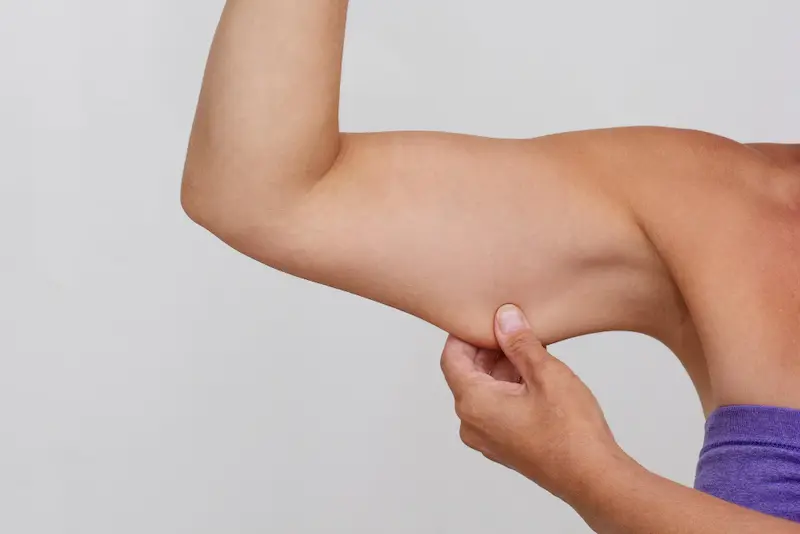
None of these symptoms are exclusive to GLP-1 or GIP use — several overlap with hypothyroidism symptoms like the muscle weakness of hypothyroid myopathy or the involuntary muscle changes seen in Hoffman's syndrome. That overlap is why you should mention these changes to your care team rather than assuming they're just part of losing weight.
A new expert position statement on weight loss incretin therapy and muscle health
In 2026, the Spanish Menopause Society published an expert position statement, also available in full through Maturitas, built on a structured review of the evidence for GLP-1 and GIP therapies. Though the panel focused on peri- and postmenopausal women, its conclusions apply broadly: the statement calls for incretin-based treatment to be considered within a framework that explicitly includes skeletal muscle health, fracture risk, resistance exercise, adequate protein intake, and structured monitoring of functional outcomes—not weight loss in isolation.
Among the panel's most practical points: candidate selection for these medications should factor in sarcopenia risk and the feasibility of resistance training and nutritional support before treatment begins, not after muscle loss is already underway. The panel also recommended monitoring beyond the scale to include functional testing—grip strength, the Short Physical Performance Battery, and the Timed Up-and-Go test—plus periodic body composition scans (DEXA) where accessible. That's a meaningfully different standard of care than “weigh in and adjust the dose.”
Real-world data on lean mass loss
Clinical-trial data is only part of the picture. The large real-world digital phenotyping study described above found a distinct “depletive” pattern — more than 20% total weight loss paired with more than 5% lean-mass loss — in about 1 in 10 patients on tirzepatide, compared with roughly 1 in 15 on semaglutide. The same research linked baseline knee pain and neck pain to significantly steeper lean-mass losses during treatment, a reminder that people who start out less mobile may be the most vulnerable to losing functional muscle.
Encouragingly, the research also shows muscle loss isn't inevitable. In the SEMALEAN study, patients on semaglutide lost lean mass in the first several months, but it then stabilized — and their handgrip strength actually improved by the one-year mark, alongside a drop in the rate of sarcopenic obesity from roughly half of participants to about a third. A small case series went further: three patients who combined semaglutide or tirzepatide with structured resistance training and higher protein intake preserved — and in two cases, increased — their lean soft tissue even while losing significant total weight. A separate analysis of animal and human data found that, once you account for how much weight is actually being lost, weight loss medication-related muscle loss tracks fairly closely with what's expected from any comparable weight loss rather than being a unique drug side effect. Put together, the research points to the same conclusion from different directions: what you do during treatment can change the outcome substantially.
Metabolism and weight regain
Muscle is metabolically expensive tissue — it burns more energy at rest than fat does. When you lose muscle, your resting metabolic rate typically drops as well. This is part of why boosting metabolism is already a struggle for many thyroid patients even before a weight-loss medication enters the picture. That slower metabolism becomes especially relevant if a patient later reduces or stops their GLP-1 or GIP medication: with less muscle available to help maintain calorie burn, regained weight tends to return disproportionately as fat, leaving a patient at a similar weight but with worse body composition than when they started.
Falls, frailty, and functional independence
Beyond metabolism, muscle keeps people upright, steady, and capable of the ordinary business of living—walking, lifting, catching yourself if you trip. Research on age-related muscle loss notes that involuntary muscle loss compounds with age, running about 1% to 2% per decade after 30 and accelerating to as much as 3% to 8% per year after 50, and that this loss raises fall risk and can accelerate both osteoporosis and metabolic decline. A medication-driven acceleration of that same process, layered on top of normal aging, is the scenario clinicians are increasingly watching for in midlife and older patients on GLP-1 or GIP therapy.
Bone health and fracture risk
Muscle and bone are mechanically linked — muscle contraction is one of the main forces that keeps bone dense and strong. That's part of why the Spanish Menopause Society panel grouped fracture risk together with muscle health as a single monitoring priority for incretin therapy, rather than treating them as separate issues. A separate 12-month study of GLP-1 and GIP therapy in people with type 1 diabetes found lean mass declined alongside weight loss even while bone mineral density held steady overall — a reassuring finding. Still, the researchers noted that this was tied to how much weight, and how much muscle, a patient lost. For thyroid patients, this adds to an already established concern, since inadequately treated hypothyroidism is linked to reduced bone density and the production of collagen, the protein that helps hold muscle, bone, and connective tissue together.
<h2 id="thyroid">The added risk for thyroid patients</h2>
Thyroid hormone is not a bystander in muscle health — it's a direct participant. Adequate thyroid hormone is required for normal muscle protein turnover. When thyroid levels run low, the result can be measurable muscle weakness: research suggests that up to 79% of people with hypothyroidism experience some degree of hypothyroid myopathy, most often felt as aching, stiffness, or weakness around the hips and shoulders. Some patients also develop Hoffman's syndrome, a related muscle condition tied to underactive thyroid function. Thyroid hormone also supports collagen synthesis, the connective-tissue protein that underpins muscle, joints, and skin — another reason hypothyroid patients may notice muscle- and joint-related symptoms more readily than others.
Layer a GLP-1 or GIP medication on top of unresolved or undertreated hypothyroidism, and two separate mechanisms working against muscle — hormone-driven and drug-driven — can compound. This is also why low-protein eating patterns can be particularly counterproductive for thyroid patients even outside the context of weight loss medication: undereating and inadequate protein intake are independently linked to a suppressed thyroid and worsened hypothyroid symptoms — the opposite of what anyone wants while also trying to build or preserve muscle on a weight-loss medication. If you're managing hypothyroidism and considering, or already taking, a GLP-1 or GIP drug, well-controlled thyroid levels and adequate protein intake aren't optional extras — they're part of the foundation the medication needs to work safely. Paloma's guide to GLP-1 medications and hypothyroidism walks through how the two treatments interact in more detail.
When you’re on a GLP-1 or GIP medication, resistance training is non-negotiable. Cardio burns calories, but resistance training is what signals your body to keep muscle rather than break it down for fuel.
Resistance training, sometimes called strength training or weight training, is any exercise that makes your muscles work against an opposing force. That force might be a barbell, a stretchy band, a machine's weight stack, or simply the weight of your own body. When muscles are challenged this way, they adapt: muscle fibers repair themselves stronger and, over time, grow larger and more efficient. This process is the foundation of improved strength, endurance, and body composition.
The mechanics are straightforward. During a workout, you create small amounts of stress and microscopic damage in muscle tissue. Rest, protein, and sleep then allow the body to rebuild that tissue. The nervous system also gets better at recruiting muscle fibers, which is why beginners often notice big strength gains in the first few weeks, well before visible changes in muscle size. The principle that drives continued progress is called progressive overload: gradually increasing the weight, repetitions, sets, or difficulty so your body always has a reason to adapt.
Resistance training increases lean muscle mass, which supports a healthy metabolism and makes everyday tasks like carrying groceries or climbing stairs easier. It helps maintain and even increase bone density, an important consideration as we age, particularly for women approaching and moving through menopause. It improves balance and coordination and strengthens joint stability, lowering the risk of falls. Research also links regular strength work with better blood sugar regulation, improved cardiovascular markers, healthier mood, better sleep, and a lower risk of chronic disease. Because muscle tissue naturally declines with age, a process known as sarcopenia, resistance training is one of the most effective tools for staying strong and independent over the long term.
Contrary to a common myth, resistance training does not automatically make you bulky. Building large muscles takes years of specific, dedicated effort, heavy training, and often a calorie surplus. For most people, a consistent routine produces a leaner, firmer, more capable body rather than a noticeably larger one.
A sensible starting point is two to three sessions per week, focusing on major muscle groups: legs, back, chest, shoulders, arms, and core. Beginners do well with one to three sets of eight to twelve repetitions per exercise, using a weight that feels challenging by the final few reps while still allowing good form. Form matters more than load, and learning proper technique early prevents injuries and builds a solid base. Rest days matter too, since recovery is when the actual strengthening happens. Anyone with a health condition, an injury, or a long stretch of inactivity should check with a healthcare provider before starting a new program.
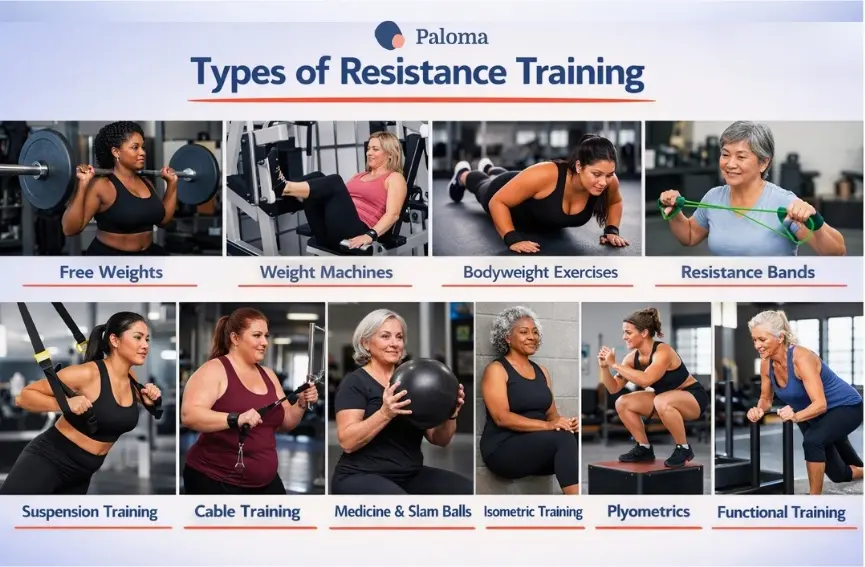
The variety of options means you can find something that suits your goals, budget, and comfort level. Here are some of the most common types of resistance training:
- Free weights: Dumbbells, barbells, and kettlebells that allow a full range of motion and engage stabilizing muscles.
- Weight machines: Guided equipment that isolates specific muscles and offers a lower learning curve for beginners.
- Bodyweight exercises: Push-ups, squats, lunges, planks, and pull-ups that require no equipment.
- Resistance bands: Portable, affordable elastic bands or tubes that provide variable tension.
- Suspension training: Systems like TRX that use straps and your body angle to adjust difficulty.
- Cable training: Adjustable pulley systems that provide constant tension throughout a movement.
- Medicine ball and slam ball work: Weighted balls used for throws, twists, and explosive movements.
- Isometric training: Holding a position under tension, such as wall sits or planks, without moving.
- Plyometrics: Explosive jumping and bounding movements that build power.
- Functional training: Multi-joint movements, such as farmer's carries and sled pushes, that mimic daily activities.
Whichever style you choose, consistency is what produces results. Start where you are, progress gradually, and build a routine you can keep doing. If you're new to strength work or managing thyroid-related fatigue, Paloma's guides to exercise fundamentals for thyroid patients and matching workout intensity to your thyroid offer practical, low-barrier ways to begin without overtaxing your energy.
Muscle loss during treatment is not inevitable. It's a reason to be intentional about taking other crucial steps to help protect and build muscle while taking a GLP-1 or GIP drug. Here's where to start.
Prioritize protein at every meal
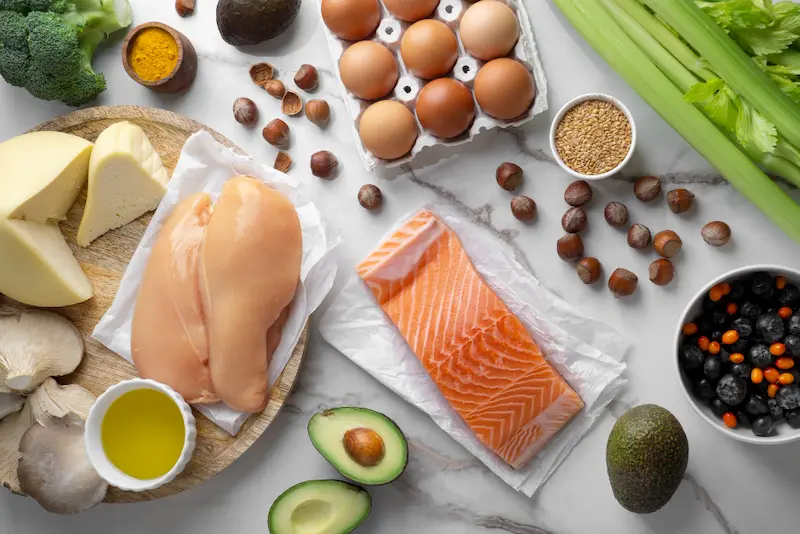
Most research on preserving lean mass during GLP-1 treatment focuses on higher protein intake, generally 1.2 to 1.6 grams per kilogram of body weight per day, spread across meals rather than loaded into one. That target is higher than general guidelines partly because muscle becomes less responsive to protein with age and with calorie restriction, a phenomenon researchers call anabolic resistance. Because appetite is often sharply reduced on GLP-1 and GIP medications, meeting that target can mean deliberately reaching for protein first at each meal, before anything else on your plate. Paloma's guide to protein and thyroid hormones is a useful starting point for building thyroid-friendly protein habits.
Ask your provider about monitoring
A number on a scale can't tell fat loss from muscle loss, but other measurements can. Ask your provider whether tracking makes sense for you — options include periodic body composition scans (DEXA or bioelectrical impedance), grip-strength testing, or simply timing how long it takes to complete a task like standing up from a chair repeatedly. If you're managing both hypothyroidism and a GLP-1 or GIP medication, this is also the right time to confirm your thyroid levels are optimized, since undertreated hypothyroidism compounds every risk discussed here.
Don't rush the taper
If you and your provider decide to reduce or stop your medication, do it gradually and keep your protein and resistance-training routine steady through the transition. The muscle you've worked to preserve during weight loss is easiest to hold onto when appetite and eating patterns change slowly rather than all at once.
Watch for warning signs, not just the scale
Revisit the signs and symptoms list earlier in this article periodically throughout treatment. New or worsening fatigue, weakness, or joint pain deserves a conversation with your provider—not just the assumption that it's a normal part of losing weight.
Paloma Health was built around the idea that thyroid and metabolic care shouldn't happen in separate silos — and GLP-1 and GIP therapy is a clear example of why that matters. Our clinicians can evaluate whether your thyroid levels are truly optimized before and during weight-loss treatment, since undertreated hypothyroidism is one of the most overlooked contributors to muscle loss and fatigue in patients on these medications. Paloma also offers nutrition and lifestyle coaching to help you build the protein intake and movement habits this article points to, alongside personalized medication plans that can include GLP-1 and GIP options when appropriate — all coordinated with your thyroid care rather than managed as an afterthought. If you're navigating hypothyroidism alongside a GLP-1 or GIP medication, or considering starting one, our team can help you build a plan that protects your muscle, not just your weight.
GLP-1 Medications & Hypothyroidism
Struggling with weight loss and hypothyroidism? GLP-1 medications may help. This guide explains how they work, why they’re helpful for thyroid patients, and how to use them safely.

Will I definitely lose muscle if I take a GLP-1 or GIP medication?
Not necessarily — research shows lean-mass loss is common, but not universal, and several studies found that patients who combined treatment with resistance training and higher protein intake preserved or even increased their lean tissue. Your individual outcome depends heavily on your starting muscle mass, activity level, and nutrition during treatment.
How much muscle loss is considered normal?
In clinical trials, lean mass has typically made up about 25% to 45% of total weight lost, depending on the specific medication and dose. Losses toward the higher end, or any loss paired with new weakness or fatigue, are worth discussing with your provider.
Does tirzepatide (Zepbound) cause more muscle loss than semaglutide (Wegovy, Ozempic)?
Real-world data suggest tirzepatide is associated with somewhat greater relative lean-mass loss than semaglutide, particularly at higher doses and with longer use. That doesn't mean one drug is right or wrong for you — it simply means the muscle-preservation steps in this article matter more, not less, if you're on a more potent medication.
How much protein do I need while taking a GLP-1 or GIP drug?
Most research supporting muscle preservation during weight loss treatment points to roughly 1.2 to 1.6 grams of protein per kilogram of body weight per day, spread across meals. Because appetite is often reduced, prioritizing protein-rich foods first at each meal is usually more realistic than trying to eat more overall.
Is resistance training really necessary, or is walking enough?
Walking supports cardiovascular health and calorie burn, but it doesn't provide the mechanical stimulus muscle needs to avoid breakdown during a calorie deficit. Two to three resistance-training sessions a week, even with bands or bodyweight exercises, are consistently linked to better lean-mass preservation than cardio alone.
Can hypothyroidism make GLP-1/GIP-related muscle loss worse?
Yes — inadequate thyroid hormone already impairs muscle protein turnover. It is linked to muscle weakness on its own, so undertreated hypothyroidism and a GLP-1 or GIP medication can compound each other's effects on muscle. Confirming your thyroid levels are well managed is an important, often overlooked, part of protecting muscle during treatment.
What tests can show whether I'm losing muscle?
A DEXA scan or bioelectrical impedance analysis can directly estimate lean versus fat mass. At the same time, grip-strength testing and functional tests like a sit-to-stand assessment offer a simpler proxy. Not every provider offers these routinely, so it's worth asking directly whether monitoring is available to you.
Will muscle loss reverse if I stop the medication?
Not automatically — muscle is generally rebuilt through resistance training and adequate protein, not simply by regaining weight, and weight regained after stopping a GLP-1 or GIP tends to return disproportionately as fat if muscle wasn't actively maintained. This is one reason providers recommend keeping strength training in place through any dose reduction or discontinuation.
Are creatine or protein supplements safe to take with a GLP-1 or GIP drug?
Many patients use protein supplements or creatine to help meet daily targets when appetite is significantly reduced, and neither is known to interact with GLP-1 or GIP medications. As with any supplement, it's worth mentioning what you're taking to your care team, particularly if you have kidney concerns or other health conditions.
Should I talk to my doctor before starting a GLP-1 or GIP drug if I'm worried about muscle loss?
Yes — muscle preservation is easiest to plan for before treatment begins, not after loss has already occurred. A conversation about your baseline muscle mass, activity level, thyroid status, and protein intake can help you and your provider build a plan tailored to your starting point.
.webp)


