



.webp)
In this article
%20(1).webp)
It’s 2:00 a.m. The glare of your phone strains your eyes as you search for an explanation for the unrelenting fatigue, the aches in your limbs, and the fog clouding your thoughts. You’ve been here before—feeling dismissed by a seven-minute doctor visit, or facing a months-long waiting list for a specialist, or frustrated by daunting co-pays or lack of insurance. Then, an algorithm delivers a savior. An influencer appears, bathed in soft ring light, filtered to perfection, speaking with the warmth of an old friend. The influencer’s earnest, relatable tone seems much more approachable than a textbook or handout. Their video or post looks polished and sounds authoritative. They describe exactly how you feel, and then they offer the “hidden truth” your doctor supposedly missed.
In these moments of vulnerability, social media feels like a sanctuary. You’re desperate for answers. And this information seems accessible and empathetic. This is especially true in areas like thyroid disease, hormone balance, weight gain, fatigue, fertility, and menopause, where mysterious symptoms are often vague, common, and deeply frustrating, and diagnosis and treatment can be challenging.
But here’s the issue: You have no idea if the information being provided by the influencer is incomplete, misleading, or flat-out wrong, not to mention potentially hazardous to your health!
These days, the line between genuine patient education and calculated digital influence has become dangerously thin. What might feel like a “health journey” is often a carefully constructed narrative designed to bypass your skepticism – and open your wallet!
There is a persistent myth that health misinformation is only a threat to people who are uneducated or not tech-savvy. The data suggests otherwise. According to researchers cited by the Mayo Clinic and the University of Chicago, younger, plugged-in generations are often more susceptible to misleading health claims than their elders.
This isn’t a lack of intelligence; it’s a feature of cognitive psychology. The sophisticated brain is often the most skilled at rationalizing what it desperately wants to believe. When a headline promises a “natural” or “quick” fix for a chronic, frustrating health challenge, something called “confirmation bias” kicks in. It becomes easy to replace the exhausting nuance and uncertainty of real medicine with the certainty of an influencer.
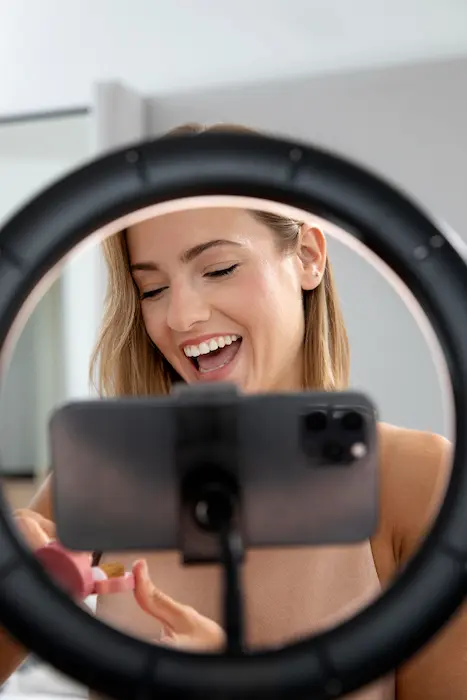
There is a reason health content on TikTok, Instagram, and similar platforms can feel so persuasive. Influencers are often good storytellers. They make complicated medical topics feel personal, accessible, and emotionally resonant. They may describe symptoms that sound just like yours, share their own health journey, or promise to reveal the “real” reason you are struggling.
Health influencers also have a secret weapon: the “parasocial bond.” This is a psychological phenomenon in which followers develop a deep, one-sided sense of trust and friendship with creators. This bond acts as a cognitive shortcut. The influencer feels relatable, so we feel we know them personally, and then assume they are reliable.
These factors are powerful, especially when they meet a real need. If you have been dismissed, told your lab test results are “normal,” or left without answers, an influencer who says, “I’ve been there,” can feel like a lifeline.
But here’s something to keep in mind:
Relatability is not the same as reliability!
A creator can have a compelling story and still oversimplify the science. They can be sincere and still be wrong. They can even share genuinely useful information while omitting important context, such as who the advice applies to, what the risks are, or whether it has been studied in the population they are talking about.
Social media platforms can be both helpful and hazardous. They can introduce you to useful ideas, but can also make weak evidence sound like established facts. An influencer can make a single anecdote feel like a universal truth. And they can turn complicated conditions into catchy slogans.
Thyroid disease, perimenopause, menopause, weight gain, and other hormone-related concerns are especially easy targets for misinformation because their symptoms overlap with so many other conditions. Fatigue, brain fog, weight gain, hair thinning, sleep problems, mood changes, cycle irregularity, anxiety, and low libido can be caused by many different factors. They can be hormonal, but they can also be related to stress, medications, nutrition, sleep disorders, autoimmune disease, anemia, depression, or other medical issues.
That ambiguity creates the perfect environment for false certainty. If a creator offers a simple explanation—“your hormones are out of balance,” “your thyroid is broken,” “you have hidden inflammation,” “you just need to detox”—the message can sound reassuring. It gives the illusion of clarity. But real medicine is more complex.
That is where misinformation tends to thrive: in the gap between uncertainty and urgency. Naturally, we want answers. Influencers often provide them in a neat, emotionally satisfying package. Unfortunately, neat and satisfying is not always the same as accurate or safe.
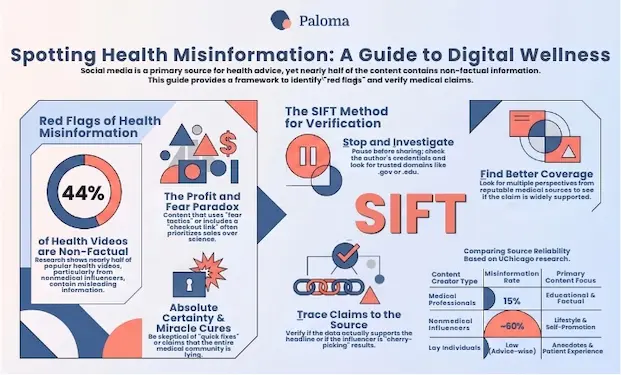
The physical consequences of these trends are far from theoretical. A University of Chicago study on TikTok coverage of sinus issues – using the hashtag #sinustok -- found that while medical professionals produced factual content 85% of the time, non-medical influencers delivered non-factual information in nearly 60% of their videos! Overall, 44% of the sinusitis-related content analyzed was found to be misleading.
The “garlic in the nose” trend is another case study in digital delusion. Users shoved raw garlic cloves up their nostrils to “clear” congestion, pointing to the subsequent flood of mucus as “proof” it worked. In reality, the garlic caused a chemical burn on the delicate nasal tissue. The mucus was actually the body’s defensive attempt to flush out a severe irritant.
Other “harmless” trends have proven equally hazardous, like creators who have encouraged their followers to drink their own urine, take essential oils by mouth (despite many of them being toxic when swallowed), or mix borax – a toxic cleaning agent – into their coffee!
Hormonal health and thyroid disease are not immune to this problem. Some influencers have been saying that spraying perfume on your neck can cause thyroid problems. (Hint: It doesn’t.) And there’s a popular psychic medium/influencer who has gained notoriety recommending celery juice as a treatment for an underactive thyroid. (Hint: it doesn’t work.)
Not every influencer is unreliable. Some are truly excellent educators who use social media to translate science into plain language and help people better understand their health. The more trustworthy creators have a few things in common.
Transparency
They are transparent about who they are and what qualifies them to speak on a topic. A licensed physician, registered dietitian, nurse practitioner, pharmacist, patient advocate, or PhD-level researcher may still make mistakes. Still, their background at least gives you a way to assess whether they have relevant training.

Credible sources
Trustworthy influencers cite credible sources. Good health educators do not just say, “Studies show…” They explain where information comes from in plain language. They explain which studies, what the findings actually were, and whether the evidence is strong or preliminary. They may link to medical journals, professional guidelines, peer-reviewed research, or respected organizations so you can verify the information yourself.
Identify anecdotal and personal advice
Responsible creators distinguish between their own personal experience, or the anecdotal experience of others, and medical advice.
Comfort with uncertainty
Influencers you can trust are comfortable with uncertainty. Real experts rarely speak in absolutes. The best health educators do not try to overwhelm you with certainty. Instead, they help you think more clearly and critically. They may say, for example, that something appears promising but has not been proven in large human studies, or that a strategy may help some people but not others. They may say that a claim is promising but not proven, or that more research is needed.
Financial ties disclosed
Trustworthy influencers disclose sponsorships, product ties, affiliate links, or other financial interests. People need to earn a living, and having a financial incentive does not automatically make their information untrustworthy, but it does give you context. A creator who sells supplements, testing kits, online courses, or coaching packages should be evaluated more critically than one who simply educates.
Recommend medical care
Responsible creators encourage you to talk with a licensed clinician, especially if the topic involves symptoms, medication, diagnosis, or treatment decisions. They do not try to replace medical care with their content.
Avoid fear and sensationalism
They also tend to avoid sensational language. A trustworthy post or video does not need to scare you to get your attention. It does not need to accuse doctors of hiding the truth. It does not need to promise you a perfect body or a permanent cure. Instead, it should help you understand your options and make a more informed decision.
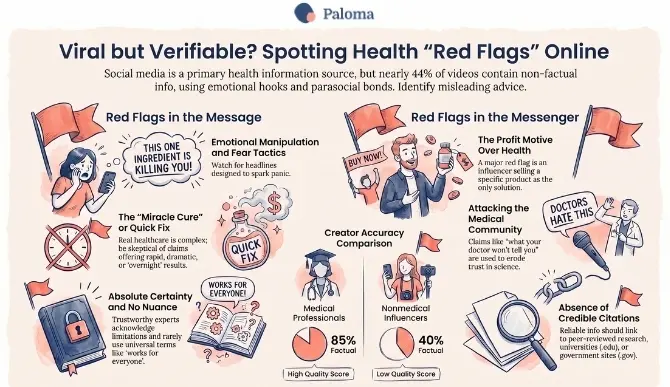
Health misinformation rarely arrives as a dry set of facts. There are common characteristics that are definite red flags that you’re on the receiving end of misinformation.
Alarmism and fear
Unreliable creators are usually confident, emotionally charged, and alarmist. Their messages are wrapped in emotional weight using fear tactics designed to cause shock, anger, or moral outrage. The point is to trigger your fight-or-flight response and shut down your critical thinking.
Their videos and posts sound scientific, but they’re not. They mention “studies” without showing them. They use vague language to suggest authority while avoiding details that would let you evaluate the claim. They use phrases like:
- “Your doctor won’t tell you this!”
- “This 1 ingredient is killing you!”
- “What the pharmaceutical industry is hiding...”
When you are anxious about your health, your brain is biologically wired to latch onto anything promising relief or to identify a clear villain (like “the medical establishment,” a hidden toxin, or a miracle cure). Fear-based content is a classic misinformation tactic. Posts that provoke panic, outrage, or urgency are often designed to keep you watching and sharing, not to help you make informed decisions.
Cherry-picking findings
One of the biggest warning signs is cherry-picking. A creator may cite one small study, one animal study, or one unpublished claim and present it as if it were settled science. They may ignore the broader body of research that tells a more complicated story. They may also emphasize the benefits of a supplement, diet, or protocol while downplaying risks, side effects, or the fact that the advice might not apply to you.
Anecdotes and personal experience
A major concern is when an influencer presents their own experience or personal anecdotes as evidence of effectiveness and suggests that their results will apply to everyone reading, watching, or listening.
Certainty
Certainty without nuance is a major red flag. Real health information usually includes caveats. If a post makes universal claims—“this works for everyone,” “this will cure your fatigue,” “this is the only way to heal Hashimoto’s,” “this is what doctors don’t want you to know”—pause and look closer.
Dramatic promises
Real hormonal health change takes time. Claims like “lose 20 pounds in 1 week,” “balance your hormones in 7 days,” “heal Hashimoto’s naturally in 30 days,” or “this works for everyone,” should trigger immediate skepticism. Complex hormonal challenges and medical conditions do not usually respond to one-size-fits-all shortcuts. If it sounds too good to be true, it almost always is!
Discrediting doctors or medicine
Any post that tells you to stop medication, skip testing, distrust your clinician, or replace medical care with social media advice is a major red flag. Good health information should help you make better medical decisions, not encourage you to avoid them.
Makes ordinary care sound dangerous
Be careful when a post claims that thyroid medication, hormone therapy, birth control, or routine testing is universally harmful. Medical care has benefits, risks, and appropriate uses. Anything that presents one side only should be considered suspect.
Ignores safety and context
A trustworthy creator should explain who should avoid a suggestion, what side effects are possible, how long it may take to work, and whether the advice could interact with medications or existing conditions. If none of that is mentioned, the content is incomplete at best.
To protect your health and your wallet, use the SIFT method—a digital literacy framework—to evaluate every post:
- S — Stop: Before you like, share, or take action on information, it’s time to stop and take a pause. Evaluate the source’s reputation. Ask yourself: Is my emotional reaction (fear or hope) clouding my judgment? Think about the motivation. Is the post trying to educate you, or is it trying to sell you something? A sales motive does not automatically make a post false, but it does mean you should be more careful and discerning.
- I — Investigate the source: Research the creator’s actual credentials. Are they actually qualified to speak on the topic? Are they a clinician, a researcher, an advocate, or someone sharing a personal story? Personal experience can be meaningful, but it is not the same thing as medical evidence. What is their financial motivation?
- F — Find other coverage to verify: You’ll want to verify the claim across other sources that aren’t from social media. Look for research studies from medical journals, medical society websites, or other sources. A key question to ask: Is there a medical consensus on this topic, or is this creator an outlier? Is the advice realistic? If it sounds too simple for a complex problem, it usually is.
- T — Trace the evidence: Click through to actual peer-reviewed studies. Do they cite reputable organizations, clinical guidelines, or actual studies? Can you find the original source, or are you just seeing a screenshot or a vague reference? Never rely on an influencer’s interpretation of a headline; often, the data does not support their sensationalist claims.
Medical information shared by social media influencers isn’t automatically good or bad—but it does require careful judgment. Some creators genuinely aim to educate, while others present misleading or incomplete information in a polished, highly shareable format. The difference often comes down to transparency, use of evidence, willingness to acknowledge nuance, and underlying motives.

If a post gives you helpful insight, that’s a great starting point—but it should remain just that: a starting point. Use it to guide further research, compare it against trusted medical sources and public health information, and discuss it with a qualified clinician before making any meaningful decisions about your health. In areas like thyroid disease and hormone balance, that extra step isn’t overly cautious—it’s essential.
Social media can be incredibly useful for discovery. It can help you put words to your symptoms, uncover questions you didn’t know to ask, and connect you with others who share similar experiences. But it should never serve as the final authority on your care. Real medicine is rarely simple or fast—it’s thoughtful, evidence-based, and tailored to the individual, not condensed into a 60-second viral clip.
A helpful way to evaluate content is to ask not just, “Is this person an influencer?” but, “What are they influencing me toward?” The most trustworthy voices guide you toward better understanding—encouraging thoughtful questions, informed discussions with your healthcare provider, and deeper awareness of your body. Less reliable voices tend to push urgency, certainty, and quick solutions—often tied to a product or a promise that feels too good to be true.
This distinction matters deeply in thyroid and hormonal health, where symptoms are often complex, frustrating, and highly individualized. People deserve careful, personalized care—not one-size-fits-all answers or viral shortcuts.
As a practical rule: if content is evidence-based, transparent about its limitations, and encourages collaboration with a licensed clinician, it may be worth your attention. If it relies on fear, absolutes, or aggressive sales tactics, it’s best treated as “interesting, but unverified.”
That’s where a medical practice like Paloma Health stands apart. Rather than offering quick fixes or one-size-fits-all advice, Paloma Health connects you with expert healthcare professionals who specialize in thyroid care, provides comprehensive lab testing, offers fact-based articles and social media content, and supports you with personalized, ongoing treatment plans. It’s a model built on evidence, nuance, and individualization—the very qualities often missing from influencer-driven health content.
In the end, social media can point you in the right direction—but your health decisions deserve more than an algorithm. With the right medical guidance, you can move from uncertainty and noise to clarity and care that’s truly designed for you.
What makes health advice on social media risky?
Social media content often lacks context, scientific backing, or personalization. Advice that works for one person may not be safe or effective for someone else.
Why do influencers seem so trustworthy?
They use storytelling and relatability to build emotional connections. This can create a false sense of trust, even if the information isn’t reliable.
Are all health influencers untrustworthy?
No, some provide accurate and helpful education. The key is to evaluate the influencer’s credentials, sources, and whether they acknowledge their own limits and uncertainties.
What are common red flags of misinformation?
Look out for dramatic claims, “miracle cures,” fear-based language, and advice that dismisses healthcare professionals or medical treatment. These are often signs that the content is not credible.
Why is hormone and thyroid content especially prone to misinformation?
Symptoms like fatigue and weight gain are common, frustrating, and can have many causes. This makes it easy for oversimplified or incorrect explanations and misleading videos to seem convincing.
Can social media health trends actually be harmful?
Yes, some viral trends can cause physical harm or delay proper treatment. Even “natural” remedies can be unsafe or ineffective without proper evidence.
How can I check if health information is accurate?
Use the SIFT method: stop and assess, investigate the source, and trace the original evidence. Always compare claims with trusted medical sources.
When should I trust medical advice online?
Trust it as a starting point, not a final answer. Always discuss important health decisions with a qualified healthcare provider for personalized guidance.


%20(1).webp)
.webp)


