


.webp)
In this article
If you've cut calories, started walking every day, cleaned up your diet, and the scale still won't budge — or keeps climbing — you've probably heard some version of "just eat less and move more." It's frustrating advice, and for a lot of people, it's also wrong. Weight regulation isn't just a matter of discipline. It's governed by a web of hormones — thyroid hormone, insulin, cortisol, estrogen, progesterone, leptin, and ghrelin — that control your metabolism, your appetite, and where your body decides to store fat.
When one or more of these hormones is out of balance, your body can work against your best efforts, not because you're doing something wrong, but because the underlying biology has changed. Below are five signs that hormonal imbalances may drive your weight gain, what's likely happening inside your body, and what you can do about it.
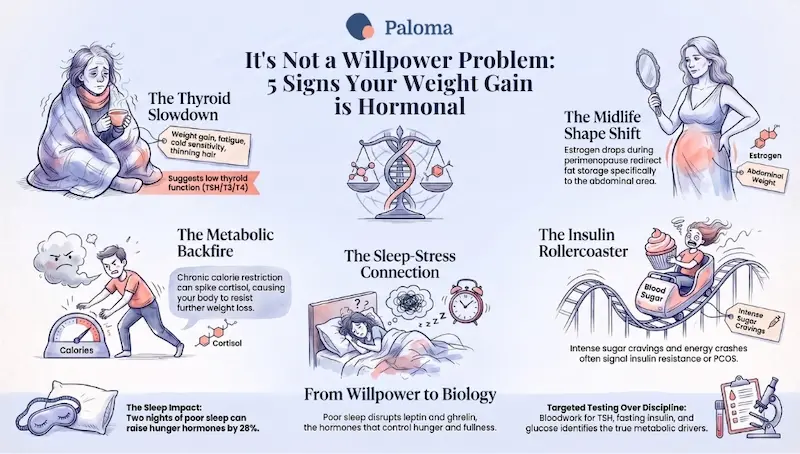
Unexplained weight gain is often one of the first noticeable symptoms of an underactive thyroid, but it rarely shows up alone. If you're also feeling unusually tired, sensitive to cold, foggy-headed, constipated, or noticing thinning hair, dry skin, or a puffy face, your thyroid may be the common thread.
Why this happens
Thyroid hormone sets the pace for your metabolism — it influences how efficiently your body burns fuel, regulates body temperature, and processes fat and sugar. When thyroid hormone output drops, as it does in hypothyroidism, those processes slow down across the board. Research has repeatedly shown a bidirectional relationship between thyroid gland function and body weight: even mildly elevated TSH (thyroid-stimulating hormone) levels are associated with a higher body mass index, and thyroid dysfunction is more common among people with obesity than in the general population.1,2,3
To be clear, most of the weight initially tied directly to hypothyroidism is modest — typically in the 5-to-10-pound range, and it often reflects fluid and salt retention rather than pure fat gain, as Paloma explains in Hypothyroidism and Weight Gain. But that doesn't make it any less real or any less worth investigating, especially if it's accompanied by other classic hypothyroid symptoms.
What to do about it
A simple blood panel measuring TSH, free T3, free T4, and thyroid peroxidase antibodies can tell you whether your thyroid is a factor. If it is, thyroid hormone replacement can help restore your metabolic rate to normal — though as Paloma covers in Will Treating Hypothyroidism Help Me Lose Weight?, medication alone often isn't a magic bullet for significant weight loss, and Why Is It So Hard to Lose Weight When You're Hypothyroid? digs into why. It's also worth understanding how thyroid medication and weight loss actually relate before assuming a dosage change is the answer.

If you're in your late 30s, 40s, or early 50s and you've noticed weight settling around your abdomen — even though your diet hasn't changed — while your periods have also become unpredictable, hormones related to perimenopause are a likely culprit.
Why this happens
As estrogen and progesterone levels fluctuate and decline during the menopause transition, fat storage patterns shift. Estrogen normally helps direct fat storage toward the hips and thighs; as levels drop, fat is more likely to be redirected to the abdomen, a pattern known as central weight distribution. Research reviewed by Paloma in Signs You're in Perimenopause suggests that roughly one in five women gains 10 pounds or more during this transition, and a peer-reviewed analysis in the journal Menopause similarly describes weight regulation becoming measurably more difficult as reproductive hormones decline.4
Declining progesterone plays its own role, too. Progesterone helps regulate appetite and fat metabolism, so when it drops — often before estrogen does — appetite can increase. Metabolism can also slow, even without any change in eating habits, a pattern explored in Weight Loss After 40: Hormonal Obstacles No One Talks About. This shift can continue as perimenopause winds down and often overlaps with other symptoms described in 10 Surprising Symptoms of Perimenopause and Menopause.
What to do about it
Because perimenopause symptoms overlap so heavily with thyroid symptoms — fatigue, brain fog, mood changes, and weight gain among them — it's worth ruling both in or out with proper testing rather than assuming it's "just hormones" or "just aging." Paloma's guide Is It Perimenopause or Hashimoto's? walks through how to tell the difference, and 11 Perimenopause Myths Debunked clears up common misconceptions about what is and isn't normal during this transition. If you're managing both hypothyroidism and the approach of perimenopause, Preparing for Perimenopause When You're Hypothyroid is worth a read.
Maybe you lost weight successfully in the past using a particular calorie target or eating plan, and now the same approach isn't just failing to work — it seems to be making things worse. This is one of the more confusing and demoralizing hormonal patterns, and it's a real physiological phenomenon, not a personal failure.
Why this happens
Chronic calorie restriction is a form of physical stress, and your body responds to stress by producing more cortisol. Elevated cortisol increases blood sugar and can drive insulin resistance, stimulates appetite (particularly cravings for sugar and fat), and promotes fat storage around the abdomen, as Paloma details in How Undereating Can Affect Your Thyroid. Meanwhile, extended low-calorie dieting can also suppress thyroid hormone conversion, further slowing metabolic rate.
This is sometimes called metabolic adaptation or "starvation mode," and it's a well-documented response to chronic under-fueling, especially when it's paired with high-intensity exercise, poor sleep, and stress — a combination Paloma addresses in detail here. It's also more common than most people realize among people with thyroid conditions, whose baseline metabolic rate is already running slower than expected.
What to do about it
Rather than cutting calories further, the evidence-based response is usually the opposite: eating enough to support your metabolism, prioritizing protein and strength training to preserve muscle mass, and addressing sleep and stress as seriously as diet. If you've been under-eating for a while, working with a clinician to rebuild your metabolic rate gradually — rather than jumping straight into another restrictive diet — tends to produce more sustainable results, as outlined in How Too Few Calories Affects Hypothyroidism Weight Loss.

If your weight gain comes with a pattern of intense carbohydrate or sugar cravings, energy crashes an hour or two after eating, dark patches of skin at the neck or armpits (acanthosis nigricans), or irregular or absent periods, insulin resistance may be playing a role — sometimes on its own, and sometimes as part of polycystic ovary syndrome (PCOS).
Why this happens
Insulin's job is to move sugar from your bloodstream into your cells for energy. When cells become resistant to insulin's signal, your pancreas compensates by producing more of it, and elevated insulin promotes fat storage while making fat harder to burn for fuel. Insulin resistance and hypothyroidism frequently travel together, in part because an underactive thyroid slows glucose metabolism and worsens insulin sensitivity, a relationship Paloma unpacks in Insulin Resistance and Hypothyroidism.
In women with PCOS, this dynamic is amplified: weight gain and obesity worsen insulin resistance, compensatory high insulin levels disrupt ovarian hormone production, and the resulting hormonal shifts make further weight gain more likely — a cycle described in detail in a widely cited review in Clinical Endocrinology.5,6
What to do about it
A fasting insulin and glucose panel (or an oral glucose tolerance test) can help clarify whether insulin resistance is contributing to your weight gain, alongside standard thyroid testing and, if your periods are irregular, hormone levels relevant to PCOS. Improving insulin sensitivity through strength training, protein-forward meals, and stress and sleep management tends to help significantly, and Paloma has also written about targeted nutrients like myo-inositol as a supplement option for hypothyroid patients dealing with weight and insulin resistance.

If your weight gain has tracked alongside a stretch of high stress, disrupted sleep, or both, cortisol and its downstream effects on appetite hormones are worth a close look — even if you don't feel especially "stressed" day to day.
Why this happens
Cortisol is your body's primary stress hormone, and it's designed for short bursts of activation, not the chronic, low-grade stress many people live with. A frequently cited study published in Psychosomatic Medicine found that women with more centrally distributed body fat showed consistently greater cortisol reactivity to repeated stress, and that this pattern persisted even after repeated exposure to the same stressor.7 Chronic elevation in cortisol is associated with increased appetite, sugar and fat cravings, and a tendency to store fat specifically around the abdomen — a pattern Paloma discusses in How a Cortisol Blocker May Affect Your Thyroid.
Sleep compounds the problem. A controlled study published in the Annals of Internal Medicine found that just two nights of restricted sleep reduced levels of leptin (a hormone that signals fullness) by 18% and increased ghrelin (a hormone that stimulates hunger) by 28%, along with measurable increases in hunger and appetite the next day.8 Add elevated cortisol from perimenopause, as covered in Weight Loss After 40, or from an already taxed thyroid, and the combination becomes a difficult cycle to break through diet alone. If this pattern of shifting hormones and midlife symptoms sounds familiar, Paloma's piece on "cougar puberty", a viral nickname for the hormonal chaos of perimenopause, may resonate.
What to do about it
Sleep and stress management aren't soft recommendations here — they're direct interventions on the hormones driving weight gain. Prioritizing 7 to 9 hours of sleep, building in daily stress-reduction practices, and avoiding excessive high-intensity exercise (which can further elevate cortisol) are all evidence-supported strategies. For some people, especially those combining perimenopause and thyroid symptoms, medical options like hormone replacement therapy or newer weight-management medications may also be worth discussing with a clinician, as explored in HRT and Tirzepatide: The Key to Weight Loss After Menopause?
If any of these signs sound familiar, please hear this clearly: hormonal weight gain is not a failure of willpower, and it is not something you have to figure out — or fix — on your own. Paloma Health was built specifically for people whose weight struggles sit at the intersection of thyroid disease, perimenopause, menopause, and metabolic health, conditions that are too often dismissed, misdiagnosed, or treated in isolation from one another
Through Paloma, you can get comprehensive at-home thyroid testing that goes beyond a basic TSH check, connect with clinicians who specialize in hypothyroidism and Hashimoto's, and receive a personalized care plan that may include thyroid hormone optimization, nutrition and supplement guidance, and support for the sleep and stress factors that quietly drive weight gain.
For women navigating perimenopause and menopause alongside thyroid issues, Paloma's clinicians understand how these hormonal systems interact and can help you sort out which symptoms belong to which condition, rather than lumping everything under "just getting older." When appropriate, that support can also include a conversation about medical weight-management options, including GLP-1 and dual-agonist medications, considered in the context of your full hormonal picture rather than as a stand-alone fix.
The goal isn't a quick fix. It's getting to the actual, testable, treatable reasons your body is holding onto weight, so the plan you follow works with your biology -- instead of against it!
%20(1).webp)
Can hormones really cause significant weight gain
Yes. Thyroid hormone, insulin, cortisol, estrogen, and progesterone all influence metabolism, fat storage, and appetite, and imbalances in any of them can lead to meaningful weight changes. That said, most hormonal conditions account for a portion of weight gain rather than all of it, which is why testing and a full picture matter.
How much weight gain is typically caused by an underactive thyroid
Research cited by the American Thyroid Association suggests that hypothyroidism typically accounts for about 5 to 10 pounds of weight, much of it related to fluid and salt retention rather than fat. Weight gain beyond that range is more likely explained by other factors working alongside the thyroid.
What blood tests should I ask for if I suspect hormonal weight gain
A reasonable starting panel includes TSH, free T4, and thyroid antibodies for thyroid function, along with fasting glucose and insulin to screen for insulin resistance. If your periods are irregular, your clinician may also check reproductive hormones relevant to perimenopause or PCOS.
Is belly fat specifically linked to hormones?
Yes, abdominal fat is closely tied to cortisol and to declining estrogen during perimenopause and menopause, both of which favor central fat storage over fat stored at the hips or thighs. This is a well-documented, measurable hormonal pattern rather than simply a cosmetic concern.
Can stress alone cause weight gain without a diagnosed hormone condition
It can. Chronic stress elevates cortisol even in people with otherwise normal thyroid and reproductive hormone levels, and elevated cortisol independently increases appetite and abdominal fat storage. Managing stress is a legitimate, evidence-based weight strategy on its own.
Will losing weight fix my hormones, or do I need to fix my hormones to lose weight
It typically goes both directions: treating an underlying hormonal issue, like hypothyroidism or insulin resistance, often makes weight loss more achievable, while modest weight loss can in turn improve insulin sensitivity and hormone balance. Testing first helps clarify where to start.
Does poor sleep really affect weight that much
Yes, even short-term sleep restriction has been shown in controlled research to reduce the fullness hormone leptin and raise the hunger hormone ghrelin within just two nights. Consistently poor sleep compounds these effects over time.
How do I know if it's perimenopause or a thyroid problem
The two conditions share many symptoms, including fatigue, weight gain, brain fog, and mood changes, which is why they're frequently confused. The most reliable way to tell them apart is through blood testing for both thyroid function and reproductive hormone patterns, ideally interpreted by a clinician familiar with both.
Can PCOS cause weight gain even in women without obesity
Yes, PCOS is driven in large part by insulin resistance, which can occur across a range of body sizes, not only in women who are overweight. Many women with PCOS notice weight gain, particularly around the abdomen, along with irregular cycles and other hormonal symptoms.
What can I do right now while I wait for test results
Focus on the fundamentals that support hormone balance regardless of the underlying cause: adequate sleep, regular strength training, protein-forward meals, and active stress management. These steps won't replace treatment if a hormonal condition is identified, but they support whichever hormonal system turns out to be involved.
.webp)


