



In this article
- What is "Ozempic hair"?
- Signs and symptoms of midlife hair loss
- What the newest research says about weight-loss drugs and hair
- The thyroid connection
- Hashimoto's and autoimmune hair loss
- Perimenopause, menopause, and thinning hair
- When every trigger hits at once
- Your next steps
- A note from Paloma
- Frequently asked questions
You finally found a medication that quiets the food noise. The scale is moving. Then one morning you notice it: more hair in the shower drain, a wider part in the mirror, a ponytail that feels thinner in your hand.
Welcome to what social media has nicknamed "Ozempic hair."
For midlife women, though, the story is rarely that simple. The same years when many of us start GLP-1 and GIP/GLP-1 medications like semaglutide (Ozempic, Wegovy) and tirzepatide (Mounjaro, Zepbound) are also the years when hypothyroidism, Hashimoto's, and the hormonal roller coaster of perimenopause and menopause tend to show up. Each one can thin your hair on its own. Together, they can feel like a perfect storm.
Here's what the newest research says, how to figure out what's really behind your shedding, and the treatments that can help you grow it back.
What is "Ozempic hair"?
"Ozempic hair" isn't a medical diagnosis. It's shorthand for the hair thinning or shedding some people notice after starting a GLP-1 receptor agonist, such as semaglutide, liraglutide, or dulaglutide, or the dual GIP/GLP-1 agonist tirzepatide.
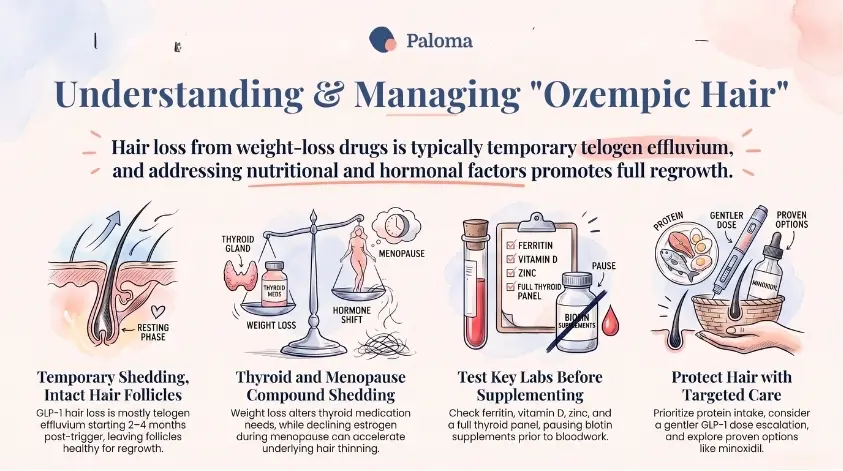
Most of the time, what's happening is a temporary shedding condition called telogen effluvium. Each hair follicle cycles through a long growth phase (anagen), a brief transition phase, and a resting phase (telogen). Normally, only about one in ten hairs is resting at any given time, and losing 50 to 100 hairs a day is normal. A major physical stressor, such as rapid weight loss, a sharp drop in calories or protein, surgery, illness, or a hormone shift, can push a large batch of follicles into the resting phase at once. Two to four months later, those hairs fall out together.
The good news is that in telogen effluvium, the follicle isn't damaged, so hair usually grows back. The less welcome news is that rapid weight loss can also unmask or speed up a slower, more persistent type of thinning, female pattern hair loss, especially in women who were already genetically primed for it.
Signs and symptoms of midlife hair loss
Not all hair loss looks the same, and the pattern offers important clues about the cause.
Telogen effluvium: the sudden shed
- Noticeably more hair in your brush, in the shower, or on your pillow
- Diffuse thinning all over the scalp rather than in one spot
- Shedding that starts two to four months after a trigger, like starting or increasing a GLP-1 dose
- Shed hairs with a tiny white bulb at the root
Female pattern hair loss: the slow widening
- A part that gets gradually wider at the crown, often with the front hairline preserved
- Hairs that grow back thinner, finer, and shorter
- More visible scalp under bright light
- A family history of thinning hair in women or men
Autoimmune and thyroid clues
- Smooth, round, coin-sized bald patches, which can signal alopecia areata
- Hair that has become dry, coarse, or brittle
- Thinning of the outer third of your eyebrows
- Hair loss alongside fatigue, stalled weight loss, feeling cold, constipation, or brain fog
Pull quote: "Your hair loss pattern is a clue. Sudden, all-over shedding points one way. A slowly widening part points another."
What the newest research says about weight-loss drugs and hair
Until recently, the link between GLP-1 drugs and hair loss rested mostly on patient stories and adverse-event reports. In 2026, several large studies brought the picture into much sharper focus.
The 2026 BMJ study
In July 2026, Penn Medicine researchers published a large study in The BMJ that emulated a randomized trial using health records. They compared roughly 12,000 adults with type 2 diabetes who started a GLP-1 drug with people starting two other diabetes drug classes. GLP-1 users had a 37% higher risk of a hair loss diagnosis than people taking SGLT-2 inhibitors and a 68% higher risk than people taking DPP-4 inhibitors. The added risk was almost entirely non-scarring hair loss, the type where follicles stay alive and regrowth is possible, with no clear rise in autoimmune alopecia areata.
Absolute risk stayed low: about 7 new hair loss diagnoses per 1,000 person-years on GLP-1 drugs, compared with roughly 4 to 5 on the other medications. SGLT-2 inhibitors also cause modest weight loss, so the smaller gap there fits the theory that shedding tracks weight loss itself.
Nearly 550,000 patients
A George Washington University team analyzed records of nearly 550,000 matched adults in a 2026 study in JAAD International. At 12 months, GLP-1 users had 76% higher odds of telogen effluvium, 64% higher odds of pattern hair loss, and 40% higher odds of non-scarring hair loss overall, after accounting for age, sex, BMI, and diabetes. In the version presented at a European dermatology congress, people with thyroid disease and menopause were excluded, which suggests the drug-associated risk exists even without those factors.
Women with existing thinning may be most affected
A smaller University of Miami study of 283 dermatology patients found that only 1% developed brand-new hair loss on GLP-1 drugs, but 12% of those who already had hair loss said it got worse. The group was 65% female, with an average age of 56, the very population most likely to be juggling thyroid and menopause issues. An analysis of FDA adverse event reports also found that semaglutide and tirzepatide stood out for alopecia reports.
Is tirzepatide different?
In the SURMOUNT-1 trial, about 5% of people on the highest tirzepatide dose reported hair loss versus about 1% on placebo, with women reporting it more often than men. Wegovy's prescribing information lists hair loss in about 3% of users versus 1% on placebo. A 2026 preprint, not yet peer-reviewed, compared about 11,000 people on each drug and found new hair loss in 4.24% on tirzepatide versus 3.33% on semaglutide, with a wider gap in women. That analysis also found hair loss was more common in people with thyroid disease or other endocrine disorders, an important flag for thyroid patients.
Why do these drugs trigger shedding?
Researchers point to several likely culprits:
- Rapid weight loss itself, a well-established trigger also seen after bariatric surgery
- Low calorie and protein intake driven by appetite suppression
- Shortfalls in iron, zinc, and other nutrients the follicle depends on
- Possible direct effects on the hair growth cycle, which scientists are still investigating
"Hair loss on GLP-1 drugs is real but uncommon, and most of it is the kind that grows back."
The thyroid connection
Thyroid hormone is essential for healthy hair. Hair follicles contain thyroid hormone receptors, and thyroid hormone helps keep them in their growth phase. Hypothyroidism, hyperthyroidism, and medication-driven swings in thyroid levels can all trigger widespread shedding.
With hypothyroidism, hair often becomes dry, coarse, and brittle, grows more slowly, and sheds evenly across the scalp. Some people also notice temporary shedding after starting or changing levothyroxine as follicles reset.
Here's where weight-loss drugs and your thyroid intersect:
- Weight loss can change how much thyroid hormone you need. Starting a GLP-1 or GIP/GLP-1 drug can change your hypothyroid dose, so labs that looked fine six months ago may be off now.
- These drugs slow stomach emptying, which may affect how consistently some people absorb oral thyroid medication.
- Undertreated hypothyroidism can deepen weight-loss-related shedding and slow recovery.
For a deeper dive, see “Is Hair Loss Normal with Hypothyroidism” and how thyroid disease affects hair loss.
Hashimoto's and autoimmune hair loss
Hashimoto's thyroiditis, the most common cause of hypothyroidism in the U.S., is an autoimmune disease, and autoimmune conditions tend to cluster. A meta-analysis of 50 studies found that people with alopecia areata, the autoimmune condition behind patchy hair loss, have higher odds of thyroid dysfunction, positive thyroid antibodies, and autoimmune thyroid disease. A 2025 Israeli study of more than 33,000 people with alopecia areata found Hashimoto's in nearly 7% of them, versus about 4% of matched controls, and in more than half of cases the Hashimoto's was diagnosed first.
What this means for you: if you have Hashimoto's and spot round, smooth bald patches, don't assume it's "Ozempic hair." Alopecia areata needs a different treatment approach, so it's worth seeing a dermatologist. Having one autoimmune condition also raises your odds of others, a pattern known as polyautoimmunity.
Perimenopause, menopause, and thinning hair
Hair follicles are estrogen-sensitive. As estrogen falls during the menopausal transition, androgens have relatively more influence on the follicle, which can shorten the growth phase and gradually shrink follicles. Researchers estimate that about half of women experience hair changes around menopause, including thinning, lost volume, and texture changes.
Two conditions show the strongest links to menopause: female pattern hair loss and frontal fibrosing alopecia, a scarring condition that causes a receding hairline and eyebrow loss. Learn more about hair loss in perimenopause and menopause, and about the difference between thyroid and menopause symptoms.
Can hormone therapy fix menopausal hair loss? A 2026 systematic review in the Journal of the American Academy of Dermatology examined 13 studies and found no consistent benefit from topical estrogen or systemic menopausal hormone therapy for hair growth. Some studies even linked systemic hormone therapy to frontal fibrosing alopecia. The authors concluded estrogen shouldn't be used routinely as a hair treatment, though hormone therapy may still be an excellent choice for hot flashes, sleep, bone health, and other symptoms.
"Hormone therapy helps many menopause symptoms, but the newest evidence says it isn't a reliable hair-growth treatment on its own."
When every trigger hits at once
For many midlife women, hair loss has more than one cause. Picture a 52-year-old with Hashimoto's who starts tirzepatide, loses 30 pounds in five months, barely eats enough protein, has low iron from years of heavy perimenopausal periods, and hasn't had her levothyroxine dose checked since the weight started coming off. Each factor stacks on the others.
The upside of stacked causes is that every one you identify and fix is a lever you can pull.
Your next steps
Get the right tests
Ask your practitioner to check:
- TSH, free T4, free T3, and thyroid antibodies (TPO and thyroglobulin), in other words, a full thyroid panel
- Ferritin and a complete blood count, since iron deficiency is common in thyroid patients
- Vitamin D, zinc, and vitamin B12
- Testosterone and DHEA-S if you have pattern thinning, adult acne, or new chin hair
For a broader checklist, see 6 blood test panels every woman over 40 needs. One important tip: biotin, a popular hair supplement, can skew many lab tests and produce misleading thyroid results, so ask your practitioner how long to pause it before testing. Learn more about biotin and hypothyroidism.
Optimize your thyroid treatment
Aim for thyroid treatment that helps you feel well, not just land somewhere in the "normal" range. Ask to recheck thyroid labs about six to eight weeks after starting or increasing a GLP-1 medication, and again as weight loss continues.
Feed your follicles
- Make protein the anchor of every meal. Many experts suggest at least 1.0 to 1.2 grams per kilogram of body weight during active weight loss, and a nutritionist can personalize your target. Learn more about protein and your hormones.
- Don't let appetite suppression turn into crash dieting, which stresses both your thyroid and your hair.
- Replace iron, vitamin D, and zinc if testing shows you're low, but avoid megadoses; excess zinc or selenium can backfire.
Talk about your GLP-1 pace
Slower weight loss is often gentler on hair. Never stop or change your dose on your own, but if shedding is significant, ask whether a slower dose escalation makes sense. Telogen effluvium usually settles within about six months once the trigger stabilizes.
Topical minoxidil
Minoxidil is the only FDA-approved medication for female pattern hair loss and is sold over the counter as 5% foam (once daily) or 2% solution (twice daily). It lengthens the growth phase and enlarges follicles. Expect some extra shedding in the first weeks, and give it four to six months. See minoxidil for thyroid-related hair loss.
Low-dose oral minoxidil
Many dermatologists now prescribe low-dose oral minoxidil off-label, often between 0.625 and 2.5 mg daily for women. A multicenter study of 1,404 patients found a good safety profile: the most common side effect was unwanted facial or body hair, and fewer than 2% stopped because of systemic effects such as dizziness, fluid retention, or a racing heart. Because it lowers blood pressure, and weight loss can too, make sure your prescriber knows you're on a GLP-1.
Spironolactone
Spironolactone is an anti-androgen that blunts testosterone's effects on the follicle. A systematic review of seven studies found that oral and topical spironolactone both improved pattern hair loss, and that it worked better combined with minoxidil. In a pilot study of 100 women, a daily capsule of 0.25 mg oral minoxidil plus 25 mg spironolactone reduced shedding and improved density over 12 months. Oral doses typically range from 25 to 200 mg daily. Side effects can include irregular bleeding, dizziness, and high potassium, so periodic bloodwork is wise, and it shouldn't be used during pregnancy. Read more about spironolactone for hair loss.
Over-the-counter topicals
- Ketoconazole shampoo, which can calm scalp inflammation and may have mild anti-androgen effects
- Rosemary oil, which performed similarly to 2% minoxidil in one small trial in men
- Caffeine shampoos and peptide serums, which have limited evidence but may improve the look of fullness
Keep expectations realistic: none of these matches minoxidil, but they can be useful add-ons.
Laser caps and devices
Low-level laser (light) therapy uses red light to energize follicles. A meta-analysis of seven double-blind, randomized trials of FDA-cleared home devices found significantly greater hair density than sham devices in both women and men, with both comb- and helmet-style designs. Caps can cost several hundred to a few thousand dollars and require consistent use several times a week for months. They pair well with minoxidil. You can also read about red light therapy and the thyroid.
In-office treatments
Platelet-rich plasma (PRP) injections, microneedling, and, for stable pattern loss, hair transplantation are options to explore with a dermatologist.
Be gentle with your hair
While you're shedding, skip tight ponytails, high heat, and harsh chemical treatments. A volumizing cut, root-lifting products, and tinted scalp powders can camouflage thinning while regrowth catches up.
A note from Paloma
At Paloma Health, we understand that hair loss isn't "just cosmetic." It affects how you feel when you look in the mirror, and it's often a signal that something in your body needs attention.
Paloma is the first virtual practice focused on hypothyroidism, Hashimoto's, perimenopause, menopause, and weight management, which means we can look at all the possible causes of your shedding together. Our at-home thyroid test kit measures TSH, free T4, free T3, and TPO antibodies, and our practitioners can add iron, vitamin D, and other markers that matter for hair.
If you're considering or already using a weight-loss medication, our GLP-1 and GIP/GLP-1 weight loss program is designed for thyroid patients, with careful dose escalation, nutrition coaching to protect your protein intake, and thyroid lab monitoring as you lose weight. Learn 10 surprising facts about GLP-1 and GIP medications for hypothyroid patients, and whether to start a GLP-1 before or after treating hypothyroidism.
And if menopause is part of your picture, our menopause and hypothyroid care team can help you weigh hormone therapy, including how HRT and tirzepatide can work together after menopause, alongside evidence-based hair treatments offered by Paloma, including minoxidil and spironolactone. You don't have to choose between losing weight and keeping your hair. Book a visit with a Paloma practitioner today.
Dealing with Hormonal Issues? Video chat with a top provider
Get answers and treatments in minutes without leaving home - anytime. Consult with a U.S. board-certified provider who specializes in hypothyroidism, menopause, and weight loss, via high-quality video. Insurance accepted.
Schedule
Frequently asked questions
Is Ozempic hair loss permanent?
Usually not, because most GLP-1-related shedding is telogen effluvium, which leaves the follicle intact. Hair typically regrows over six to twelve months once your weight and nutrition stabilize.
When does hair loss start after beginning a GLP-1 drug?
Shedding typically begins two to four months after starting or increasing a dose, because hairs pushed into the resting phase take time to fall out. That delay is why many people don't connect it to their medication.
Does tirzepatide cause more hair loss than semaglutide?
Clinical trials and an early comparison suggest hair loss may be slightly more common with tirzepatide, likely because it causes more weight loss. The difference is small, and both drugs carry a low overall risk.
Should I stop my GLP-1 medication if my hair is falling out?
Don't stop on your own, because the shedding usually resolves and the metabolic benefits are significant. Talk with your practitioner about slowing your dose escalation, checking your labs, and starting hair treatments.
Can hypothyroidism cause hair loss even if my labs are normal?
Yes, some people have hypothyroid symptoms with "normal" labs, especially if only TSH was tested. A full panel with free T3 and antibodies, plus iron and vitamin D, gives a clearer picture.
How can I tell if my hair loss is from my thyroid or menopause?
Thyroid-related loss tends to be diffuse with dry, brittle texture and outer eyebrow thinning, while menopausal loss more often widens the part at the crown. Since both can happen together, lab testing is the most reliable way to tell.
Does Hashimoto's cause patchy hair loss?
Hashimoto's itself usually causes diffuse thinning, but it's linked to alopecia areata, which causes round, smooth patches. If you notice patches, see a dermatologist for a proper diagnosis.
Will hormone replacement therapy regrow my hair?
A 2026 review found no consistent evidence that estrogen therapy regrows hair in menopause. HRT may still help other symptoms, but minoxidil and spironolactone have stronger evidence for hair.
Can I use minoxidil while taking a GLP-1 drug?
Topical minoxidil is generally safe to use alongside GLP-1 medications. Oral minoxidil lowers blood pressure, so your prescriber should monitor you, especially as you lose weight.
Do biotin supplements help hair loss?
Biotin only helps if you're truly deficient, which is rare. It can also interfere with thyroid lab results, so tell your practitioner if you take it.


