



.webp)
In this article
- What is retatrutide, and how does it work?
- How does retatrutide differ from semaglutide and tirzepatide?
- Inside the new research: A 2025 game-changer review
- Phase 3 results: The TRIUMPH trials show bariatric-level weight loss
- Retatrutide and your thyroid: What Hashimoto's and hypothyroidism patients should know
- Retatrutide, perimenopause, and menopause: What midlife women should know
- Why stubborn weight resists treatment, and where retatrutide may fit
- When will retatrutide be available to patients?
- Your next steps
- A note from Paloma
- Frequently asked questions
Every few years, a new weight-loss drug shows up promising to change everything. Semaglutide (Ozempic, Wegovy) did it in 2021. Tirzepatide (Mounjaro, Zepbound) did it again in 2022. Now there's a new name circulating in medical journals and online alike: retatrutide. Early trial data has been striking enough that some researchers are calling it a game changer for obesity treatment, with weight loss numbers that edge into territory once reserved for bariatric surgery.
If you're a Paloma Health reader or member, you're probably not approaching this news the same way a general audience would. You may be managing Hashimoto's or hypothyroidism, navigating perimenopause or menopause, or simply tired of a metabolism that seems to fight you at every turn. So before you get swept up in the hype, let's walk through what retatrutide actually is, what the latest research shows, and what it specifically means if your body already has a thyroid or hormone story of its own.
What is retatrutide, and how does it work?
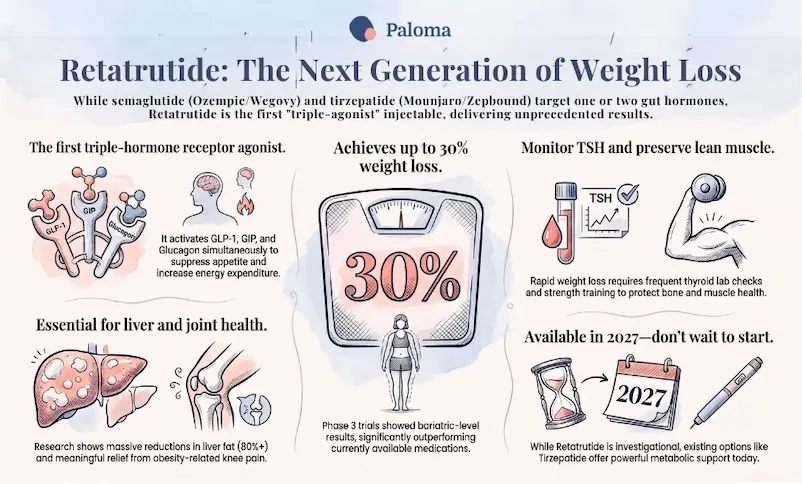
Retatrutide (also known by its research code, LY3437943) is an injectable medication developed by Eli Lilly that activates three hormone receptors simultaneously: GLP-1, GIP, and glucagon. A 2025 review published in the journal Biomolecules describes it as a first-in-class triple receptor agonist, meaning no other approved or investigational drug currently combines all three targets in one molecule.
Semaglutide activates only the GLP-1 receptor. Tirzepatide activates GLP-1 and GIP. Retatrutide adds a third lever: the glucagon receptor, which is believed to increase the body's energy expenditure and encourage the liver to burn stored fat, in addition to the appetite suppression and slowed gastric emptying that all incretin-based drugs share. Animal studies cited in the review found retatrutide delayed gastric emptying and reduced food intake more effectively than earlier incretin-based therapies, and human trials have shown the same pattern of dose-dependent weight loss.
We've covered the broader category of these medications before in Beyond Ozempic: A Look at GLP-1 Medications, which is a helpful primer if you're newer to this class of drugs.

How does retatrutide differ from semaglutide and tirzepatide?
All three drugs are once-weekly injections that work on the same family of gut hormones, but they are not interchangeable. The difference comes down to how many receptors each targets, and it shows up clearly in the weight-loss numbers from their respective trials.
Semaglutide: One pathway, proven results
Semaglutide activates only the GLP-1 receptor. In the pivotal STEP 1 trial, participants lost an average of 14.9% of their body weight over 68 weeks. It remains the most studied and longest-available of the three, with the most real-world safety data behind it.
Tirzepatide: Doubling the target
Tirzepatide adds GIP activation alongside GLP-1. In the SURMOUNT-1 trial, the highest dose produced an average weight loss of 22.5% at 72 weeks, a meaningful step up from semaglutide and the reason many clinicians consider it the current benchmark.
Retatrutide: The triple-target newcomer
Retatrutide adds glucagon receptor activity on top of GLP-1 and GIP. In its phase 2 trial published in the New England Journal of Medicine, the highest dose produced an average weight loss of 24.2% at 48 weeks, already ahead of both semaglutide and tirzepatide at similar timepoints. As you'll see below, phase 3 data released in 2026 pushed those numbers even higher.
Inside the new research: A 2025 game-changer review
The centerpiece of the current retatrutide conversation is the May 2025 review in Biomolecules, written by a team of Greek cardiologists who synthesized the preclinical and clinical evidence on the drug to date. Their conclusions were notably direct:
Retatrutide's unique three-receptor structure produced greater weight reduction, better blood sugar control, and more favorable metabolic outcomes than earlier incretin-based therapies in head-to-head comparisons of trial data.
The review highlights several findings beyond the scale. Phase 1 and 2 trials showed dose-dependent reductions in Hemoglobin A1c (HbA1c is a marker of long-term blood sugar control), along with measurable improvements in liver steatosis, or fatty liver. A companion phase 2a substudy published in Nature Medicine found that the highest doses of retatrutide reduced liver fat by more than 80% at 24 weeks, one of the largest liver-fat reductions ever recorded for any drug in clinical development. Separate laboratory research has also examined whether retatrutide's metabolic effects extend to slowing obesity-associated cancer progression, an active and early area of study.
The review's authors were careful to flag what's still unknown, too: most trial data so far tracks BMI and total weight lost, not the composition of that weight loss, and long-term safety in diverse populations is still being established in the ongoing phase 3 program described below.
Phase 3 results: The TRIUMPH trials show bariatric-level weight loss
Lilly's phase 3 program for retatrutide, called TRIUMPH, includes eight separate trials studying the drug across obesity, type 2 diabetes, cardiovascular disease, knee osteoarthritis, sleep apnea, and chronic low back pain. Results have been rolling out steadily since late 2025, and each readout has reinforced the phase 2 promise.
TRIUMPH-1: Up to 30% weight loss
The pivotal TRIUMPH-1 obesity trial enrolled 2,339 adults with obesity or overweight and at least one weight-related health condition. According to topline results announced by Eli Lilly and detailed by HCPLive, participants at 80 weeks lost:
- An average of 19.0% of body weight on the 4 mg dose
- 25.9% on the 9 mg dose, and
- 28.3% on the 12 mg dose
compared with 2.2% on placebo. Among participants who continued into a blinded extension, those with a starting BMI of 35 or higher who stayed on the 12 mg dose lost an average of 30.3% of their body weight by 104 weeks. Nearly half of participants on the highest dose lost 30% or more of their body weight, a level of weight loss historically associated with bariatric surgery.

TRIUMPH-4: Relief for aching joints
The first successful phase 3 readout actually came from TRIUMPH-4, a trial in adults with obesity and knee osteoarthritis, published in December 2025. According to reporting in the Pharmaceutical Journal, participants on the 12 mg dose lost an average of 28.7% of body weight at 68 weeks, alongside a substantial reduction in reported knee pain. That combination of weight loss and joint-pain relief matters for anyone whose mobility has been limited by both extra weight and aging joints.
Beyond the scale: Liver, cholesterol, and blood sugar
The broader TRIUMPH program is also testing retatrutide in people with type 2 diabetes (TRIUMPH-2), established cardiovascular disease (TRIUMPH-3), and even chronic low back pain linked to excess weight, a trial (TRIUMPH-7) currently recruiting participants. Early reporting on the diabetes-focused trial, TRANSCEND-T2D-1, found an average 16.8% weight loss at 40 weeks on the 12 mg dose. Combined with the liver-fat findings from the phase 2a substudy, the picture emerging is of a drug being positioned well beyond simple weight loss, into metabolic disease more broadly.
Retatrutide and your thyroid: What Hashimoto's and hypothyroidism patients should know
None of the retatrutide trials described above were designed specifically around thyroid patients, which means a lot of what matters to you has to be pieced together from what's known about the broader GLP-1 and GIP drug class. Here's what you and your clinician should understand before you discuss it.
The medullary thyroid cancer warning, explained
Every approved GLP-1 and GIP-based drug carries a boxed warning about medullary thyroid carcinoma (MTC), a rare form of thyroid cancer, because rodent studies found an increased rate of C-cell tumors at high doses. Retatrutide, sharing the same drug class, is expected to carry a similar warning if approved. It's important to understand the scope of that warning: MTC accounts for only a small share, roughly 1 to 4%, of all thyroid cancers, and it is not the type most commonly seen in Hashimoto's or typical hypothyroidism. The warning specifically applies to people with a personal or family history of MTC or the inherited syndrome MEN2, who should not take drugs in this class at all. If that doesn't describe you, the warning is still worth discussing with your provider, but it isn't a reason for most hypothyroid patients to rule out this category of medication.
Could retatrutide affect your thyroid medication?
One underappreciated issue with this entire drug class is delayed gastric emptying. A 2024 review in the Journal of Clinical Endocrinology and Metabolism found that GLP-1 and GIP receptor agonists slow how quickly the stomach empties, which can theoretically affect how well other oral medications, including levothyroxine, are absorbed. Because retatrutide works through the same mechanism, it's reasonable to expect a similar effect. The practical takeaway is one you may already be doing: take your thyroid medication consistently, on an empty stomach, and separated from other supplements or medications, and plan on a follow-up thyroid panel after starting or adjusting the dose of any GLP-1 class drug. Our guide on GLP-1 medications and hypothyroidism goes into more detail on using these drugs safely alongside thyroid treatment.
What weight loss can do to your TSH
There's also a lesser-known feedback loop worth knowing about. A large retrospective study covering more than 21,000 patients with hypothyroidism found that meaningful weight loss on a GLP-1 medication was associated with a measurable drop in TSH levels. Since levothyroxine dosing is often calculated in part by body weight, losing a significant amount of weight, the kind retatrutide's trials suggest is possible, may eventually mean your thyroid medication dose needs to come down, not up. This is exactly the kind of shift that makes ongoing lab monitoring, rather than a one-and-done thyroid test, so important while using these medications.
Retatrutide, perimenopause, and menopause: What midlife women should know
If you're navigating perimenopause or menopause, you're in good company among people already using this drug class. A 2025 RAND Corporation analysis found that women aged 50 to 64 reported the highest rate of GLP-1 use among demographic groups, with roughly 1 in 5 reporting current or past use. Yet the same analysis notes that research specifically addressing this population's unique risks and needs is still catching up to real-world use.
Why midlife weight gain is different
Declining estrogen during the menopause transition tends to redirect fat storage toward the abdomen. It can slow resting metabolism, which is part of why so many women notice stubborn weight gain in their 40s and 50s even without major changes to diet or activity. We've written more about the hormonal mechanics of this transition in Common Symptoms in Perimenopause, Menopause, and Hypothyroidism, since the symptom overlap with thyroid dysfunction can make it genuinely hard to tell what's driving what.
The muscle mass question
This is arguably the most important caution for midlife women considering any drug in this class. A 2025 review in BMJ Nutrition, Prevention & Health found that lean muscle mass can account for 25 to 40% of total weight lost on GLP-1 class medications, not just fat. Because estrogen loss during menopause already accelerates natural muscle decline, adding a powerful weight-loss drug on top of that transition raises real questions about long-term strength and bone health. Prioritizing protein intake and resistance training alongside any GLP-1 or triple-agonist therapy isn't optional in this life stage; it's protective.

Hormone therapy and GLP-1 drugs, together
A growing number of women are using menopause hormone therapy and GLP-1 class drugs at the same time, and early research suggests the combination may be worth discussing rather than avoiding. Reporting from NewYork-Presbyterian on a SURMOUNT program analysis found that postmenopausal women on tirzepatide lost weight at rates comparable to premenopausal women, countering an old assumption that midlife bodies simply respond less well to these drugs. A separate 2025 clinical review reached a similar conclusion: GLP-1 class drugs are consistently effective for peri- and postmenopausal women, even as researchers continue working out the finer points of how hormone therapy and these medications interact. If you're weighing hormone therapy for other menopause symptoms, our guide on Treating Perimenopause with Hormone Replacement Therapy is a useful place to start that separate conversation with your provider.
Why stubborn weight resists treatment, and where retatrutide may fit
If you've spent years feeling like your body simply won't cooperate with weight loss, you're not imagining it. Untreated or under-treated hypothyroidism slows metabolic rate directly, and many patients also develop leptin resistance. In this separate hormonal issue, the brain stops correctly registering the body's fat stores and fullness signals. We've explained this mechanism in more detail in Leptin Resistance, Weight Loss, and Hypothyroidism, and in Why Is It So Hard to Lose Weight When You're Hypothyroid?
This is precisely the kind of metabolic resistance that retatrutide's added glucagon activity is designed to work against, by increasing energy expenditure rather than relying on appetite suppression alone. That's a meaningful theoretical advantage for anyone whose weight struggles have outlasted their willpower. But it is not a substitute for optimized thyroid treatment. Every source of evidence we have on this drug class assumes a baseline of adequately treated thyroid function; layering a powerful weight-loss drug on top of an under-treated thyroid is unlikely to give you the results the trials describe, and may mask a problem that needs its own fix first.
When will retatrutide be available to patients?
Retatrutide is not yet approved by the FDA for any use, and it is still investigational. As of this writing, Lilly's TRIUMPH phase 3 program has released positive topline results from TRIUMPH-1 and TRIUMPH-4, with additional trials, including TRIUMPH-2 in type 2 diabetes and TRIUMPH-3 in cardiovascular disease, expected to report throughout the rest of 2026. Lilly has indicated it plans to present detailed TRIUMPH-1 data at the American Diabetes Association's Scientific Sessions.
Data for the phase 3 program typically need to be complete before a company files a New Drug Application with the FDA, and a standard review process follows. Given where the program stands today, most industry watchers do not expect retatrutide to reach pharmacy shelves before 2027 at the earliest, and that timeline could shift depending on how the remaining trials read out. In the meantime, we'd strongly caution against seeking out research-grade retatrutide sold from abroad, or outside of a licensed clinical trial. These products are unregulated, unverified for purity or dosing, and not a safe way to access a medication that hasn't completed the approval process. If you're curious about what else is in this pipeline while you wait, our roundup of New Weight Loss Drugs On the Way covers several other emerging options.
Your next steps
Retatrutide isn't available yet, but there's a lot you can do right now to put yourself in the best position for it, or for any GLP-1 class medication, whenever the time comes.
- Get your thyroid dialed in first. Ask your Paloma clinician for a full panel, TSH, free T4, and free T3, and confirm you're at an optimal dose before considering any weight-loss medication.
- Ask about currently available options. Semaglutide and tirzepatide are both approved today and already prescribed through Paloma alongside thyroid care; you don't have to wait for retatrutide to start!
- Flag your personal and family history. Tell your provider about any personal or family history of medullary thyroid cancer or MEN2 before starting any drug in this class.
- Start building your muscle reserve now. Increase protein intake and add resistance training two to three times a week, especially if you're perimenopausal or menopausal, so you're protecting lean mass before you ever start a GLP-1 class drug.
- Plan for lab follow-up, not a single test. If you do start a GLP-1 class medication, expect your thyroid panel and medication dose to need rechecking as your weight changes.
A note from Paloma
At Paloma Health, we know that weight challenges rarely have a single cause when your thyroid is involved. That's why our approach starts with getting your thyroid treatment right, through convenient at-home testing and providers who specialize in Hashimoto's and hypothyroidism, before layering in additional tools. For patients who are candidates, our providers can prescribe and monitor currently available GLP-1 and GIP medications alongside your thyroid care, watching for exactly the interactions and lab shifts described above rather than treating weight loss as separate from your thyroid story.
We also know this journey doesn't stop at medication. Our nutrition coaching, thyroid-specific supplement guidance, and perimenopause and menopause support are all designed to work together, especially for patients who need to protect muscle and bone while losing weight. As retatrutide and other next-generation drugs move closer to approval, we'll continue tracking the research and updating our guidance so you're never navigating it alone. You can read more in our guide to GLP-1 medications and hypothyroidism or schedule a call with Paloma to talk through your specific situation.
Dealing with Hormonal Weight Gain? Video chat with a hormone doctor
Get answers and treatments in minutes without leaving home - anytime. Consult with a U.S. board-certified provider who treats hormonal health challenges and weight loss via high-quality video. Insurance accepted.
Schedule
Frequently asked questions
Is retatrutide FDA-approved yet?
No. Retatrutide is still an investigational drug moving through Eli Lilly's phase 3 TRIUMPH trials, and it has not been approved for any use. Most estimates put a possible approval and launch no earlier than 2027.
How much weight can you lose on retatrutide?
In the pivotal TRIUMPH-1 trial, participants on the highest dose lost an average of 28.3% of body weight at 80 weeks, with some reaching over 30% in extended follow-up. Individual results vary by dose, treatment duration, and other health factors.
Is retatrutide safer than Ozempic or Mounjaro?
Retatrutide's reported side effects so far are similar to semaglutide and tirzepatide, mostly gastrointestinal issues like nausea that are dose-related. It's too early to say it's definitively safer, since long-term safety data across diverse populations is still being collected.
Can I take retatrutide if I have Hashimoto's or hypothyroidism?
Having Hashimoto's or hypothyroidism does not rule you out of this drug class, though the boxed warning about a rare thyroid cancer applies to anyone with a personal or family history of medullary thyroid cancer or MEN2. Talk with your clinician about your specific history before starting.
Will retatrutide affect my thyroid medication dose?
It's possible. Drugs in this class can slow gastric emptying, which may affect how well levothyroxine is absorbed, and significant weight loss can lower how much thyroid hormone your body needs. Plan on more frequent thyroid test panels while adjusting to any GLP-1 class medication.
Is retatrutide safe during perimenopause or menopause?
There's no dedicated safety data yet for perimenopausal or menopausal patients specifically, since the trials to date haven't isolated this population. What research does show is that GLP-1 class drugs are effective for midlife women, though muscle mass preservation deserves extra attention during this life stage.
What are the side effects of retatrutide?
Reported side effects are primarily gastrointestinal, including nausea, diarrhea, and constipation, and tend to be dose-related and most noticeable during dose escalation. These mirror the side effect profile of other drugs in the GLP-1 and GIP class.
How is retatrutide taken?
In its clinical trials, retatrutide is administered as a once-weekly subcutaneous injection, similar to semaglutide and tirzepatide, with the dose gradually increased over several weeks. This dosing schedule could change before or if the drug is approved.
Can I get retatrutide through Paloma Health right now?
Not yet, since it isn't FDA-approved, Paloma Health currently prescribes and monitors other GLP-1 and GIP medications, such as semaglutide and tirzepatide, for eligible patients alongside thyroid care.
Should I wait for retatrutide instead of starting another GLP-1 now?
For most patients, there's little reason to delay addressing weight and metabolic health while waiting on a drug that may not be available for another year or more. Discuss currently approved options with your clinician now, and you can always revisit retatrutide once it's available.


